Daishin sees KOSPI below 5,300 as an ‘undershooting’ opportunity at 3.54x P/E; CoreWeave and permitting risks remain
Daishin Securities strategist Lee Kyoung-min argues that the KOSPI’s drop below 5,300 — reaching 3.54x 12-month forward earnings and 0.95x book value at the Nov. 6 close of 5,059.69 — represents a valuation undershoot relative to rising forward EPS estimates. While Republican state senates in Texas, Georgia and Ohio constrain new statutory bans, existing administrative actions, an estimated 23 GW of 2028 data-center capacity exposed to permitting delays, and CoreWeave’s $10.6 billion debt schedule through 2027 remain key tests.

Market data: Korea Exchange regular-session close & Hana Bank USD/KRW reference rate, 2026-11-09 (KST)
South Korea’s benchmark KOSPI closed at 5,018.85 on Nov. 9, falling 0.81% even as a three-month regulatory exemption from brokerages’ mandatory 140% credit-loan collateral maintenance requirement took effect and domestic institutions recorded provisional net buying of 719.6 billion won. Monday’s decline followed a sharp first-week November sell-off in which Daishin Securities figures show the KOSPI fell 11.7% for the week (with 11.0 percentage points of that drop occurring over the final two sessions), touching an intraday low of 4,911 under a circuit breaker on Nov. 6 before closing that day at 5,059.69.
In a weekly strategy note published on Nov. 9 (“Earnings Rose and Only Price Collapsed: An UnderShooting Phase to Hold or Accumulate”), Daishin Securities strategist Lee Kyoung-min argued that the index’s drop below 5,300 represents a valuation undershoot relative to corporate profit estimates. In Daishin’s assessment, market concerns over artificial-intelligence cloud financing at CoreWeave and state-level data-center permitting restrictions in the United States have compressed Korean equity multiples to levels historically associated with economic downturns, even as consensus earnings estimates have risen.
| Metric / Indicator | Daishin Nov. 9 Note / Official Filing Figure | Valuation Date & Analytical Context |
|---|---|---|
| KOSPI 12M forward EPS (since June 22) | Up 32.9% (1,075 to 1,429 index points) | Daishin cites 12M forward net profit up 9.7% over the past month |
| KOSPI Q4 operating profit consensus | KRW 264 trillion to KRW 290 trillion | Cited by Daishin as upward earnings revision during price drop |
| KOSPI 12M forward P/E & P/B | 3.54x P/E / 0.95x P/B (at Nov. 6 close of 5,059.69) | Implies ~3.51x P/E at Nov. 9 close (5,018.85); P/B 1.0x is 5,330 |
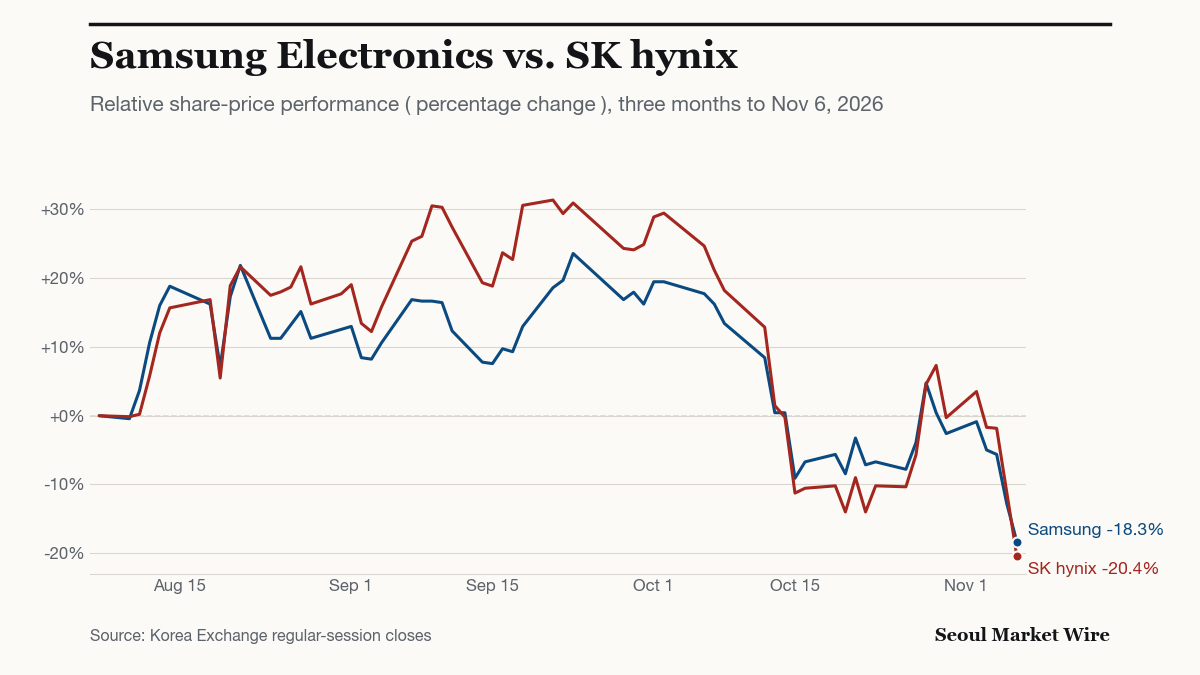
| Bellwether 12M forward P/E (Daishin) | Samsung Electronics 2.67x / SK hynix 2.2x | Daishin cites KRW 7.7 trillion foreign chip selling in Nov. week 1 |
| CoreWeave debt & Q2 interest ratio | $35.55B June 30 debt ($10.60B due through 2027) | Q2 net interest ($640M) equaled 24.9% of Q2 revenue ($2.575B) |
| US data-center additions (2027 vs. 2028) | 2027: 33.8 GW (75% under construction) | 2028: 62.2 GW planned; 30–45% (18.7–28.0 GW) delay exposure |
1. Daishin’s ‘undershooting’ math: EPS up 32.9% vs. forward P/E at 3.54x
Lee Kyoung-min’s thesis centers on the divergence between KOSPI profit revisions and index levels since June 22. According to Daishin’s figures, 12-month forward net income consensus for the KOSPI rose 9.7% over the past month, while fourth-quarter operating profit estimates increased from 264 trillion won to 290 trillion won. Measured in index-equivalent points, 12-month forward earnings per share (EPS) rose 32.9% from 1,075 points on June 22 to 1,429 points.
Over that 93-trading-day period, price declines more than offset the rise in forward EPS, compressing the valuation multiple from 8.5x to 3.54x at the Nov. 6 close of 5,059.69 (which Daishin cites as the lowest forward P/E since 2001, and which equates to roughly 3.51x at the Nov. 9 close of 5,018.85 if the 1,429-point EPS estimate is held constant). Note that an initial EPS of 1,075 points at an 8.5x multiple implies an index level of roughly 9,137.5, from which the Nov. 6 close of 5,059.69 represents a 44.6% decline and the Nov. 6 intraday low of 4,911 represents a 46.3% decline; Daishin summarizes the drawdown from the peak as 44.5%. At the Nov. 6 close, Daishin places the KOSPI’s 12-month forward price-to-book (P/B) ratio at 0.95x (with 1.0x book value at 5,330) alongside a cited 12-month forward return on equity (ROE) of 26.8%, while citing forward P/E multiples of 2.67x for Samsung Electronics (005930.KS) and 2.2x for SK hynix (000660.KS).
Daishin compares the 44.5% drop to the median drawdown of 10 KOSPI declines of 30% or more since 1980, noting that reaching that depth in 93 trading days was faster than the 109 trading days recorded in 1997 and the 240 trading days in 2008. While the speed of the decline is consistent with forced selling and derivatives liquidation, rapid price drops alone do not rule out future fundamental revisions. Daishin notes that the Nov. 6 intraday low of 4,911 stopped near its two-standard-deviation forward P/E band of 4,923, and characterizes the 4,600 level as “Rock Bottom” territory that would price in a recession.
In its historical review of 30%-plus drawdowns since 1980, Daishin reports median subsequent KOSPI returns of 31% over three months, 41% over six months and 60% over 12 months from each trough, alongside an 80% 12-month win rate (median gain of 34%) when buying on the first close down 40% from a peak. Because returns measured from retrospectively identified troughs involve hindsight in dating the bottom, they do not establish that the current market has already troughed. As an arithmetic benchmark, at an unchanged forward EPS of 1,429 points, a 5.0x forward P/E multiple would imply an index level of 7,145 (or roughly 7,100 in Daishin’s rounded figure), about 41.2% above the Nov. 6 close.
2. CoreWeave’s Nov. 11 conference call: balance-sheet schedule and five checkpoints
Daishin attributes the initial autumn sell-off to credit concerns in the AI infrastructure chain, but argues the stress is concentrated in leveraged neocloud operators rather than major US hyperscalers. In Daishin’s data, secondary-market bond yields for CoreWeave rose to 16.5%, whereas bond yields for five major US Big Tech companies declined, CoreWeave’s five-year credit default swap (CDS) spread turned lower, and aggregate US high-yield spreads remained near historical lows. Yield movements alone reflect both Treasury rates and credit spreads, making CoreWeave’s upcoming disclosures a focal point for equity investors.
CoreWeave is scheduled to hold its third-quarter 2026 financial results conference call on Wednesday, Nov. 11 at 7:00 a.m. KST (Tuesday, Nov. 10 at 5:00 p.m. ET). Daishin cites third-quarter consensus estimates of $3.54 billion in revenue (up 37% quarter-on-quarter) and -$1.28 in earnings per share. Beyond headline revenue, CoreWeave’s second-quarter Form 10-Q (as of June 30, 2026) and earnings filings illustrate the balance-sheet figures cited in Daishin’s note:
- Debt principal and maturity schedule: Note 10 of CoreWeave’s second-quarter Form 10-Q reported total debt principal of $35.55 billion as of June 30, 2026, with scheduled principal payments of $4.41 billion over the remainder of 2026 and $6.18 billion in 2027 (a combined $10.60 billion through 2027). Separate from the June 30 balance, CoreWeave disclosed in a Sept. 17, 2026 Form 8-K the issuance of $4.2 billion in 2.875% convertible senior notes due 2033; third-quarter filings will clarify how much of the near-term schedule has been repaid or refinanced since June.
- Interest burden and customer concentration: In its second-quarter 2026 results release, CoreWeave reported Q2 revenue of $2.575 billion and net interest expense of $640 million, equivalent to 24.9% of quarterly revenue. Note 2 of the second-quarter Form 10-Q disclosed that its top three customers accounted for 72% of Q2 2026 revenue (36%, 26% and 10%, respectively).
Daishin highlights five checkpoints for the Nov. 11 call: ① how state-level data-center permitting restrictions (including in Texas) affect site schedules, following management’s August statement that guidance was unaffected at that time; ② third-quarter funding volume and borrowing rates; ③ the fourth-quarter operating margin path (which Daishin describes as a “low-10%” target, where company outlook presentations track adjusted operating income); ④ progress in easing the 72% top-three customer concentration recorded in Q2; and ⑤ 2027 capital-expenditure and gigawatt (GW) power plans. Daishin views guidance upside and funding visibility as a potential relief catalyst for semiconductors and power equipment, while warning that weaker guidance or costly borrowing could test the KOSPI’s 5,000 level on Wednesday morning.
3. US data-center permitting: existing Texas actions, state senates and 2027–2028 GW exposure
Last week’s equity drop followed the US midterm elections, amid concerns over data-center power and permitting policy; Daishin cites a 12.2% drop in the Philadelphia Semiconductor Index on the night of Nov. 5 alongside weekly declines in Taiwan (-12.2%) and Japan’s Nikkei (-9.3%). According to Daishin’s tally, Democratic candidates won governorships in five of the top 14 US data-center states and 40 of 41 local data-center ballot measures ended in opposition, with campaign pledges in Texas (halting approvals pending legislation) and in Georgia and Ohio (pausing new approvals until ratepayer and grid conditions are met).
In evaluating those political headlines, existing executive actions must be separated from future legislative requirements:
- Pre-election administrative action in Texas: Permitting friction in Texas did not begin solely as a post-election campaign pledge. On Sept. 21, 2026, incumbent Republican Gov. Greg Abbott directed the Texas Commission on Environmental Quality (TCEQ) to halt certain data-center permits pending the completion of an Electric Reliability Council of Texas (ERCOT) grid reliability audit, which an ERCOT market notice schedules for release by Dec. 10, 2026.
- State legislative composition and session timelines: For statutory changes such as repealing tax incentives or enacting statewide moratorium laws, legislative approval is required. Daishin notes that in Texas, Georgia and Ohio, the Republican Party holds the State Senate majority, constraining the passage of outright statutory bans. In Texas, the 140-day regular legislative session runs from Jan. 12 to May 31, 2027. Daishin models an approximately 10-month policy adjustment window leading to reduced tax breaks and residential electricity-rate protections rather than permanent shutdowns, estimating federal moratorium probability below 5% and weighted suspension risk at 11%.
- Prior state precedents: Daishin cites Virginia, where Gov. Abigail Spanberger took office on Jan. 17, 2026, noting that capacity under construction rose 16.5% over the one-year period spanning her inauguration despite tighter conditions, while Illinois, Arizona and New York paused only new tax incentives or new permits.
In Daishin’s capacity model, potential permitting delays fall primarily on planned 2028 additions rather than projects scheduled for 2027:
- 2027 US additions (33.8 GW): Daishin estimates that three-quarters (about 25.4 GW) of US data-center capacity scheduled to come online in 2027 is already under construction. Across the five states with gubernatorial campaign pledges, Daishin places planned capacity at 124 GW and capacity currently under construction at 30 GW, though it notes that final operating approvals in Texas remain a variable. Daishin also cites a 1.2% upward revision in consensus 2027 CapEx for the five largest US Big Tech firms after the election.
- 2028 US additions (62.2 GW): Because most 2028 capacity has not yet started construction, Daishin estimates that 30% to 45% of planned 2028 additions — a range of 18.7 GW to 28.0 GW, or roughly 23 GW as a midpoint estimate — is exposed to permitting delays or site relocation.
4. Seoul Market Wire’s View: Risks to the valuation case and upcoming catalysts
Daishin’s report separates short-term liquidity pressure from long-term statutory reality, but investors weighing the 3.54x forward P/E multiple should distinguish between verified filing data, conditional supply-chain transmission channels, and earnings sensitivity:
[EPS Sensitivity Illustration at the Nov. 6 Close of 5,059.69]
Supplied 12M Forward EPS (1,429 points)  ──>  Implied Forward P/E: 3.54x (3.51x at Nov. 9 close)
Illustrative 30% EPS Reduction (~1,000p) ──>  Implied Forward P/E: 5.06x (5.02x at Nov. 9 close)
(Note: Sensitivity calculation only, not an earnings forecast)
① Forward EPS sensitivity if 2027–2028 equipment orders are deferred
At the Nov. 6 close of 5,059.69, the 3.54x P/E multiple relies on the 1,429-point 12-month forward EPS estimate (which covers earnings through roughly November 2027). While 75% of 2027 US data-center capacity is reported under construction, any extended permitting delays affecting 2028 projects — or administrative bottlenecks on final operating approvals in Texas following ERCOT’s Dec. 10, 2026 report — could influence server and memory procurement schedules ahead of 2028 facility completion, depending on customer inventory policy and revenue-recognition timing. For illustration, as a sensitivity calculation rather than an earnings forecast, if the 1,429-point forward EPS estimate were revised down by 30% (to 1,000.3 points) with the index unchanged at 5,059.69, the implied forward P/E would rise from 3.54x to about 5.06x (or from 3.51x to 5.02x at the Nov. 9 close of 5,018.85).
② Incremental demand and neocloud financing costs
Even if major US hyperscalers maintain healthy credit profiles, CoreWeave’s June 30 debt schedule ($10.60 billion due across the rest of 2026 and 2027) and Q2 net interest burden (24.9% of revenue) highlight the financing constraints facing debt-funded cloud providers. Slower capacity expansion by leveraged neoclouds could soften incremental demand for GPU servers, though its ultimate impact on Korean HBM pricing will depend on hyperscaler contract terms and reallocation of supply.
③ Trading flows and key scheduled releases in November 2026
Daishin points to several supportive macro and flow indicators: the US 10-year Treasury yield eased from a peak of 5.31% to 4.86%, West Texas Intermediate (WTI) crude fell 12.8% last week, foreign investors bought 2.88 trillion won in KOSPI futures alongside cash equity sales, financial investment accounts bought 3.68 trillion won in the first week of November (61% in semiconductors), and domestic pension funds hold an estimated 20.4% domestic equity weight compared with a 20.8% 2026 target plan.
Even so, the KOSPI declined 0.81% on Nov. 9 despite 719.6 billion won in provisional institutional net buying, as foreign investors sold 658.5 billion won in cash equities and individual investors sold 511.1 billion won. Key scheduled events over the next week include the US October Consumer Price Index release on Nov. 10 at 10:30 p.m. KST (8:30 a.m. ET), CoreWeave’s Q3 earnings call on Nov. 11 at 7:00 a.m. KST, Applied Materials’ Q4 FY2026 earnings call on Nov. 13 at 6:30 a.m. KST (Nov. 12 at 4:30 p.m. ET), and NVIDIA’s Q3 FY2027 earnings call on Nov. 18 at 7:00 a.m. KST (Nov. 17 at 5:00 p.m. ET). Within power equipment, where Daishin favors ultra-high-voltage transformers first and defers distribution and wire stocks until after ERCOT’s report (expected by Dec. 10, 2026) and the Texas gubernatorial transition in January 2027, investors should verify company-specific order backlogs and regional project exposure.
Sources
- Daishin Securities Research Channel — Weekly Market Outlook & Investment Strategy by Lee Kyoung-min: UnderShooting Phase (Nov. 9, 2026) telegram.me
- Financial Services Commission — Staged market stabilization measures and exemption from 140% collateral-maintenance requirement (Nov. 6, 2026) fsc.go.kr
- CoreWeave — Second Quarter 2026 Financial Results Release (Aug. 2026) investors.coreweave.com
- CoreWeave — Form 10-Q for the Quarterly Period Ended June 30, 2026 (Note 2 & Note 10) d18rn0p25nwr6d.cloudfront.net
- CoreWeave — Form 8-K on $4.2 Billion 2.875% Convertible Senior Notes due 2033 (Sept. 17, 2026) sec.gov
8 more sources
- CoreWeave — Announcement of Third Quarter 2026 Financial Results Conference Call (Nov. 2026) investors.coreweave.com
- Office of the Texas Governor — Gov. Abbott directs TCEQ to halt data-center permits pending ERCOT audit (Sept. 21, 2026) gov.texas.gov
- ERCOT Market Notice — Large Load Interconnection Study and Dec. 10, 2026 Report Schedule (Sept. 14, 2026) ercot.com
- Texas Legislative Reference Library — Dates of Texas Legislative Sessions (89th/90th Legislature, Jan. 12 to May 31, 2027) lrl.texas.gov
- US Bureau of Labor Statistics — 2026 Schedule of Selected Releases for Consumer Price Index bls.gov
- Applied Materials — Q4 FY2026 Earnings Conference Call Schedule (Nov. 12, 2026 ET / Nov. 13, 2026 KST) appliedmaterials.gcs-web.com
- NVIDIA — Third Quarter FY2027 Financial Results Conference Call Announcement (Nov. 17, 2026 ET / Nov. 18, 2026 KST) investor.nvidia.com
- Kookje Daily News — KOSPI closes at 5,018.85 (-0.81%) on Nov. 9 with institutional net buying (Nov. 9, 2026) kookje.co.kr