Strong US payrolls split Korean brokers on case for more Fed hikes
Four Korean brokerages draw different conclusions from October's US jobs figures. A separate iM report examines AI sentiment, foreign flows and the won.

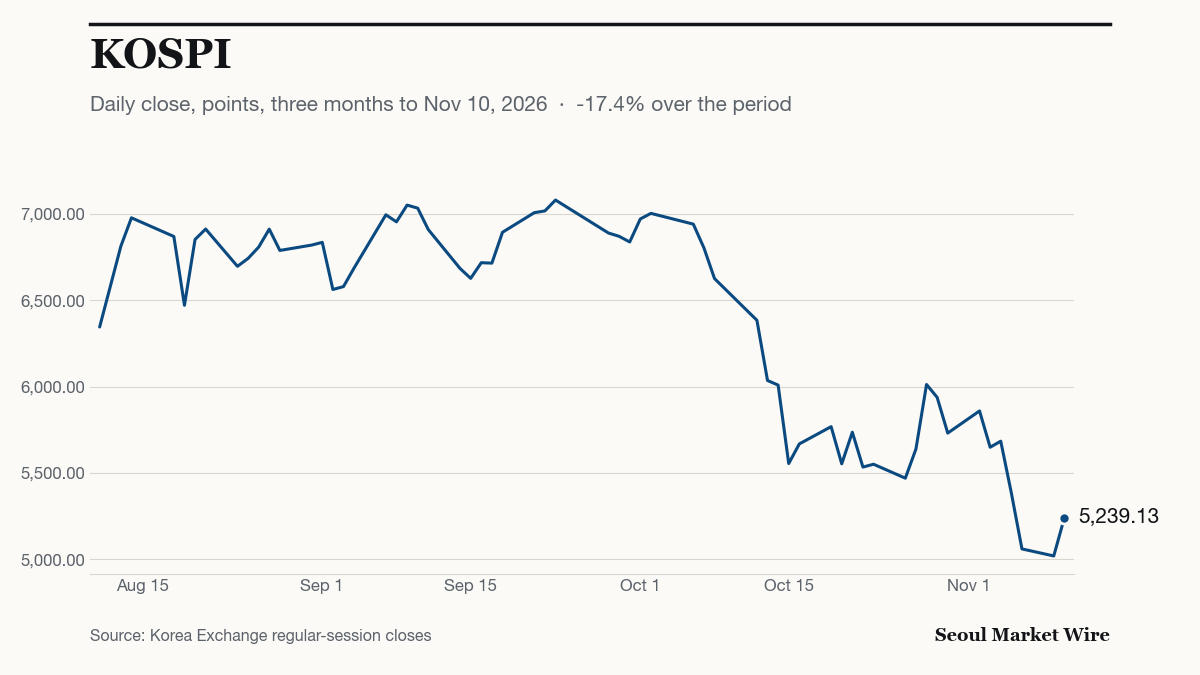
Market data: Korea Exchange regular-session close & Hana Bank USD/KRW reference rate, 2026-11-10 (KST)
Stronger US hiring supports further Federal Reserve rate increases, according to Daishin Securities, but SK Securities argues that October’s jobs figures alone do not justify more tightening. Their Nov. 9 reports differ on whether resilient employment supports further hikes or merely removes pressure to cut rates.
Neither brokerage describes the labour market as overheated. Daishin sees scope for employment to improve further without overheating, while SK cites slower annual wage growth and uneven conditions for workers as reasons for caution about additional tightening.
October payrolls beat broker-cited forecasts
US nonfarm payrolls increased by 165,000 in October. The brokerages cited different forecasts: 70,000 at Hanwha Investment & Securities, using a Bloomberg estimate, and 65,000 at SK and Shinhan Securities. The Hanwha and Shinhan reports were also dated Nov. 9.
Revisions added 84,000 jobs to August and September, bringing the three-month average to 137,000. The unemployment rate edged down to 4.1% from 4.2%, while labour-force participation reached 61.9%. Average hourly earnings rose 0.4% from September and 3.1% from a year earlier, according to the Bureau of Labor Statistics.
Do the jobs figures justify another Fed hike?
For Daishin, resilient employment reduces the risk that raising rates to restrain inflation would compound labour-market weakness. The brokerage regards the figures as supporting further increases, rather than evidence that jobs themselves are overheating.
A December move and subsequent tightening are separate questions in Shinhan’s analysis. Its economists view a 25-basis-point increase at the December Federal Open Market Committee meeting as all but certain, while expecting caution over subsequent hikes. They consider the improvement too concentrated to establish a broad expansion that warrants stronger tightening.
Broader hiring in rate-sensitive and consumer-facing industries, and faster pay growth among workers staying in the same job, are conditions Shinhan identifies for assessing further tightening. ADP reported median year-on-year base-pay growth of 3.0% for job-stayers in October; this is distinct from total earnings growth.
For SK, the report weakens the argument for urgent cuts without establishing a case for more hikes. Its analysts consider lower inflation necessary to improve household purchasing power and create room for rates to fall.
How broad was the improvement?
Some gains reflected AI data-centre investment, in Shinhan’s interpretation. Official industry totals do not identify how many jobs were attributable to that spending. Professional and business services added 70,000 jobs, transportation and warehousing 25,000, and manufacturing 19,000. Health care also added 42,000. Construction employment fell by 3,000 and leisure and hospitality by 13,000.
Income distribution adds another qualification. In the nonfarm business sector, third-quarter productivity rose 2.1% from a year earlier, compared with 1.0% growth in real hourly compensation, according to the BLS preliminary release published Nov. 5. The sector’s labour share was 53.0%, the lowest in the series dating to 1947. SK interprets the gap as evidence that output gains have not translated fully into workers’ purchasing power.
Finding work also remained difficult, in Hanwha’s assessment. The brokerage attributed much of the lower unemployment rate to fewer people on temporary layoff and saw little risk of a jobs recession, while stopping short of calling a full recovery. Among unemployed people, the median duration of unemployment was 11.9 weeks. The number working part time for economic reasons increased by 339,000.
Why does the distinction matter for Korea?
The currency connection extends beyond US interest rates. In its Nov. 9 FX report, iM Securities linked weaker AI sentiment to foreign selling of Korean equities and pressure on the won during the week ended Nov. 6. It sees AI-related shares as a key influence on foreign flows and the currency, alongside dollar movements and demand for safe assets.
After those reports were published, the KOSPI closed 4.39% higher at 5,239.13 on Nov. 10, according to Naver Pay Securities. The provider’s provisional data for Nov. 10 showed net foreign buying on the KOSPI market.
Sources
- Daishin Securities — US employment: a good position for the Fed to focus on inflation (Nov. 9, 2026) stock.naver.com
- Shinhan Securities — AI-led hiring, cooling domestic demand (Nov. 9, 2026) stock.naver.com
- SK Securities — US October jobs: relief on employment, inflation still the challenge (Nov. 9, 2026) stock.naver.com
- Hanwha Investment & Securities — US October jobs: a full recovery is not here yet (Nov. 9, 2026) stock.naver.com
- iM Securities — Weak AI sentiment exposes the won's vulnerability (Nov. 9, 2026) stock.naver.com
5 more sources
- BLS — The Employment Situation, October 2026 bls.gov
- BLS — Productivity and Costs, Third Quarter 2026, Preliminary (Nov. 5, 2026) bls.gov
- ADP — October 2026 National Employment Report mediacenter.adp.com
- Naver Pay Securities — KOSPI finance.naver.com
- Naver Pay Securities — KOSPI investor flows, provisional data for Nov. 10, 2026 m.stock.naver.com