Korean chip sell-off raises questions over AI demand and financial contagion
After a 6.02% Friday drop capped an 11.71% weekly slide in the KOSPI, Korean broker notes and Federal Reserve disclosures offered a framework for separating data-centre scheduling risks from a 2008-style banking crisis.
Market data: Korea Exchange regular-session close & Hana Bank USD/KRW reference rate, 2026-11-06 (KST)
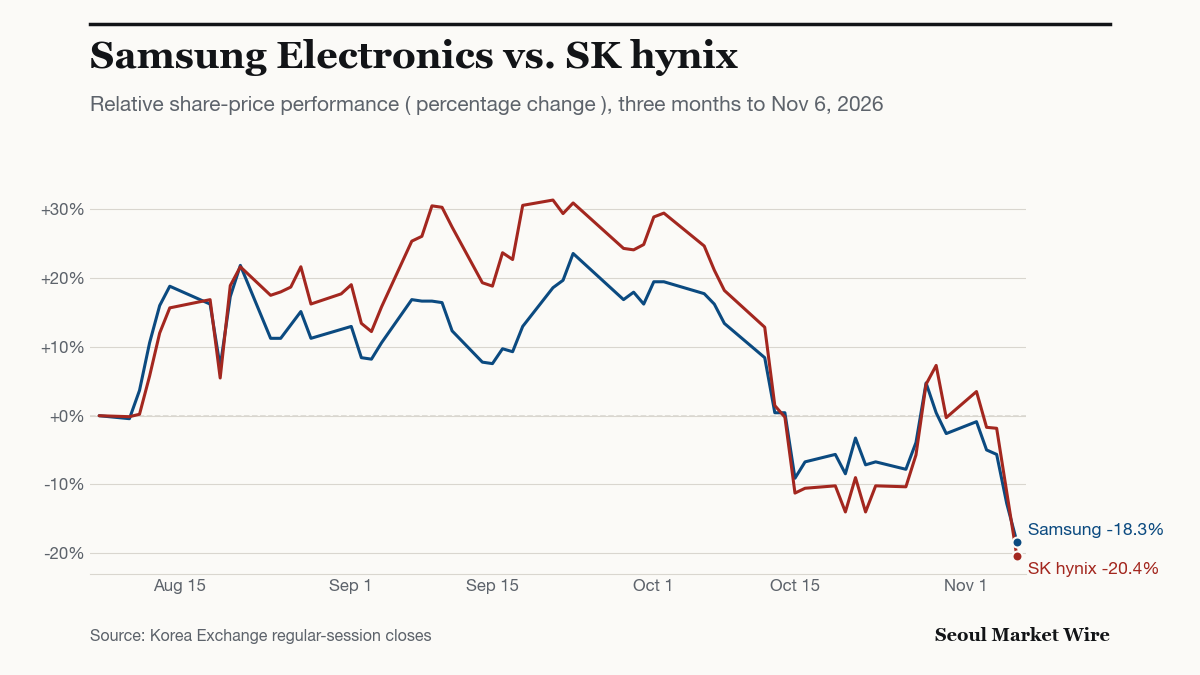
At the Nov. 6 close in Seoul, the benchmark KOSPI fell 6.02% to 5,059.69 after a market-wide circuit breaker halted trading for 20 minutes and a sell-side program-trading sidecar was triggered. Measured from the Oct. 30 close of 5,730.74, the index lost 11.71% over the week.
Samsung Electronics (005930.KS) dropped 6.35% on Friday to 188,700 won, while SK hynix (000660.KS) slid 10.44% to 1,132,000 won. Foreign investors were net sellers of KOSPI shares across the Nov. 5 and Nov. 6 sessions, and the won finished daytime trading at 1,356.60 per dollar at 3:30 p.m. on Nov. 6.
Brokerage notes dated Nov. 4 to Nov. 6 and recent disclosures from the US Federal Reserve separate two questions raised by the equity drawdown: how US post-election energy policy could affect the timing of hardware orders, and whether financial stress among leveraged technology borrowers carries the same banking-system risks seen in 2008.
US data-centre policy and growth trade-offs
Korean strategy notes published on Nov. 5 examined how Democratic majorities in both chambers of the US Congress following the Nov. 3 midterms could reshape artificial-intelligence infrastructure policy. Voter concern over residential electricity bills has increased political scrutiny of large data centres, bringing grid-expansion cost sharing and stricter local permitting into focus.
A federal construction ban and state or local permitting restrictions follow different legal processes. In a Nov. 5 note, Kiwoom Securities said a nationwide halt to new data-centre construction faced hurdles including the presidential veto, diverging regional interests within the Democratic Party and US competition in artificial intelligence. SK Securities wrote the same day that divided control between the White House and Congress would constrain new legislation and budgets more readily than it would reverse existing executive policies, while noting that grid-expansion charges, potential cuts to tax incentives and minimum electricity-use commitments could raise upfront project costs.
Macroeconomists have also weighed the growth trade-offs of curbing technology investment. Because private capital expenditure on AI infrastructure and household consumption tied to equity market gains have supported US output, a sharp policy freeze on data-centre construction could weigh on business investment, while its effect on consumer spending would depend on how far equity prices and household balance sheets adjusted.
Long-term commitments and memory inventory risk
For Korean semiconductor suppliers, project delays at US utilities or local permitting boards matter because they can alter customer ordering behaviour. In periods of rapid memory price increases and perceived supply scarcity, hardware buyers have an incentive to place precautionary orders ahead of actual server deployment schedules, adding buffer stock on top of immediate installation demand.
Public filings show how heavily AI infrastructure demand is weighted toward multi-year schedules. In its amended S-1/A registration statement with the US Securities and Exchange Commission, AI developer Anthropic reported $895.4 billion in total contractual obligations as of Sept. 30, 2026. Of that undiscounted total, $69.8 billion was due within 12 months, whereas $451.2 billion consisted of uncommenced data-centre leases scheduled to begin between 2026 and 2028. Anthropic’s filing documents long-term compute and facility commitments rather than customer memory-chip inventories, but it illustrates how much planned capacity rests on facilities that have not yet opened.
In a Nov. 5 report, iM Securities judged concerns about an immediate slowdown in AI capital spending to be somewhat excessive. Long-term supply agreements for high-bandwidth memory (HBM) can improve near-term shipment visibility, though their cancellation, repricing and delivery provisions determine how much demand is protected. A potential risk period could emerge later in the decade as greenfield memory fabrication lines progress from cleanroom completion—such as SK hynix’s first Yongin cluster cleanroom scheduled for February 2027—toward full volume production in late 2028 and 2029. If utility bottlenecks delay data-centre openings at the same time new wafer capacity ramps up, easing shortage expectations could reduce the need for precautionary stockpiling and trigger a temporary destocking cycle.
Private credit exposure versus 2008 bank balance sheets
Even if higher financing costs or slower project schedules pressure smaller cloud operators, Federal Reserve data highlight structural differences between current corporate credit markets and the 2008 financial crisis. In 2008, thinly capitalised commercial and investment banks held direct on-balance-sheet exposure to subprime mortgages and structured credit vehicles, causing loan defaults to threaten deposit-taking institutions and dealer banks.
Over the past decade, a growing share of higher-risk corporate lending has taken place through non-bank private-credit funds. According to an Oct. 16, 2026 Federal Reserve FEDS Notes study (Introducing Private Credit into the Financial Accounts of the United States), covered domestic and foreign private-credit vehicles held $2.661 trillion in financial assets at the end of 2025, including $1.857 trillion at US-domiciled vehicles. Total private-credit loan instruments stood at $1.494 trillion, with loans to nonfinancial businesses accounting for about $1.311 trillion.
Because private-credit funds rely primarily on closed-end capital commitments from institutional investors, borrower defaults are absorbed first by fund investors rather than triggering immediate retail deposit runs. That structure reduces some redemption pressures compared with 2008, though it does not eliminate bank exposure: the same Federal Reserve study estimated that US-domiciled private-credit vehicles owed $349 billion in bank loans at the end of 2025.
Reserve balances and liquidity backstops
US depository institutions also enter market downturns with substantially larger cash buffers and central-bank liquidity tools than existed before 2008. According to the Federal Reserve’s Nov. 5, 2026 H.4.1 statistical release, reserve balances at Federal Reserve Banks averaged $2.930 trillion in the week ended Nov. 4, with a Wednesday balance of $2.963 trillion, compared with less than $50 billion prior to the 2008 crisis.
In July 2021, the Federal Reserve established two permanent liquidity backstops: the Standing Repo Facility (SRF) for domestic counterparties and the Foreign and International Monetary Authorities (FIMA) Repo Facility for overseas central banks. During the March 2023 regional banking turmoil, the central bank paired discount-window lending with the temporary Bank Term Funding Program (BTFP) to contain funding stress without restarting economy-wide quantitative easing. While aggregate reserve balances and standing repo lines cannot prevent equity repricing when earnings or inventory expectations shift, they reduce the likelihood that a correction in technology shares escalates into a systemic funding freeze.
Sources
- Kiwoom Securities — Blue wave policy repricing and divergent share moves (Nov. 5, 2026) stock.naver.com
- iM Securities — Why US markets cheered the blue wave (Nov. 5, 2026) stock.naver.com
- SK Securities — Macro comment: the age of the veto, policy speed and the cost of investment (Nov. 5, 2026) stock.naver.com
- Federal Reserve — Introducing Private Credit into the Financial Accounts of the United States (Oct. 16, 2026) federalreserve.gov
- Federal Reserve — H.4.1 Factors Affecting Reserve Balances of Depository Institutions (Nov. 5, 2026) federalreserve.gov