Korea's October exports surge; breadth of demand remains in question
Non-semiconductor exports rose 34% in October. The question is whether growth beyond AI infrastructure can persist as Shinhan projects slower growth in hyperscaler capital spending.
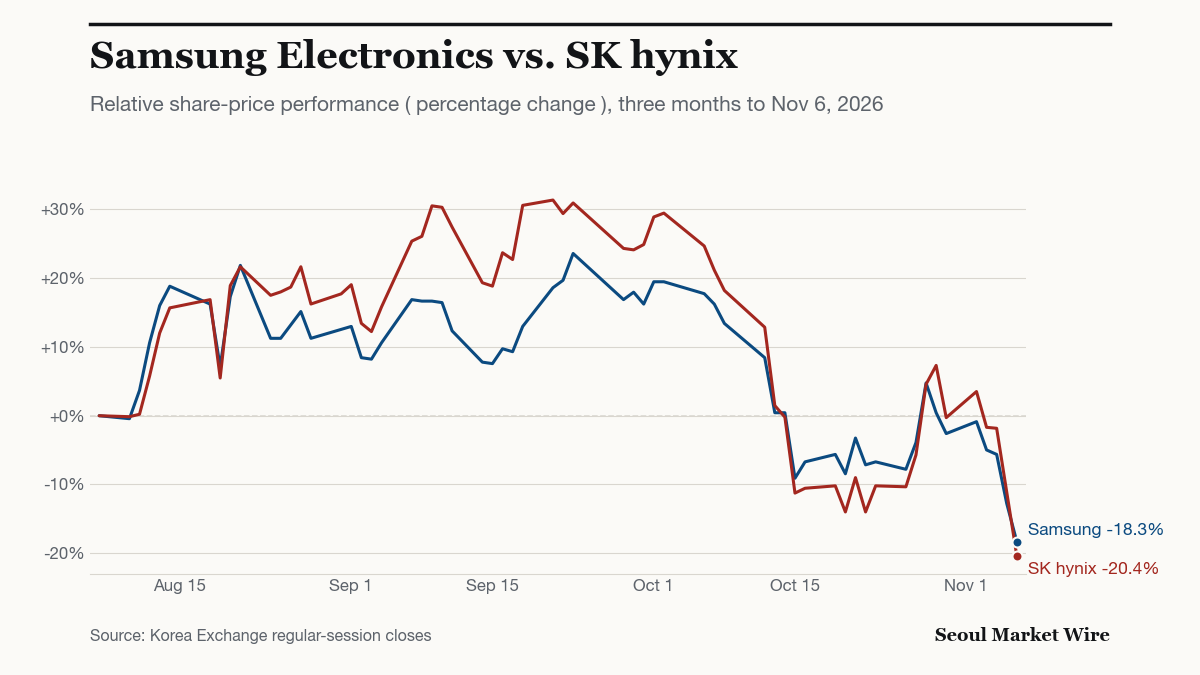
Market data: Korea Exchange regular-session close & Hana Bank USD/KRW reference rate, 2026-11-06 (KST)
Korea’s exports rose 93.7% year on year in October, or 76.0% on a daily-average basis, according to preliminary government data. But those gains do not establish sustained demand beyond AI infrastructure, even though non-semiconductor exports also rose 34%.
Shinhan Securities’ Econ Check-up, dated Nov. 6, described exports excluding investment-related goods as weak. The report does not specify the excluded products or the comparison basis for that assessment. It cannot therefore be treated as evidence that non-semiconductor exports generally failed to grow.
The breadth of October’s export growth
The government’s release recorded growth in 18 of the 20 main product categories, including cars, cosmetics and agricultural and fisheries food products. Export growth was broader than chips alone.
Higher export values did not always reflect higher volumes. Petroleum-product and petrochemical export values rose 80.0% and 27.5%, respectively, while volumes fell 7.5% and 6.8%. In those categories, rising dollar receipts coincided with fewer goods shipped.
Non-semiconductor goods are also distinct from non-AI demand. The government linked computer and electrical-equipment exports to AI infrastructure investment. Removing semiconductors from the total would still leave some exports exposed to that spending cycle.
What slower hyperscaler spending growth means
The brokerage’s 2027 economic outlook uses company guidance and consensus estimates to put combined capital expenditure by the major hyperscalers included in the report at about $1.07 trillion in 2027, up from about $785 billion in 2026. This is a capex aggregate, rather than a separately measured total devoted exclusively to AI.
Its analysts project year-on-year growth slowing from 109% in the fourth quarter of 2026 to 20% in the fourth quarter of 2027. The forecast annual increase is about $400 billion in 2026 and $290 billion in 2027. Total spending continues to rise, but the annual increase shrinks.
The report also distinguishes equipment purchases, which can support Korean exports, from construction spending within the United States. The combined spending total alone does not measure how much demand reaches Korean suppliers.
How much does profit growth slow?
In its KOSPI earnings estimates, presented with FnGuide data in the quant/ETF outlook, the brokerage projects operating-profit growth of 38.2% in 2027 and 9.5% in 2028. That is slower growth, rather than a flattening of profit levels.
Non-semiconductor operating-profit growth is projected to edge up from 10.6% in 2027 to 11.2% in 2028, even as aggregate growth slows. Those aggregate figures do not measure how many companies or industries are recording profit gains.
Why export growth does not settle the currency question
Currency flows also worked in opposing directions. In its FX Check-up, the brokerage described semiconductor exporters’ dollar sales as limiting USD/KRW gains during the week, while dollar demand associated with foreign selling of Korean equities pushed the pair higher.
Shinhan reported that USD/KRW traded in the 1,340s during the week before rising into the high 1,350s.
Sources
- Ministry of Trade, Industry and Resources — October 2026 export and import trends (Nov. 1, 2026) motir.go.kr
- Shinhan Securities — Shinhan Econ Check-up (dated Nov. 6, 2026; p. 1) stock.naver.com
- Shinhan Securities — 2027 Economic Outlook: Time of Tempering (dated Nov. 6, 2026; p. 21) stock.naver.com
- Shinhan Securities — 2027 Quant/ETF Outlook: The Next Wave of Earnings (dated Nov. 6, 2026; pp. 119-120) stock.naver.com
- Shinhan Securities — Shinhan FX Check-up (dated Nov. 6, 2026; p. 1) stock.naver.com