Why Samsung’s 8:50 a.m. limit-down quote rattled Korean retail investors — and why it opened at 187,200 won
South Korean retail investors checking brokerage apps around 8:50 a.m. on Nov. 9 saw Samsung Electronics displayed at the 30% daily lower limit of 132,100 won alongside steep indicative drops across major blue chips. Those figures were unexecuted KRX opening-auction indications rather than live trades, and the stock opened the regular session at 187,200 won (-0.79%) as brokerage margin-relief rules diverged.
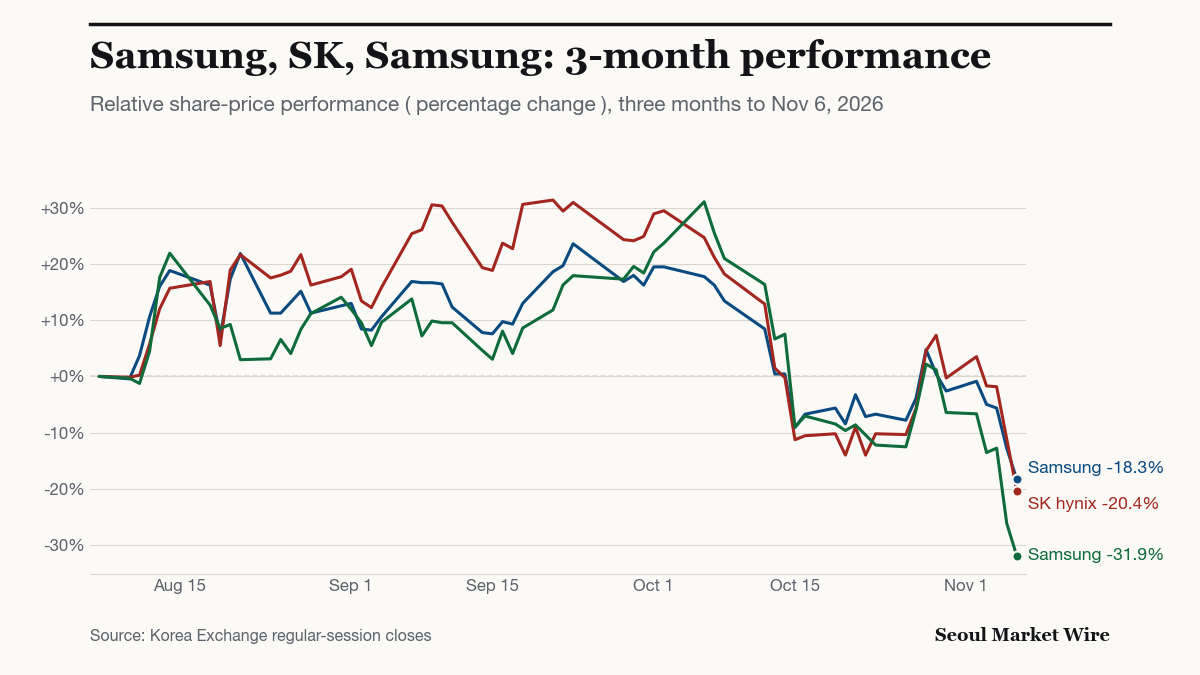
Market data: Korea Exchange regular-session close & Hana Bank USD/KRW reference rate, 2026-11-09 (KST)
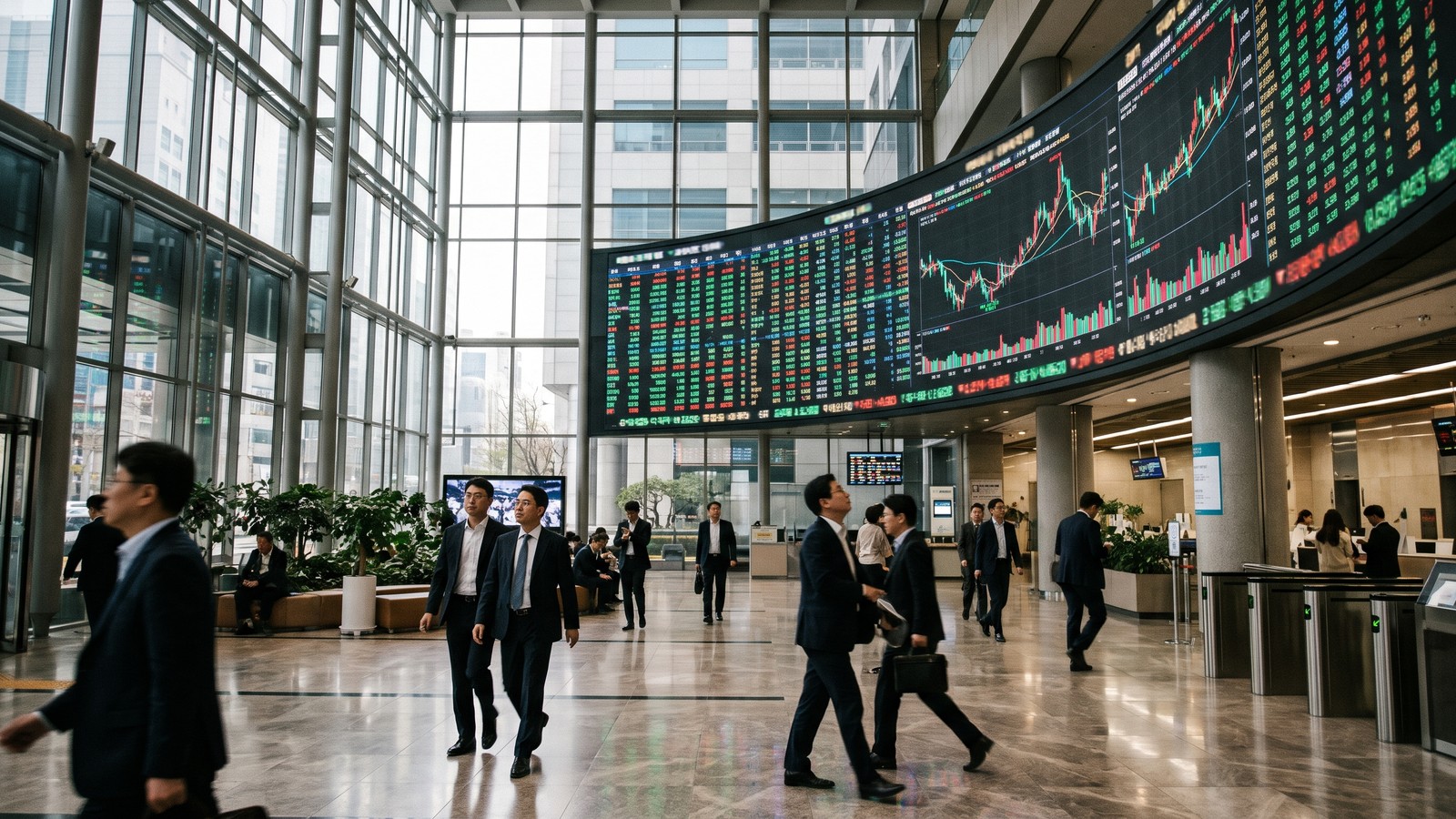
South Korean retail investors checking their mobile and desktop brokerage apps around 8:50 a.m. in Seoul on Nov. 9 were met with an alarming screen: Samsung Electronics (005930.KS) was displayed at 132,100 won, down the 30.0% daily lower limit from its Nov. 6 regular-session close of 188,700 won, according to a report by News1. At the same time, opening-auction quotes showed daily lower-limit readings for Samsung Electro-Mechanics (009150.KS) and Samsung C&T (028260.KS), alongside indicative declines of 29.9% in LG Electronics (066570.KS), 29.8% in Hyundai Motor (005380.KS) and more than 26% in SK hynix (000660.KS), prompting sensational morning headlines and confusion across domestic retail stock forums.
None of those 8:50 a.m. figures represented an executed trade. Not a single share changed hands at 132,100 won during the Korea Exchange (KRX) pre-open order-collection window. When the KRX regular session opened at 9:00 a.m. on Nov. 9, Samsung Electronics cleared its opening auction at 187,200 won, down 0.79% from the Nov. 6 close (with a morning intraday low of 187,000 won), while SK hynix opened at 1,130,000 won, down 0.18%, before both stocks rebounded into positive territory during morning trading.
| Company | Ticker | Nov. 6 close | Nov. 9 8:50 a.m. KRX indication | Nov. 9 KRX opening price | Opening change |
|---|---|---|---|---|---|
| Samsung Electronics | 005930.KS | 188,700 won | 132,100 won (-30.0% limit-down) | 187,200 won | -0.79% |
| SK hynix | 000660.KS | 1,132,000 won | Over -26% indicative drop | 1,130,000 won | -0.18% |
| Samsung Electro-Mechanics | 009150.KS | 870,000 won | Daily lower-limit indication | 847,000 won | -2.64% |
| Samsung C&T | 028260.KS | 273,500 won | Daily lower-limit indication | 268,000 won | -2.01% |
| LG Electronics | 066570.KS | 138,600 won | -29.9% indicative drop | 135,800 won | -2.02% |
| Hyundai Motor | 005380.KS | 279,500 won | -29.8% indicative drop | 275,000 won | -1.61% |
Why retail screens flashed limit-down at 8:50 a.m. — and why the open cleared at 187,200 won
The confusion among individual traders stemmed from how pre-open order books and quote disclosures operate across South Korea’s dual trading venues. KRX collects opening-auction orders (dongsi-hoga) from 8:30 a.m. to 9:00 a.m. (with a randomized closing period of up to 30 seconds) without executing any trades during the collection window. Crucially, under market-structure rules documented by the Financial Services Commission (FSC), 8:50 a.m. is the exact moment KRX begins disclosing real-time indicative opening-auction prices (yesang-chegyeolga) on brokerage screens for the final 10 minutes before the 9:00 a.m. open.
At that same 8:50 a.m. mark, alternative trading system Nextrade (NXT) finishes its live 8:00 a.m. to 8:50 a.m. pre-market session and suspends trading until 9:00:30 a.m. so that KRX can determine the official regular-session opening price. Because retail brokerage apps switch focus from live NXT pre-market prints to KRX’s newly disclosed opening-auction indication at 8:50 a.m., many individual investors mistook the unexecuted 8:50 a.m. auction snapshot for an actual crash in live trading.
News1 reported that securities firms typically submit automated forced-liquidation (bandae-maemae) sell orders — entered as market orders or lower-limit orders to ensure execution — into the KRX opening-auction book prior to the 9:00 a.m. open for margin accounts that failed to meet collateral maintenance requirements. Because those forced-selling orders were already sitting in the order book when KRX began publishing indicative prices at 8:50 a.m., before offsetting buy orders entered ahead of 9:00 a.m., the provisional matching price briefly registered at the 30% daily lower limit.
Under KRX single-price call auction rules, all orders matched in the opening auction execute at a single clearing price at 9:00 a.m. Even if a brokerage’s automated forced-sale order or a retail trader’s sell order was entered at the 132,100 won lower limit at 8:50 a.m., any portion matched in the opening auction cleared at the 187,200 won opening price rather than 132,100 won.
Why forced liquidations still hit retail accounts despite the Nov. 9 regulatory waiver
A second source of confusion for South Korean retail investors on Monday morning was why forced margin liquidations occurred at all on the very day regulatory relief took effect. Following sharp equity volatility on Nov. 5 and Nov. 6, the FSC announced on Nov. 6 that it would exempt securities firms from mandatory enforcement of the 140% credit margin maintenance ratio for three months starting Nov. 9 (reported by News1 and Digital Daily as running through Jan. 31, 2027 under a Financial Supervisory Service no-action opinion).
According to Korea Financial Investment Association (KOFIA) figures cited by News1, domestic credit-loan balances stood at 28.7715 trillion won as of Nov. 5, compared with 27.4207 trillion won at the start of the year and a June 24 peak of 38.6328 trillion won, while unpaid stock-purchase receivables (misugeum) totaled 904.1 billion won on the same date. Those aggregate balance figures are distinct from a single morning’s forced-liquidation volume, and unpaid cash-purchase receivables are governed separately from credit margin loans.
As Digital Daily reported, many retail investors assumed the government’s Nov. 6 announcement meant all brokerages would automatically lower their margin maintenance threshold from 140% to 130% across the board on Nov. 9. Instead, because regulators waived mandatory enforcement for brokerages and left implementation to each firm’s internal risk policies, treatment of existing margin-call accounts varied sharply by house:
- KB Securities and Mirae Asset Securities (automatic threshold cut with exclusions): According to KB Securities’ Nov. 6 notice, the firm lowered its domestic equity credit maintenance ratio threshold from 140% to 130% effective from the Nov. 9 liquidation date until further notice, excluding overseas stock loans and CMA-backed loans while leaving deficiency-amount calculations and liquidation procedures unchanged. Yonhap News and Digital Daily reported that Mirae Asset Securities likewise lowered its domestic stock credit maintenance ratio from 140% to 130% through Jan. 31, 2027, while maintaining 160% for administrative or delisting-issue stocks and 140% for overseas equity loans.
- NH Investment & Securities (prior client consent required; 140% liquidation sizing kept): In a Nov. 6 notice, NH lowered its forced-liquidation selection threshold from 140% to 130% for domestic equities (and from 170% to 160% for overseas equity loans) from Nov. 9 until further notice, but only for accounts where the client submits prior consent. Applications cannot be submitted during the daily collateral evaluation window between 3:30 p.m. and 4:30 p.m., though consent submitted by 8:30 a.m. on a scheduled liquidation date can cancel same-day forced selling if the account also satisfies the relaxed collateral ratio. NH’s notice states that consent does not mean actual collateral sufficiency, and liquidation quantities and deficiency notices continue to be calculated against the original 140% standard.
- Korea Investment & Securities and Kiwoom Securities (manual deferral application only): Neither brokerage applied an automatic across-the-board reduction. Under Korea Investment & Securities’ Nov. 6 notices, clients facing Nov. 9 or subsequent liquidations must apply via a branch or call center (between 4:00 p.m. and 5:00 p.m. on the prior business day, or between 8:00 a.m. and 8:30 a.m. on the liquidation date) to defer forced selling by one business day, excluding unpaid receivables (misugeum) and matured loans. Accounts with KRX closing collateral ratios of 130% or more but below 140% may reapply each business day if eligible, while accounts of 120% or more but below 130% are limited to one deferral per collateral-deficiency period; accounts below 120% are ineligible. Separately, for new margin purchases executed from Nov. 9, Korea Investment raised initial margin deposit rates from 45% to 50% (and to 60% for Samsung Electronics and SK hynix) and shortened the initial loan maturity from 180 days to 90 days (extendable subject to firm conditions), while earlier purchases retain their previous 180-day terms. Yonhap News and Digital Daily reported that Kiwoom Securities also grants a one-day deferral only upon client application for accounts with closing collateral ratios of 130% or more but below 140%.
Collateral math: cash top-ups vs. loan repayment
For a leveraged retail investor, a 10-percentage-point reduction in a target maintenance ratio changes the theoretical collateral threshold by 10% of the outstanding loan balance, though the cash needed to reach a target ratio depends on whether an investor adds collateral or repays loan principal from external funds.
The 130% case below is a hypothetical ratio calculation, not a brokerage’s required payment amount. NH Investment & Securities retains the 140% basis for liquidation calculations, and its relaxed trigger requires prior consent.
Consider an educational illustration (excluding interest, fees and taxes, and assuming a 100% collateral recognition rate) of a margin account holding 30 million won in credit loans ($D$) against 38.7 million won in recognized stock collateral ($A$), equal to a 129% collateral ratio:
- Under a 140% target ($1.4 \times D = 42\text{ million won}$): Adding cash strictly as collateral without reducing the loan balance requires $42,000,000 - 38,700,000 = 3,300,000\text{ won}$. If the investor instead uses outside cash to pay down loan principal while keeping the 38.7 million won stock position intact ($D - A / 1.4$), the minimum whole-won repayment is $2,357,143\text{ won}$.
- Under a 130% target ($1.3 \times D = 39\text{ million won}$): Adding cash as collateral to reach a 130% ratio requires $39,000,000 - 38,700,000 = 300,000\text{ won}$, or 3 million won less than under a 140% target. Paying down loan principal with outside cash to reach 130% ($D - A / 1.3$) requires a minimum whole-won repayment of $230,770\text{ won}$.
Across Korean brokerages, NH’s relaxed selection threshold requires prior client consent, Korea Investment and Kiwoom require manual deferral applications, and KB’s notice leaves its deficiency-calculation and liquidation procedures unchanged.
Sources
- Financial Services Commission — Staged market stabilization measures on heightened equity volatility (Nov. 6, 2026) fsc.go.kr
- Financial Services Commission — Dual-market trading structure and KRX indicative price disclosure hours fsc.go.kr
- Nextrade (NXT) — Market Structure and Trading Hours (accessed Nov. 9, 2026) nextrade.co.kr
- Korea Exchange (KRX) — Single-Price Call Auction Matching Method (accessed Nov. 9, 2026) regulation.krx.co.kr
- Korea Exchange (KRX) — Single-Price Call Auction Allocation Rules (accessed Nov. 9, 2026) regulation.krx.co.kr
7 more sources
- KB Securities — Temporary adjustment to credit margin maintenance ratio (Nov. 6, 2026) kbsec.com
- NH Investment & Securities — Notice on margin maintenance ratio criteria (Nov. 6, 2026) nhsec.com
- Korea Investment & Securities — Temporary deferral application for margin liquidations (Nov. 6, 2026) truefriend.com
- Korea Investment & Securities — Notice image on margin deferral and revised initial margin rates (Nov. 6, 2026) file.koreainvestment.com
- Yonhap News — Major brokerages adjust margin maintenance rules following regulatory waiver (Nov. 6, 2026) yna.co.kr
- News1 — Forced-selling orders push Samsung Electronics to pre-market limit-down before flat open (Nov. 9, 2026) n.news.naver.com
- Digital Daily — Divergent brokerage rules on margin-call relief (Nov. 9, 2026) n.news.naver.com