Eugene: Five states that flipped Democratic account for 41.2% of reported US data-centre pipeline power
IBK sees a federal construction moratorium as unlikely but flags state permitting risk. Eugene's separate tally measures geographic concentration, not exposure to delays.

Market data: Korea Exchange regular-session close & Hana Bank USD/KRW reference rate, 2026-11-06 (KST)
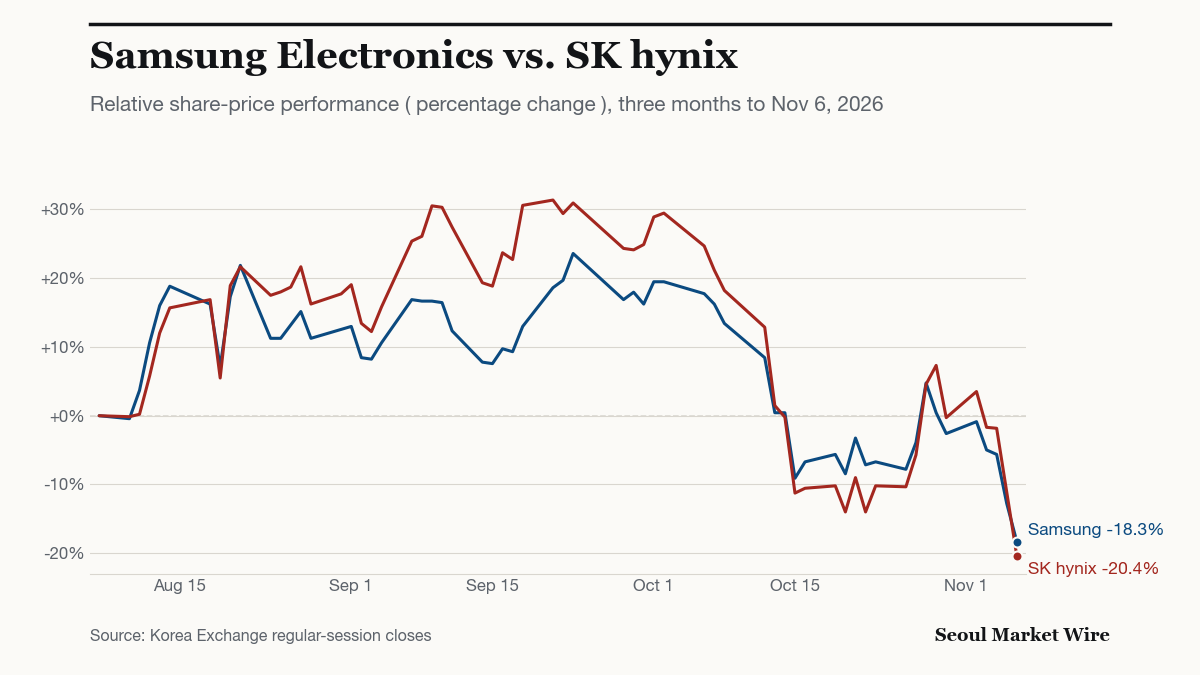
A federal halt to US data-centre construction is unlikely, but state permitting remains a risk, IBK Investment & Securities argued on Nov. 5. Korean brokers are assessing the implications for memory makers Samsung Electronics and SK hynix after the sell-off.
A separate Nov. 6 tally by Eugene Investment & Securities placed 41.2% of reported US data-centre pipeline power in five states it identified as having elected Democratic governors to replace Republicans. The pipeline covers projects under construction or planned, using reported or announced power figures. The share measures geographic concentration, not the proportion likely to face delays or cancellation.
At the Nov. 6 close in Seoul, Samsung Electronics fell 6.35% to 188,700 won and SK hynix dropped 10.44% to 1,132,000 won. The KOSPI lost 6.02% to 5,059.69.
Could Congress impose a nationwide halt?
IBK judged a federal construction moratorium unlikely, citing the usual 60-vote threshold to end Senate debate on legislation and the risk of a presidential veto. The threshold concerns ending debate, rather than the simple majority generally needed to pass a bill. Its analysts also cited bipartisan support for maintaining US leadership in AI.
Cost allocation has already drawn congressional action. On Sept. 16, the House passed the Ratepayer Protection Act, H.R. 9340, by 417–3. The House-passed text would require state utility regulators and nonregulated utilities to consider standards for recovering the full incremental costs of generation, transmission and distribution upgrades from qualifying large-load customers.
The definition covers non-residential customers requesting or entering electricity-service agreements on or after enactment for facilities primarily serving IT infrastructure, with aggregate peak demand of at least 100 megawatts at a single site or campus. The House vote did not itself impose a nationwide cost-recovery requirement.
A broad construction halt also looked unlikely to Kiwoom Securities in its Nov. 6 Weekly Macro, given projects’ contributions to local growth, tax revenue, investment and employment. Its economists focused instead on how higher power and environmental costs would be shared between data-centre operators and other users. They described a possible adjustment in the pace of investment, rather than an end to the AI investment cycle.
What does the 41.2% measure?
The tally uses DCMap’s October database update. Its power figures combine different measures and project scopes, including IT load, facility input, grid-connection requests and generation capacity. They are not a uniform measure of actual electricity demand. DCMap’s methodology also includes approved or permitted projects that have yet to start construction within the planned category.
Texas, Georgia, Ohio, Nevada and Iowa together account for 505 facilities and projects, or 31.6% of the 1,599 nationwide under construction or planned. Their reported pipeline power totals 142.5 gigawatts out of 345.9 gigawatts nationally, according to Eugene’s calculation from DCMap.
Texas alone accounts for 93.1 gigawatts, or 26.9% of that total, about three times Virginia’s 31.6 gigawatts. Texas, Georgia and Ohio together account for 37.7% of reported pipeline power. These shares do not identify which projects still require permits.
The Texas directive predates the election. Republican Governor Greg Abbott ordered the Texas Commission on Environmental Quality on Sept. 21 to halt permits sought by data centres pending an audit by the Electric Reliability Council of Texas, according to the governor’s office. IBK expected permitting restrictions to last longer under the incoming Texas administration; that was a forecast, not a new restriction already in force.
What are brokers watching after the sell-off?
Despite maintaining a cautious stance, Eugene urged investors to avoid selling into the decline. Its assessment preceded the further fall on Nov. 6.
Possible construction delays and higher costs remained concerns in Daishin Securities’ Nov. 6 weekly outlook, even though it viewed a full federal halt as unlikely. Its analysts identified CoreWeave’s cash flow, interest expense and financing plans as tests of AI investment sentiment.
CoreWeave’s third-quarter earnings call is scheduled for Nov. 10 at 5 p.m. Eastern Time, or Nov. 11 at 7 a.m. KST, according to its official announcement.
Sources
- Eugene Investment & Securities — Spot comment: stock market slide after the US midterm elections (Nov. 6, 2026; pp. 1, 5) stock.naver.com
- IBK Investment & Securities — Global Markets Monitor: the blue wave an angry Trump created (Nov. 5, 2026; p. 1) stock.naver.com
- Kiwoom Securities — Weekly Macro: AI investment expectations reset, focus on inflation and the Fed (Nov. 6, 2026; p. 1) stock.naver.com
- Daishin Securities — Next week's market: where a blue-wave market could turn (Nov. 6, 2026; p. 1) stock.naver.com
- DCMap — US data-centre statistics, October 2026 dcmap.us
8 more sources
- DCMap — US data centres by state, October 2026 dcmap.us
- DCMap — Methodology dcmap.us
- Texas governor's office — Abbott directs TCEQ to halt data-centre permits (Sept. 21, 2026) gov.texas.gov
- US Senate — Filibusters and cloture senate.gov
- Congressional Record — Ratepayer Protection Act debate (Sept. 17, 2026) govinfo.gov
- Ratepayer Protection Act — House-passed text, H.R. 9340 govinfo.gov
- Korea Exchange (KRX) global.krx.co.kr
- CoreWeave — Third-quarter 2026 results conference call announcement investors.coreweave.com