Daishin sees two more BOK hikes, calls Korean bond rally overdone
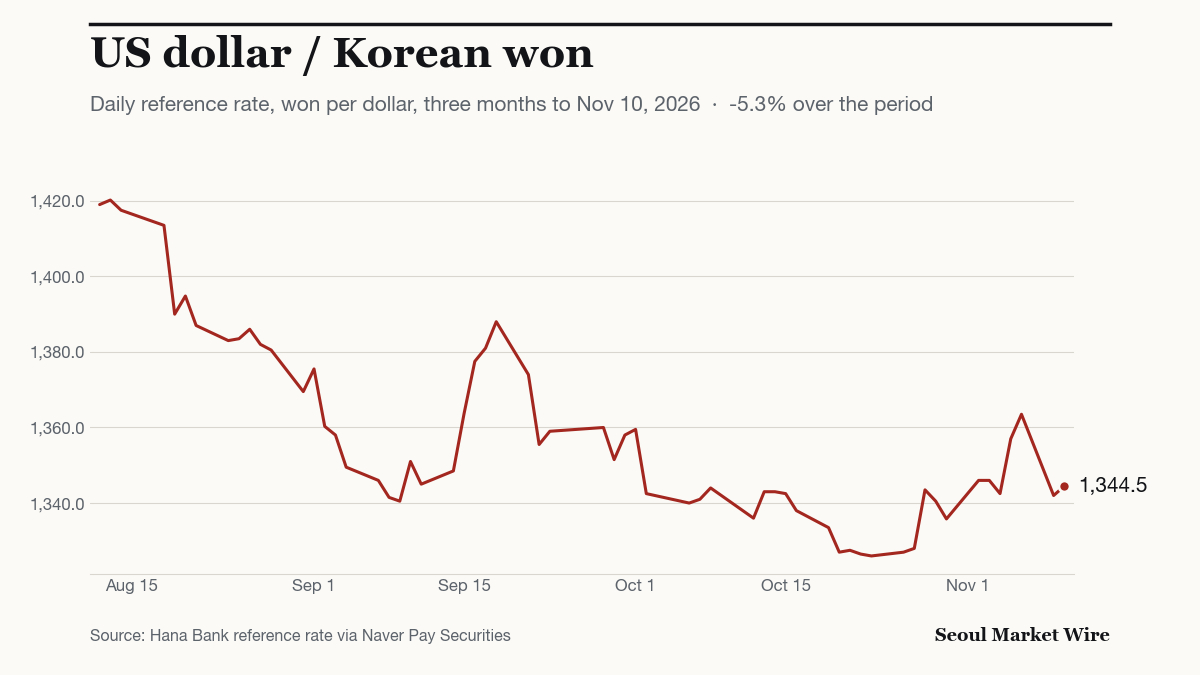
Daishin forecasts a 3.50% terminal BOK rate and expects Korean bond yields to rise. It sees trade inflows capping a rebound in USD/KRW at the high KRW 1,300s per dollar.

Market data: Korea Exchange regular-session close & Hana Bank USD/KRW reference rate, 2026-11-10 (KST)
The rally in Korean government bonds has gone too far, according to Daishin Securities, which still expects two more Bank of Korea rate increases. Its weekly rates and currency outlook, dated Nov. 9 and posted Nov. 10, forecasts a rise to 3.25% from 3.00% in November 2026 and a further increase to a terminal rate of 3.50% in 2027.
The forecast follows a volatile stretch for Korean assets. The KOSPI rose 4.39% to 5,239.13 on Nov. 10 after three straight losing sessions. Foreign investors were net buyers of KOSPI shares.
Why does Daishin still expect BOK hikes?
Recent financial-market turmoil has not changed the brokerage’s forecast for further tightening in Korea and the United States. It expects Korean government bond yields to rise as investors price in further BOK rate increases.
The three-year Korean government bond yield stood at 3.639% on Nov. 9, according to Kiwoom Securities’ Nov. 10 Morning Letter. That was 10.1 basis points below its level five trading sessions earlier, although it rose 2.6 basis points on Nov. 9 itself.
The central bank’s latest decision left policy unchanged. On Oct. 22, the BOK held its base rate at 3.00%, citing strong export- and investment-led growth, inflation near 3% and financial-stability risks. It wanted more time to assess external uncertainties and the effects of two earlier rate increases. All seven board members supported the hold.
The projected November increase and 3.50% terminal rate are Daishin’s forecasts, rather than announced BOK decisions.
What do US Treasury yields tell the brokerages?
In its Nov. 10 report, iM Securities put the US 10-year Treasury yield at 4.874% at the Nov. 9 close. The report interpreted lower yields and oil prices as signs of stabilisation after the US midterm-election shock. It linked the yield decline to expectations of smaller US fiscal deficits and the possibility that the Federal Reserve’s hiking cycle could end after a December increase.
A separate Nov. 10 post-midterm analysis from Daishin also describes the election result as favourable for bonds, while judging the immediate yield decline excessive. The brokerage attributes part of the fall to a reversal of earlier yield increases and part to safe-haven demand during the stock-market selloff. It nevertheless takes a neutral view of US bond supply and demand, citing concerns about Treasury and corporate-bond issuance.
Further out, Shinhan Securities’ Nov. 10 policy report forecasts that the US will reach its debt limit in spring 2027 and its cash-exhaustion X-date in the fourth quarter. These are distinct stages in the brokerage’s scenario, rather than official US Treasury deadlines.
What could limit a dollar rebound against the won?
The weekly outlook allows for a short-term rise in USD/KRW after the won’s earlier gains and renewed concern about US data-centre construction. Even so, Daishin expects trade-surplus inflows to cap a rebound at the high KRW 1,300s per dollar.
Its broader post-midterm report retains a forecast for dollar weakness after the Fed’s hiking cycle ends, which it expects in early 2027. Slower US growth and lower rates underpin that view. Korea’s exposure to AI investment could leave the won with less scope to strengthen than previously expected, however. The brokerage’s assessment that currency stress should remain limited depends on semiconductor prices avoiding a sharp fall.
In its Nov. 10 report, iM described USD/KRW as having returned towards its pre-election level after an initial jump. The dollar index was also slightly below its pre-election level, according to the report.
Sources
- Daishin Securities — Weekly rates and FX outlook (dated Nov. 9; posted Nov. 10, 2026), p. 1 stock.naver.com
- Daishin Securities — Macro, market and sector effects after the US midterm elections (Nov. 10, 2026), pp. 12–13 stock.naver.com
- iM Securities — Financial markets recover from the midterm shock (Nov. 10, 2026), p. 1 stock.naver.com
- Shinhan Securities — Reviewing the US policy environment after the midterm elections (Nov. 10, 2026), p. 1 stock.naver.com
- Bank of Korea — Monetary policy decision (Oct. 22, 2026) bok.or.kr
2 more sources
- Naver Pay Securities — KOSPI index and investor trends finance.naver.com
- Kiwoom Securities — Morning Letter (Nov. 10, 2026), p. 1 stock.pstatic.net