Sidecars and circuit breakers on the Korea Exchange: when trading pauses
A sidecar restricts program trading; a circuit breaker stops the affected market. Different thresholds govern their activation and the handling of orders.
Information current as of 2026-11-06 (KST)
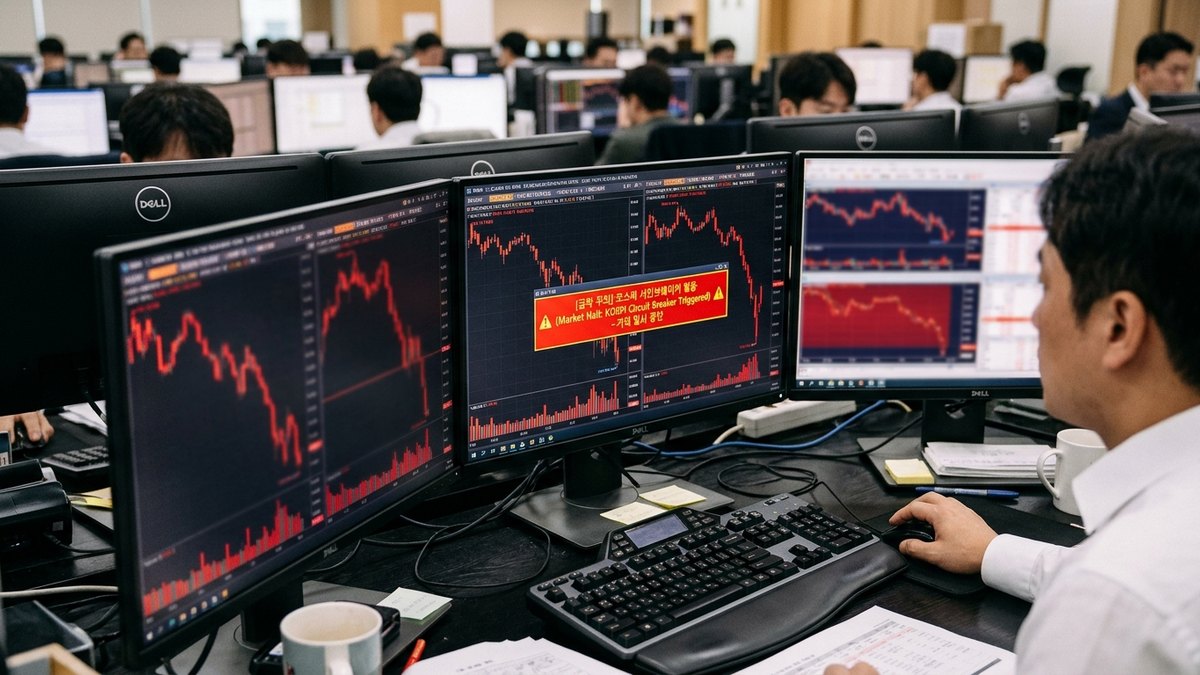
When does a Korea Exchange trading alert mean the whole market has stopped? A sidecar suspends specified program-trading orders, while a circuit breaker halts trading across the relevant stock market, according to KRX’s trading guide.
What triggers a sidecar?
For each market, KRX uses the KOSPI 200 or KOSDAQ 150 futures contract with the highest trading volume on the preceding trading day. The reference-contract selection appears in KRX’s KOSPI sidecar notice and Article 13 of the KOSDAQ market regulations.
The thresholds differ between the two stock markets:
- KOSPI: The reference futures contract must rise or fall at least 5% from its base price, with the condition lasting one minute.
- KOSDAQ: The reference futures contract must rise or fall at least 6% from its base price, while the KOSDAQ 150 index moves at least 3% from its previous close in the same direction. Both conditions must hold together for one minute.
The futures base price and the cash index’s previous close are distinct reference points. On KOSDAQ, a futures move alone is insufficient: KRX requires the accompanying cash-index move.
A sidecar can activate only once per market per day, regardless of direction. Activation conditions are assessed only after five minutes have elapsed from the regular-session open. No sidecar can activate in the final 40 minutes before the close. These timing provisions appear in Article 16 of the KOSPI market regulations and Article 13 of the KOSDAQ market regulations.
Which orders does a sidecar restrict?
Program trading includes index arbitrage, which links baskets of shares with futures or options, and qualifying non-arbitrage basket trades. For non-arbitrage trades, the criteria include simultaneous trades by the same participant in at least 15 KOSPI constituents or 10 KOSDAQ constituents, as explained in KRX’s KOSPI program-trading guidance and KOSDAQ sidecar guidance.
An upward sidecar prevents program-buy orders received during the restriction from participating in matching. A downward sidecar applies the restriction to program-sell orders. These orders can still be received; other share transactions continue.
The restriction normally lasts five minutes. Once it is released, the suspended orders become eligible to participate in price formation in receipt order; this does not guarantee execution. Release also occurs 40 minutes before the close. If a circuit breaker interrupts the sidecar period, the restriction is released when market trading resumes, under KRX’s sidecar procedure.
What triggers a market-wide halt?
Circuit breakers use the broad KOSPI or KOSDAQ index, rather than the futures contracts and narrower indices used for sidecars.
KRX’s circuit-breaker rules specify three stages:
- Stage one: The relevant index falls at least 8% from its previous close for one minute.
- Stage two: After stage one and reopening, the index falls at least 15% from its previous close and at least another 1% relative to the index level that triggered stage one. Both conditions must persist for one minute.
- Stage three: After stage two and reopening, the index falls at least 20% from its previous close and at least another 1% relative to the stage-two trigger level. Both conditions must persist for one minute.
The additional 1% decline is measured from the preceding stage’s trigger level, rather than as one percentage point added to the decline from the previous close.
Each stage can activate only once per day. Stages one and two cannot activate in the final 40 minutes before the close; stage three can. Circuit breakers apply during the regular session. KRX’s KOSPI rules also specify halts for linked futures and options.
How are orders handled, and how does trading resume?
During circuit-breaker stages one and two, trading stops for 20 minutes. Only cancellation instructions may be submitted during the halt.
Orders are then collected for a 10-minute call auction to set the reopening price. Continuous trading follows, under KRX’s reopening procedure.
Stage three ends trading for the day and prevents submission of orders, including cancellations, under KRX’s trading guide.
Sources
- KRX — Guide to Trading in the Korean Stock Market global.krx.co.kr
- KRX — KOSPI market circuit breakers regulation.krx.co.kr
- KRX — Program trading and KOSPI sidecars regulation.krx.co.kr
- KRX — KOSDAQ market circuit breakers regulation.krx.co.kr
- KRX — KOSDAQ sidecars regulation.krx.co.kr