Daishin and Hanwha see bottoming signs; Yuanta flags foreign-flow constraint
Daishin sees a possible bottom-forming process and Hanwha puts prices in bottoming territory. Yuanta cautions that sustained foreign buying faces a rate-gap constraint. It also linked renewed net buying to USD/KRW falling below its six-month moving average.
Market data: Korea Exchange regular-session close & Hana Bank USD/KRW reference rate, 2026-11-06 (KST)
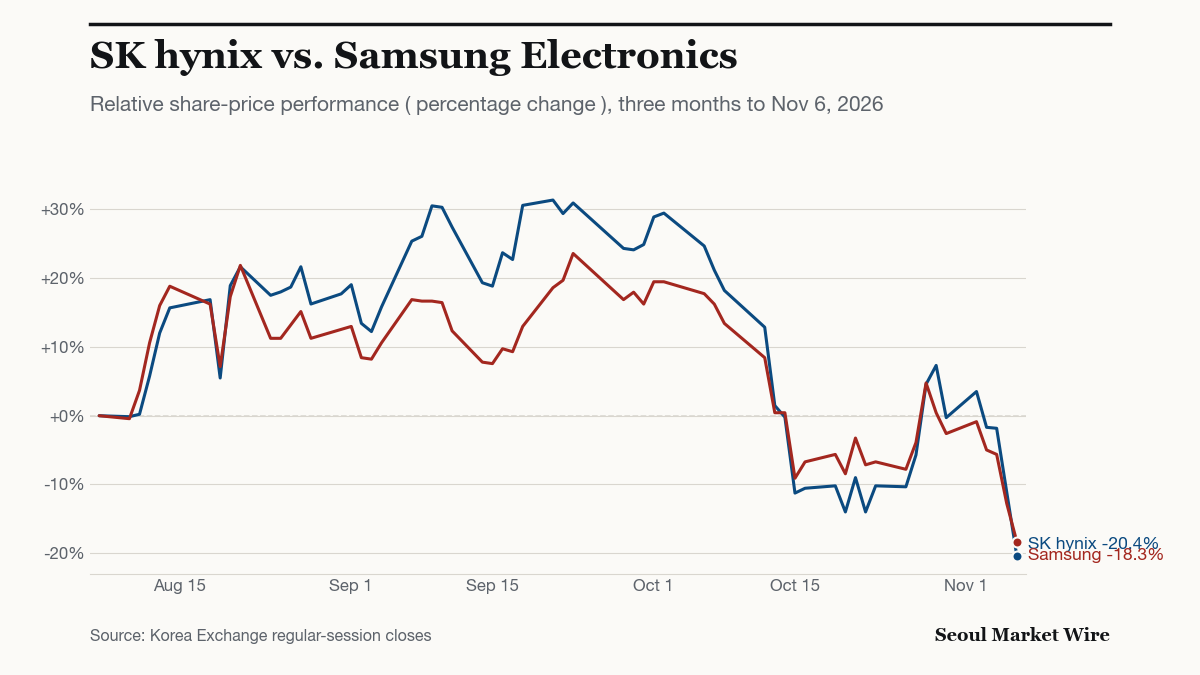
Two Korean brokerages saw signs that shares were forming a bottom in Nov. 6 reports, with Daishin Securities calling AI investment fears excessive and Hanwha Investment & Securities describing prices as already in bottoming territory. But Yuanta Securities warned that the US-Korea interest-rate gap could limit sustained foreign inflows, even if currency conditions encouraged a return to net buying.
Renewed foreign buying was a condition for recovery in Hanwha’s assessment; Daishin’s bottom-forming case left room for further declines.
How much selling is established?
The KOSPI fell 5.28% to 5,383.80 on Nov. 5, according to Kiwoom Securities’ Nov. 6 Morning Letter. Foreign investors net sold about 3.40 trillion won of KOSPI-listed shares that day, their fifth consecutive session of net selling. That market-wide total does not establish how much they sold in Samsung Electronics or SK hynix individually.
What could bring foreign buyers back?
In its Nov. 6 earnings-season screening report, Yuanta described the US-Korea interest-rate gap as a constraint on a long-term trend of foreign inflows. The relevant discussion did not specify the rate types or maturities being compared, so it does not establish a numerical policy-rate gap.
Foreign investors tended to become net buyers when USD/KRW fell below its six-month moving average, the analysts observed. That historical association permits a return to buying without demonstrating that inflows would persist.
What would support the bottoming case?
CoreWeave’s upcoming third-quarter results were a test of AI investment sentiment in Daishin’s Nov. 6 weekly outlook, with cash flow, interest costs and funding plans the main points to examine. Confirmation that the company was maintaining investment plans and could secure funding could help semiconductor sentiment recover, the report argued. Renewed concern about its borrowing burden or cuts to investment plans could instead increase pressure for further declines across the AI value chain.
The analysts also judged a federal halt to data-centre construction unlikely. Their case for a rebound in oversold growth shares depended in part on confirmation of US disinflation, which they argued could stabilise interest rates.
Does Korean inflation settle the rate-gap question?
October consumer prices rose 2.8% from a year earlier, according to the official release. Inflation excluding agricultural products and petroleum products also reached 2.8%, up from 2.7% in September.
A separate Daishin AI Research note, dated Nov. 3 and posted on Naver on Nov. 4, interpreted the data as supporting an extended rate hold at the Bank of Korea without removing the case for another hike.
The AI Research note cited a terminal rate of 3.25%, with 3.50% as an upside scenario, against a current base rate of 3.00%. Those figures were scenarios in that note, rather than an announced central-bank path. Korean inflation alone cannot determine the future interest-rate differential between the two countries.
How broad is earnings support?
Earnings revisions in Yuanta’s 200-stock universe showed a divide between semiconductors and the rest of its sample. Using estimates as of Nov. 4, the brokerage reported that aggregate operating-profit estimates rose 3.9% during the week of SK hynix’s earnings release, led by semiconductors, and subsequently held that level.
The figures cover the brokerage’s sample, rather than every listed Korean company. Excluding semiconductors, estimates for 2026 annual operating profit fell about 0.4% in the latest weekly comparison.
Sources
- Yuanta Securities: [QWER] November week 1, a screening strategy for the Q3 earnings season (Nov. 6) stock.naver.com
- Hanwha Investment & Securities: November strategy, everything is ready except flows (Nov. 6) stock.naver.com
- Daishin Securities: Next week's market, clues to a turnaround after the Blue Wave (Nov. 6) stock.naver.com
- Kiwoom Securities: Kiwoom Morning Letter (Nov. 6) stock.naver.com
- Daishin AI Research: Korea consumer prices, headline slows as expected while core settles at 2.8% (dated Nov. 3; posted Nov. 4) stock.naver.com