DS sees 2028 AI server growth; brokers flag funding risks
DS's shipment forecast assumes more buying outside four U.S. cloud giants. Kiwoom sees limited risk to overall big-tech capex despite funding delays at some buyers.
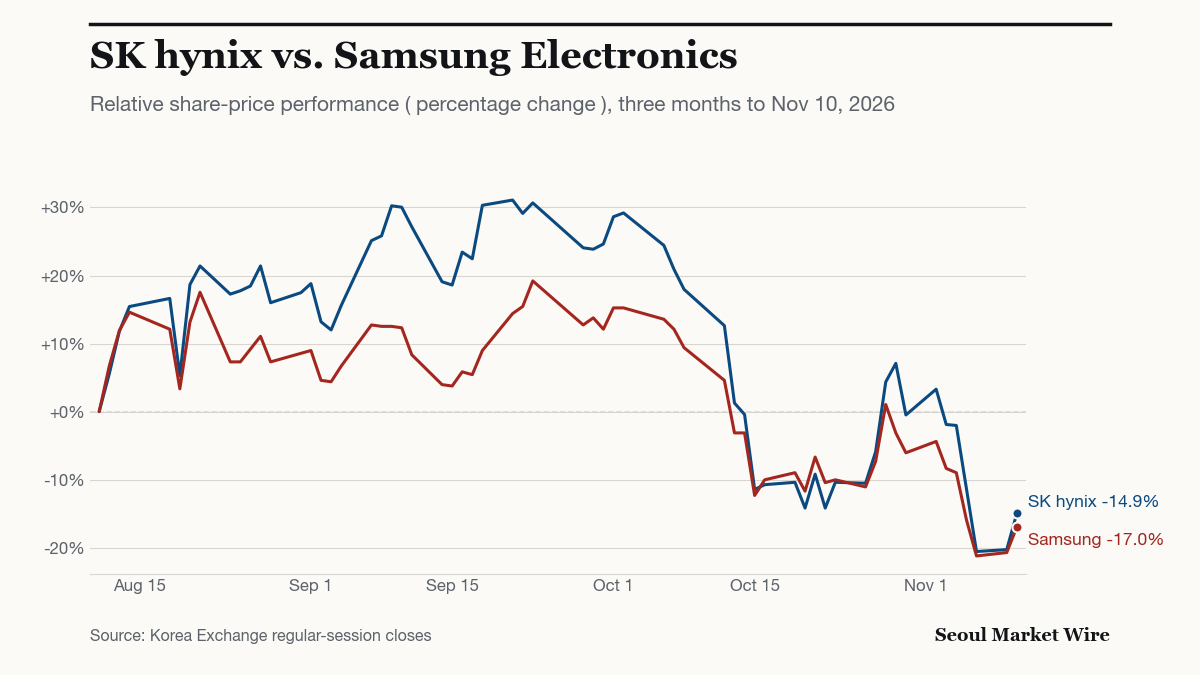
Market data: Korea Exchange regular-session close & Hana Bank USD/KRW reference rate, 2026-11-11 (KST)
Rising AI server shipments can sustain memory demand even as spending growth slows, DS Investment & Securities argues in its Nov. 10 report. But that forecast assumes buyers outside four U.S. cloud giants take a larger share of purchases, while other brokers flag financing pressure at some operators.
For investors in Samsung Electronics and SK hynix, shipment forecasts need to be assessed alongside buyers’ ability to finance purchases.
Can server demand grow as spending growth slows?
In “Muscle Memory,” DS forecasts global AI server shipments of 5.03 million units in 2028, up 30% year on year. Its model assumes company-wide capital expenditure growth at Microsoft, Amazon, Alphabet and Meta slows from 53% in 2027 to 14% in 2028.
The four companies’ AI server purchases rise about 12% in the model, which incorporates equipment-budget shares and server prices. Global shipment growth reaches 30% partly because DS assumes their share of global purchases falls from 58% in 2027 to 50% in 2028.
More memory per server also supports the brokerage’s demand case. Under its base case, the two Korean suppliers’ combined 2029 operating profit would be about 70% of its combined 2027 forecast, even after assuming cumulative declines in average DRAM and NAND prices of 36% and 44%, respectively, over 2028–29.
How much does financing constrain buyers?
An earlier warning came from Hana Securities in a report dated July 10, 2026. It argued that heavy AI investment was increasing hyperscalers’ external funding needs. Its chart tracks five major hyperscalers’ combined 12-month forward free cash flow, highlighting pressure on projected cash generation.
The July analysis described corporate bonds and structured finance as funding sources. It put AI servers’ economic life at two to three years and warned that companies slow to monetise AI would face greater financing risk. That lifespan is an economic assessment, rather than a uniform accounting depreciation period.
A separate Nov. 10 ETF report from the brokerage tracks five-year credit default swap spreads, which reflect the market cost of protection against default.
The Nov. 11 strategy report from Kiwoom Securities anticipates financing-related investment delays at neoclouds, specialist providers of AI computing capacity, and Oracle. However, its analysts see limited risk of a broad pullback in overall big-tech capex.
Microsoft, Alphabet and Amazon account for 73% of the brokerage’s projected 2027 capex for a five-company group also comprising Meta and Oracle. Kiwoom classifies those three as able to fund most spending from operating cash flow. Its criteria include an operating-cash-flow shortfall of no more than 15% of capex and five-year CDS spreads below 100 basis points. Neoclouds are outside that sample; the projections use Microsoft’s June 2027 and Oracle’s May 2027 fiscal year-ends.
A separate San Francisco Fed study, published May 18, examined investment concentration among U.S. public companies. The largest AI-positive firms contributed 10 percentage points of the 11% growth in physical capital investment among AI-positive firms in its sample in 2025. It defined the largest firms as the top 1% by assets across the full sample. The study does not measure Korean memory suppliers’ customer revenue concentration.
When would funding pressure reach memory earnings?
Financing constraints could hurt memory suppliers’ earnings if they delayed orders and other buyers did not make up the shortfall. DS’s global shipment forecast depends partly on purchases outside the four U.S. cloud giants, making those buyers’ investment execution part of its demand assumptions.
The brokerage sees room to combine operating cash flow with external financing. It treats customer memory inventories and server deployment rates as better warning signals than free cash flow alone.
Its report records rising component inventories at Dell and HPE and a temporary increase in cloud providers’ DRAM inventories in the second quarter of 2026. DS argues that those increases do not yet indicate a sustained correction in memory orders.
Sources
- DS Investment & Securities — Muscle Memory (Nov. 10, 2026) stock.naver.com
- Hana Securities — The U.S. in the AI era: three structural changes in a transition phase (July 10, 2026) stock.naver.com
- Hana Securities — Total ETF: Limits ahead and time to recover (Nov. 10, 2026) stock.naver.com
- Kiwoom Securities — 2027 global equity and ETF strategy: Money Game (Nov. 11, 2026) stock.naver.com
- Federal Reserve Bank of San Francisco — Is Optimism for Artificial Intelligence Boosting Investment? (May 18, 2026) frbsf.org