IMF mission raises Korea's 2026 growth forecast to 3.9%, flags high-tech concentration
A higher growth forecast does not settle how widely Korea's semiconductor gains are spreading. Kiwoom examines the borrowing-cost constraint as the IMF mission recommends further tightening.
Market data: Korea Exchange regular-session close & Hana Bank USD/KRW reference rate, 2026-11-18 (KST)
The International Monetary Fund’s annual consultation mission raised its forecast for South Korea’s 2026 growth to 3.9%, but the upgrade leaves a question for households and businesses outside the semiconductor industry: how much of that expansion will reach them as borrowing costs rise?
In a Nov. 18 assessment, Kiwoom Securities economist Kim Yu-mi described limited spillovers from chip-led growth to other industries and domestic demand. The report expects further monetary tightening and warns that financing costs could restrain consumption and investment.
That caution does not amount to a disagreement over whether Korea is growing. The mission itself acknowledged that gains remained concentrated in high-tech industries and would spread gradually, even as it identified a strengthening domestic recovery.
What changed in the IMF forecast?
The mission projected growth of 3.9% for 2026 and 3.3% for 2027, according to the government’s account of the annual consultation. The Kiwoom report gives the previous forecasts as 3.3% and 2.8%, respectively.
| Forecast year | Previous forecast, as reported by Kiwoom | Nov. 17 mission forecast | Revision |
|---|---|---|---|
| 2026 | 3.3% | 3.9% | +0.6 percentage points |
| 2027 | 2.8% | 3.3% | +0.5 percentage points |
Both years received upgrades, but the new projections still imply a slowdown in 2027: growth would be 0.6 percentage points below the 2026 rate.
The mission also projected inflation of 2.7% this year and 2.3% next year. It judged additional monetary tightening appropriate to prevent price pressures from becoming entrenched. Faster growth and tighter policy therefore appear together in its assessment.
These are the consultation mission’s preliminary findings. The government account says a report will subsequently go through IMF management approval and Executive Board consideration.
Sources: Korean government, Nov. 17; Kiwoom Securities, Nov. 18. Previous forecasts are those reported by the brokerage. All figures are projections.
How far does the chip expansion reach?
The distinction is between higher aggregate output and a broader recovery. Strong semiconductor exports can lift national growth while other manufacturers and domestic businesses recover more slowly. Kim identifies that uneven transmission as a continuing constraint.
The mission’s policy recommendations address the distribution of those gains. It calls for measures to raise labour-force participation, reduce wage gaps between employment categories and strengthen the social safety net to support household income and consumption. Those are proposed ways to broaden the recovery, rather than evidence that the benefits have already reached households across the economy.
Borrowing costs introduce a separate constraint. In the brokerage’s analysis, households and companies could face greater financing burdens even while the export economy expands. The resulting pressure on consumption and investment would limit the domestic benefit of stronger semiconductor activity.
The distinction also matters when reading the growth upgrade as a market signal. A higher GDP forecast does not, by itself, establish an improvement in demand or profitability for every industry. The report’s concern is that differences between high-tech exporters and the rest of the economy could persist.
Does stronger growth mean higher interest rates?
The brokerage expects a Bank of Korea rate increase in November and another in 2027. These are analyst forecasts, not announced central-bank decisions.
Its reasoning combines improving growth with continuing inflation pressure. Together, those conditions support the case for additional tightening and, in the report’s assessment, limit the scope for domestic market yields to decline.
There is a qualification: a deeper equity-market correction could increase financial-stability concerns and temper the central bank’s language. Kim does not treat that possibility as sufficient to remove the prospect of further tightening.
The distinction is between the tone of policy communication and the projected rate path. A less forceful statement would not necessarily mean that the brokerage’s expected increases had been abandoned.
How could exports and interest rates support the won?
The currency argument runs through two channels. Export-related foreign-currency supply can support the won, while a narrower Korea-US interest-rate gap can improve the relative appeal of won-denominated assets. The report identifies both as potential sources of appreciation.
Neither channel requires domestic consumption to strengthen at the same pace as semiconductor exports. The brokerage can therefore hold a supportive view of the currency while remaining cautious about the breadth of the recovery.
Its assessment is directional: it links stronger exports and the rate differential to won support without providing a specific exchange-rate target in this report.
What to watch next
The relevant catalysts are policy decisions and evidence of semiconductor growth spreading into domestic demand. The cited report provides a month for its next expected BOK increase, but no exact meeting date or company earnings-release dates.
| KRX ticker or indicator | Key sensitivity | Next catalyst and date |
|---|---|---|
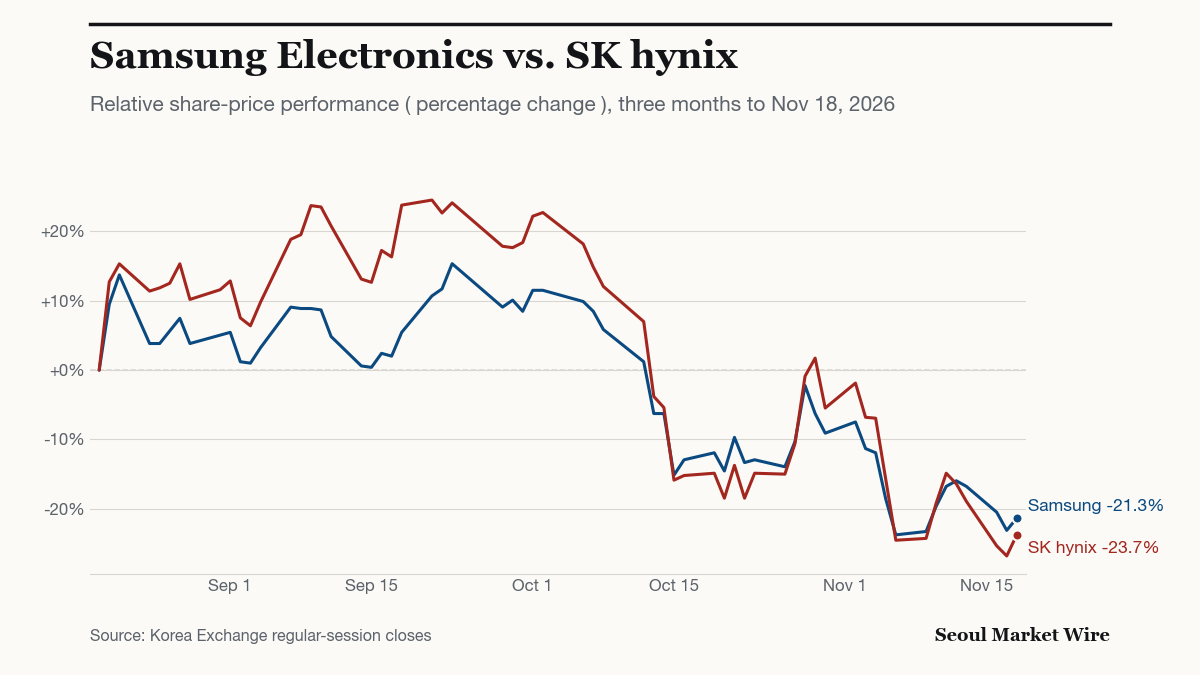
| Samsung Electronics — 005930.KS; SK hynix — 000660.KS | Semiconductor demand and investment, the industry drivers discussed in the report | Next company results and investment updates; release dates are not established by the cited sources |
| BOK policy rate and domestic market yields | Growth revisions, inflation pressure and household financing costs | November 2026 policy decision and revised economic outlook, discussed by Kiwoom; exact dates are not specified in the report |
| USD/KRW | Export-related currency supply and the Korea-US rate differential | November 2026 BOK decision, the brokerage’s next expected rate catalyst; a further increase in 2027 is also its forecast, not an announced decision |
Sources
- Korean government — IMF annual consultation assessment and Korea growth forecasts (Nov. 17, 2026) korea.kr
- Kiwoom Securities — 김유미, (Macro Snapshot) AI 투자 우려에도 한국 성장률 상향 (Nov. 18, 2026; original PDF) bbn.kiwoom.com
- Naver Securities — Kiwoom Securities, (Macro Snapshot) AI 투자 우려에도 한국 성장률 상향 (Nov. 18, 2026; report listing) stock.naver.com