PharmaResearch's cosmetics-led growth squeezes margins as broker targets diverge
Six of eight brokerage reports reviewed cut their targets after third-quarter results. A higher cosmetics share of sales, CG USA acquisition expenses and operating losses weighed on margins.

Market data: Korea Exchange regular-session close & Hana Bank USD/KRW reference rate, 2026-11-17 (KST)
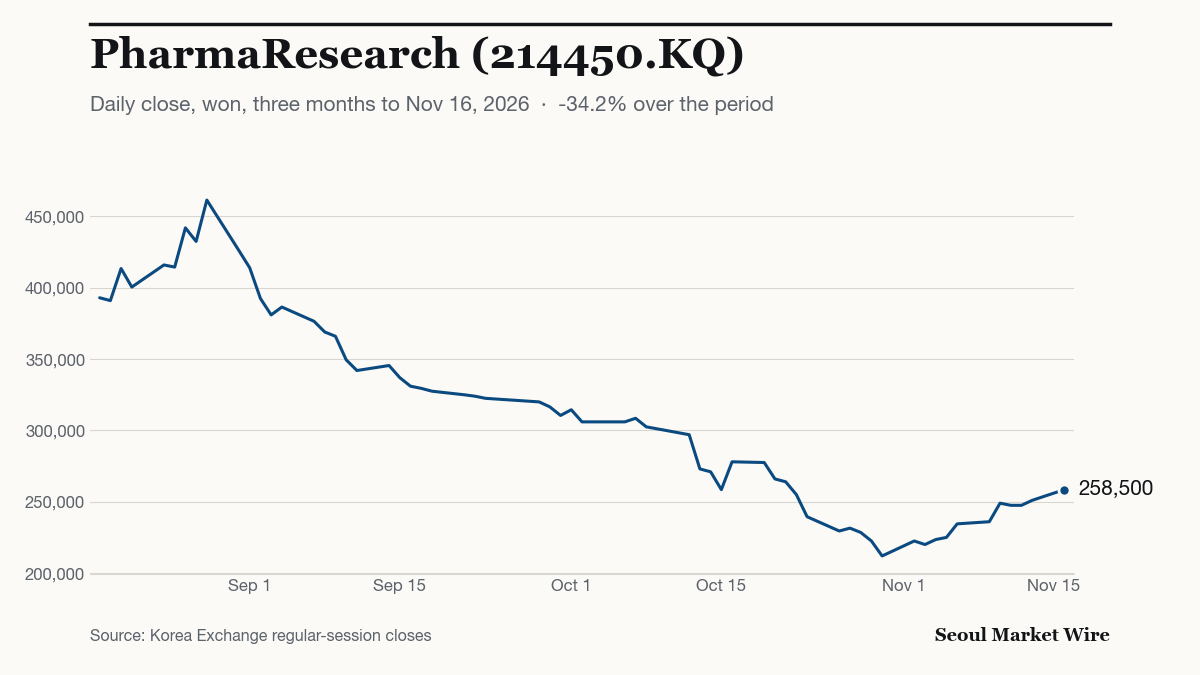
Six of eight brokerage reports reviewed cut their PharmaResearch price targets after its third-quarter operating margin fell to 36.5%. Analysts attributed the pressure to a higher share of cosmetics in total sales, CG USA acquisition expenses and operating losses at the acquired business. Targets ranged from 324,000 won to 530,000 won.
All eight reports were dated Nov. 9, 2026. The comparison is a defined sample, not a survey of every report published through Nov. 17. Within it, six targets fell, one rose and one was unchanged. The revisions raise two separate questions: how quickly earnings can grow, and what valuation that growth deserves as the company’s revenue mix changes.
Why did sales growth produce little profit growth?
Third-quarter revenue reached 171.5 billion won, up about 27% from a year earlier, while operating profit increased 1.2% to 62.6 billion won. Yuanta Securities Korea and IBK Securities put exports at 81.6 billion won, up 62%, and domestic sales at 89.9 billion won, up 6%.
Cosmetics revenue rose 76.2% to 62.0 billion won, accounting for about 36% of total sales. Cosmetics exports increased 92% to 42.1 billion won. IBK attributed part of the export growth to initial shipments to Costco in the United States and additional Sephora listings.
Domestic cosmetics revenue increased 50% to 19.9 billion won. Yuanta linked the gain to Olive Young and shipments through Coupang and Silicon2. It also noted that some revenue classified as domestic represented products destined for overseas markets. The accounting split therefore does not fully identify where final consumption occurs.
Domestic medical-device revenue was approximately flat at 57.1 billion won. Exports performed better: Eugene Investment & Securities reported 53% year-on-year growth in medical-device exports.
The changing sales mix helps explain why profit barely grew. IBK attributed a five-percentage-point decline in gross margin, to 76%, to the larger cosmetics contribution. Yuanta put the decline in operating margin at nine percentage points.
Acquisition expenses added a separate burden. Both Kyobo Securities and Yuanta distinguished 2.0 billion won of one-off CG USA acquisition expenses from 1.5 billion won of operating losses at the acquired business. Only the acquisition expenses were identified as one-off; that description does not establish that the operating losses will disappear.
Did the results miss expectations?
Brokerages agreed on the reported figures but differed on whether they met expectations.
Operating profit missed consensus by 5.7%, according to Kiwoom Securities. Yuanta compared the result with a market estimate of 66.4 billion won, also implying a shortfall of about 5.7%.
By contrast, Mirae Asset Securities described both revenue and operating profit as in line with market expectations. Eugene used a one-month consensus benchmark revised down after late-October previews and judged the results to be in line with those reduced expectations. The assessment from Shinhan Securities was that results held up better than seasonal and currency concerns had suggested.
Eugene’s assessment was explicitly relative to reduced expectations. It should not be read as evidence that the quarter met the forecasts in place before the late-October revisions.
How far apart are the targets?
The eight targets average 415,500 won, with a median of 415,000 won. These are calculations from the reports reviewed, not a measure of the entire market’s current consensus.
| Brokerage | Report date | Target price | Previous target | Change |
|---|---|---|---|---|
| Kyobo Securities | Nov. 9, 2026 | 530,000 won | 530,000 won | Unchanged |
| Kiwoom Securities | Nov. 9, 2026 | 480,000 won | 430,000 won | +11.6% |
| Mirae Asset Securities | Nov. 9, 2026 | 450,000 won | 600,000 won | -25.0% |
| Daishin Securities | Nov. 9, 2026 | 420,000 won | 460,000 won | -8.7% |
| Shinhan Securities | Nov. 9, 2026 | 410,000 won | 510,000 won | -19.6% |
| Eugene Investment & Securities | Nov. 9, 2026 | 370,000 won | 420,000 won | -11.9% |
| IBK Securities | Nov. 9, 2026 | 340,000 won | 530,000 won | -35.8% |
| Yuanta Securities Korea | Nov. 9, 2026 | 324,000 won | 450,000 won | -28.0% |
The largest percentage reduction was IBK’s 35.8% cut. Kiwoom was the only brokerage in the sample to raise its target, lifting it by 11.6%. The highest and lowest targets were separated by 206,000 won.
What explains the domestic slowdown?
The reports emphasised different customer groups. Yuanta attributed weak domestic medical-device sales to reduced dermatology spending by foreign visitors, particularly Japanese visitors, during July and August, alongside a stronger won. Kyobo also identified stalled Japanese customer traffic during those months.
In IBK’s account, foreign medical demand held up while demand from Korean patients weakened. The reports do not provide a common customer-level breakdown that reconciles these explanations. They should therefore be read as differing assessments of demand, rather than comparable measurements of each group’s contribution.
Evidence of improvement from September appeared in several reports. Daishin Securities relayed the company’s account of recovering domestic medical-device demand and its expectation of high-single-digit sequential sales growth in that business during the fourth quarter. Kiwoom and Kyobo also described a recovery beginning in September.
A sequential rebound would not, by itself, mean a return to earlier annual growth rates. Eugene forecast fourth-quarter domestic medical-device revenue growth of 8% from the third quarter but only 3% from a year earlier. Its analysts did not expect the business to regain its previous pace of expansion.
What valuation does the changing business deserve?
The distinction between earnings estimates and valuation multiples is clearest in Daishin’s calculation. The brokerage used a target price-to-earnings ratio of 19.6 times and a 12-month forward earnings-per-share estimate of 21,230 won. Multiplying those inputs gives 416,108 won, or approximately 416,000 won, close to its published target of 420,000 won.
That multiple is about 10% below the stock’s two-year average of 21.8 times. Its EPS estimate was broadly unchanged, making valuation restraint a central part of the target reduction. The analysts cited the need to confirm the speed of domestic demand recovery and repeat orders from new overseas cosmetics channels.
Repeat orders matter because an initial shipment does not by itself demonstrate sustained consumer demand. IBK identified initial Costco shipments as one contributor to third-quarter cosmetics exports; Daishin’s focus on reorders addresses whether new channels can keep generating sales after that first delivery.
The 19.6-times multiple is a target-setting assumption, not the stock’s current trading P/E. A price target also depends on the earnings estimate and forecast period to which the multiple is applied, so differences between targets cannot be attributed to multiples alone.
For Eugene, slower domestic medical-device growth and a larger cosmetics contribution justify some reduction in the premium previously supported by Rejuran’s domestic growth and profitability. Its analysts also see overseas cosmetics expansion as a potential source of global brand value. That is a prospective benefit, while the lower gross and operating margins are already reflected in the third-quarter figures.
Which costs could constrain fourth-quarter profit?
The third-quarter CG USA operating loss is separate from the one-off acquisition expenses. The 1.5 billion won loss measures the acquired business’s operating performance; it is not a fee for consolidating the subsidiary. The distinction matters when assessing how much of the third-quarter burden might recur.
For the fourth quarter, Eugene expects higher advertising expenditure, including approximately 3.0 billion won of event expenses, to reduce operating profit from the preceding quarter.
Its forecasts are for revenue of 178.2 billion won, up 25% year on year, and operating profit of 59.6 billion won, up 15%. Those figures imply an operating margin of 33.4%, down from 36.5% in the third quarter. The 33.4% figure is calculated from the two forecasts, rather than quoted as the brokerage’s stated margin.
Sales growth also depends on currency translation as well as shipment volumes. Kiwoom reported that exchange-rate movements weighed on third-quarter cosmetics export revenue despite continued volume growth.
The annual forecasts allow for continued margin pressure. Kyobo projects a mid-30% operating margin in 2027 as cosmetics gain sales share. Eugene forecasts 2027 revenue of 828.0 billion won, up 23%, and operating profit of 297.2 billion won, up 21%, with exports accounting for 52% of sales.
What to watch next
The periods below are forecast periods or broker-indicated launch windows. The cited reports do not establish exact company announcement dates.
| KRX ticker | Key sensitivity | Next catalyst and date |
|---|---|---|
| PharmaResearch — 214450 (214450.KQ) | Domestic medical-device recovery and repeat orders from overseas cosmetics channels | Fourth-quarter 2026 results; release date not established in the cited reports. Eugene forecasts domestic device sales growth of 8% quarter on quarter. |
| PharmaResearch — 214450 (214450.KQ) | Advertising expenses and CG USA operating performance | Fourth-quarter 2026 results; release date not established. Eugene’s revenue and operating-profit forecasts imply a 33.4% margin. |
| PharmaResearch — 214450 (214450.KQ) | Combined use of Rejuran and the planned Rinex microneedle radiofrequency device | Early 2027 is the launch window described in Eugene’s Nov. 9 report; no exact launch date is established. |
Sources
- Eugene Investment & Securities — 3Q26 Review: Time to focus on profit growth over margins (Nov. 9, 2026) stock.naver.com
- Yuanta Securities Korea — Export-led growth as margins pause (Nov. 9, 2026) stock.naver.com
- Daishin Securities — The share price has passed its low (Nov. 9, 2026) stock.naver.com
- IBK Securities — Time to focus on export-led growth (Nov. 9, 2026) stock.naver.com
- Kyobo Securities — 3Q26 Review: The bottom is passing (Nov. 9, 2026) stock.naver.com
3 more sources
- Kiwoom Securities — PharmaResearch third-quarter review (descriptive label; Nov. 9, 2026) stock.naver.com
- Mirae Asset Securities — PharmaResearch third-quarter review (descriptive label; Nov. 9, 2026) stock.naver.com
- Shinhan Securities — Growth confirmed despite concerns (Nov. 9, 2026) stock.naver.com