Korean bond demand offers no simple measure of support for the won
Foreign purchases of Korean bonds can support the won, but their currency effect depends on funding and hedging. Index weights measure benchmark exposure, not fresh money converted into won.

Market data: Korea Exchange regular-session close & Hana Bank USD/KRW reference rate, 2026-11-17 (KST)
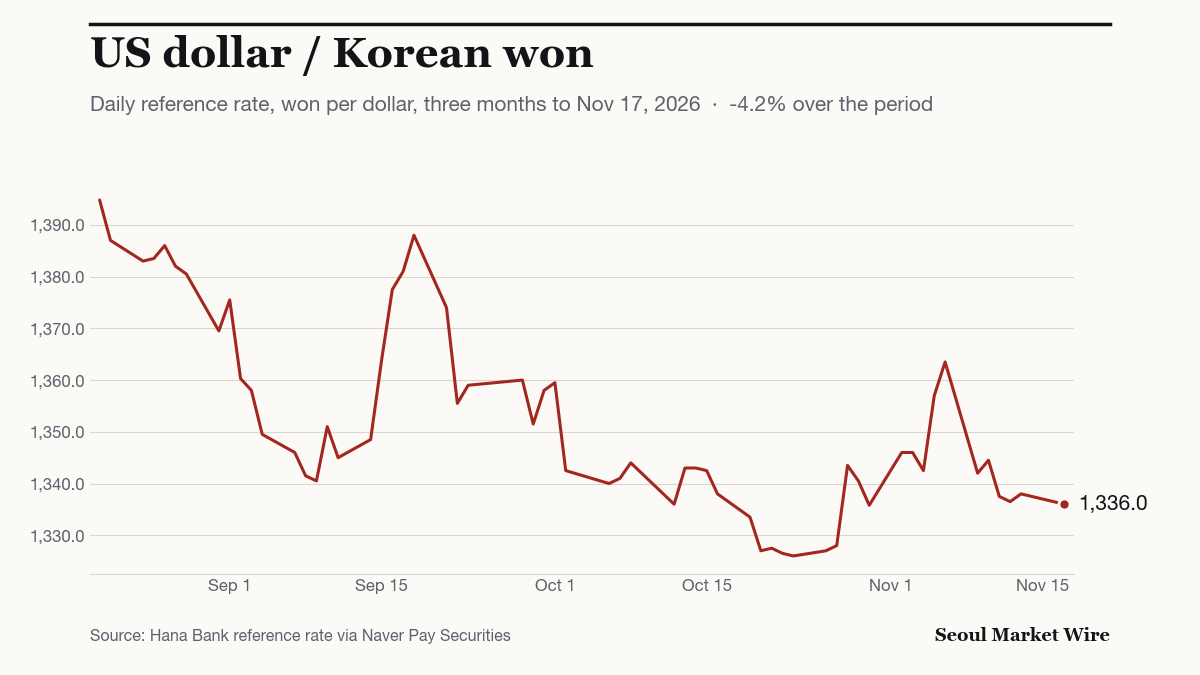
Foreign purchases of Korean government bonds can support the won by creating demand for the currency. But some holdings serve as hedges against obligations to Korean insurers, while the funding and currency transactions behind those positions remain separate questions.
For additional bond demand to generate fresh buying of won, investors must convert foreign currency rather than fund the entire purchase from existing won balances. They may also hedge currency exposure. Funding determines how the purchase is paid for; hedging determines which risks the investor retains. A currency hedge does not, by itself, mean that no spot conversion occurred.
The supportive case therefore requires evidence of fresh conversion into won. The caveat requires equal care: identifying a bond position as hedge-related does not prove that it supplied no currency demand. Neither interpretation can be quantified from a holdings total alone.
What do foreign bond holdings reveal?
A holdings figure measures assets owned at a particular date. Net buying measures purchases less sales during a specified period. Existing holdings can reflect transactions completed long before the period under examination, so a large stock of foreign-owned bonds is not equivalent to a continuing flow of new money.
The ownership label can also obscure the purpose of the position. In its Nov. 16 fixed-income weekly, Hanwha Investment & Securities describes contracts under which Korean insurers agree to buy long-dated government bonds from foreign banks at a future date. The counterparties acquire cash bonds to hedge their delivery obligations. Positions booked offshore can then appear in foreign bond holdings. Report PDF, p. 2.
That structure connects a foreign account’s bond purchase to a domestic insurer’s demand for duration. It still creates demand for the bond. What changes is the interpretation: the purchase need not represent an independent decision by an overseas investor to increase exposure to Korean interest rates.
Delivery creates another distinction. Transferring the bond to the insurer can reduce the foreign account’s holdings without constituting a sale prompted by a deteriorating view of Korea. The brokerage’s analysis is useful for separating these motives, but a hedge against a bond-delivery obligation is not a hedge against the won. Currency exposure requires its own evidence.
Scheduled inclusion fractions calculated from FTSE Russell’s N/8 rule; these are not observed investment flows.
What do the WGBI numbers measure?
The March classification review, published April 7, specified eight monthly inclusion stages. The first applied to the April profile after the March month-end rebalance; completion was scheduled for the November profile. Official announcement, p. 2.
The report’s projected full-inclusion weights can be checked against its underlying market values. All figures below use March 31, 2026 data, not November observations.
| Index | Published full-inclusion weight | Primary-source market values: Korea / index total, USD bn | Recalculated weight | Rounded to two decimals |
|---|---|---|---|---|
| WGBI | 1.75% | 609.7 / 34,774.0 | 1.7533% | 1.75% |
| WGBI ex Japan | 1.91% | 609.7 / 31,866.1 | 1.9133% | 1.91% |
| WGBI ex Japan ex China | 2.18% | 609.7 / 27,992.9 | 2.1781% | 2.18% |
Source: FTSE Russell, Figures 1-3. Calculations divide Korea’s market value by each post-inclusion index total and multiply by 100; displayed inputs are themselves rounded.
A benchmark weight expresses a share of an index’s market value. It is neither a cash subscription nor a record of currency purchases. Applying that weight to an investment portfolio would still leave questions about the investor’s existing holdings, implementation timing and funding.
The same limitation applies to the timetable. Completion of a scheduled phase-in does not establish that subsequent foreign purchases stopped. Index-related buying remains bond demand, while the amount converted into won depends on the transactions used to implement it.
How do exports and equity sales enter the calculation?
Export receipts provide another potential source of won demand when companies exchange foreign currency. Export values, however, measure trade rather than conversion. A stronger export total does not specify how much foreign currency companies sold or when they sold it.
There is also a risk to the underlying receipts. Yuanta Securities’ Nov. 16 report identifies tighter US controls on AI chip exports to China and slower AI investment as potential threats to Korean export prices and volumes. Its warning is a conditional assessment, not evidence that both have already fallen. Report page, PDF summary.
On Nov. 17, foreign investors were net sellers of KOSPI shares. The index closed at 4,968.48, down 2.59%, according to the market data carried by Naver Pay Securities. KOSPI data.
Selling shares produces won proceeds; exchanging those proceeds for foreign currency and remitting them overseas are additional transactions. Subtracting equity sales from bond purchases would compare securities-market totals, leaving the conversion decisions unresolved. Measuring their combined currency effect requires transactions covering the same period and a consistent market scope.
What to watch next
These releases were scheduled after the draft’s Nov. 18, 00:42 KST timestamp. The tickers identify related Korean-market exposures; they do not imply a predicted price response. All times are KST.
| KRX ticker or indicator | Key sensitivity | Next catalyst and date |
|---|---|---|
| Samsung Electronics (005930.KS); SK hynix (000660.KS) | Information relevant to semiconductor demand | NVIDIA fiscal 2027 third-quarter results: Nov. 18, approximately 06:20; conference call at 07:00. Official schedule |
| USD/KRW; Korean government bonds | US residential activity as an input to growth and rate expectations | October US housing starts and building permits: Nov. 18, 22:30. Census calendar |
| USD/KRW; Korean government bonds | The Federal Reserve’s recorded policy discussion | Minutes of the Oct. 27-28 FOMC meeting: Nov. 19, 04:00. Federal Reserve calendar |
Sources
- Hanwha Investment & Securities — FI Weekly: Breaking down foreign demand (Nov. 16, 2026), pp. 2-3 stock.pstatic.net
- Yuanta Securities — Variables shaping the economy: no need to take bigger steps on prices driven by supply bottlenecks (Nov. 16, 2026) stock.naver.com
- Yuanta Securities — Report PDF (Nov. 16, 2026), summary stock.pstatic.net
- Naver Pay Securities — KOSPI market data and investor trends finance.naver.com
- FTSE Russell — March 2026 Fixed Income Country Classification results (published April 7, 2026), pp. 2-4 lseg.com
3 more sources
- NVIDIA — Third-quarter financial results conference-call schedule investor.nvidia.com
- US Census Bureau — 2026 economic indicators calendar census.gov
- Federal Reserve — November 2026 calendar federalreserve.gov