SK hynix falls 7.9%, more than Samsung, as brokers assess Nvidia exposure
Samsung fell less than SK hynix as Korean brokerage research distinguished changes in AI demand from risks to the financing that supports investment.
Market data: Korea Exchange regular-session close & Hana Bank USD/KRW reference rate, 2026-11-16 (KST)
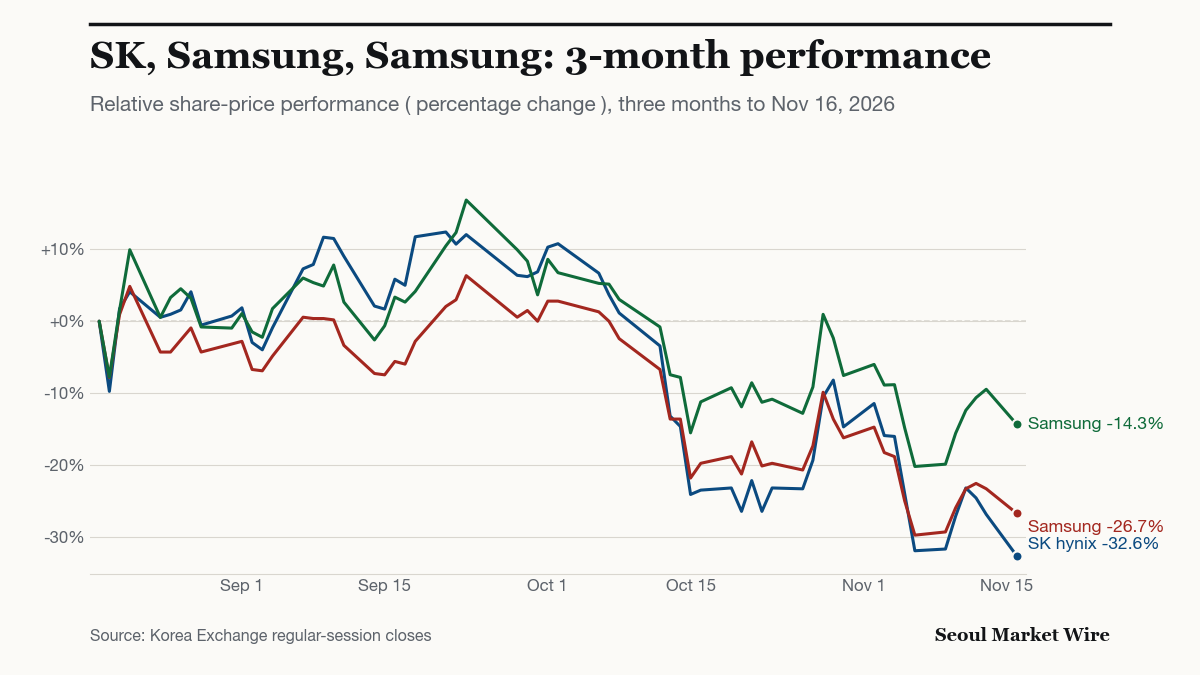
SK hynix fell 7.89% to 1,120,000 won on Nov. 16, underperforming Samsung Electronics, which declined 4.47% to 196,800 won. The 3.42-percentage-point gap accompanied a distinction in Korean brokerage research: AI demand could persist or shift among suppliers while the financing supporting that investment became more vulnerable.
The KOSPI closed down 3.59% at 5,100.50 and the KOSDAQ fell 4.86% to 665.65. Samsung’s preferred shares lost 5.40% to 161,300 won. All prices and index levels are Nov. 16 Korean regular-session closes.
What does the gap between the chipmakers establish?
Both common shares fell more than the KOSPI. SK hynix underperformed the benchmark by 4.30 percentage points, compared with Samsung’s 0.88 percentage point. Samsung’s smaller decline therefore represented relative resilience within a falling market.
An earlier explanation appeared in Shinhan Securities’ market-close commentary dated Nov. 13. On page 1, the brokerage cited Samsung’s comparatively diversified supply chain when discussing its smaller decline that day: approximately 1%, against about 3% for SK hynix.
That wording describes supply-chain diversification. It does not quantify either company’s revenue dependence on Nvidia or establish a difference in customer concentration.
The same commentary identified expectations of a shift toward application-specific integrated circuits, or custom chips, as a reason for differentiation among AI-related companies. Its argument was that uncertainty surrounding Nvidia could redistribute opportunities within the industry without ending demand for AI computing.
This was an interpretation of the earlier session, not proof of what caused the Nov. 16 performance gap. The latest prices establish the difference in returns; they do not isolate the contribution of supplier relationships, financing concerns or interest rates.
Can demand hold up while financing becomes riskier?
A distinction between business performance and funding runs through iM Securities’ Nov. 16 analysis. The report compared Nvidia’s share-price path since 2020 with Cisco Systems’ trajectory beginning in 1995, but judged the risk of a dot-com-style collapse very low.
That assessment rested on an expectation that Nvidia’s operating performance would remain broadly intact despite Jensen Huang’s departure. It was a forecast about the business, rather than a claim that its shares could not fall further.
The brokerage also pointed to recent stabilization or declines in credit-default-swap spreads, a market measure of credit risk. Figure 4 on page 3 plots Amazon, Google, Nvidia and Oracle over a period spanning May 2025 to November 2026. Its reassurance concerned the recent movements: the chart also shows spreads rising substantially earlier in 2026.
Those four series cannot establish funding conditions for every AI borrower. The report’s principal reservation concerned AI-focused cloud providers, often called neoclouds, and whether Nvidia-related funding arrangements would continue smoothly after the leadership change.
Its analysts highlighted guarantees and financing backed by graphics processing units. Disruption to those arrangements could damage AI investment and increase credit risk, they argued. The report raised a vulnerability; it did not establish that financing had already been withdrawn.
Support for demand appeared in IBK Investment & Securities’ Nov. 13 economic assessment. On page 1, the brokerage cited strong semiconductor orders and a rising share of long-term contracts as reasons to expect exports to keep supporting Korean growth.
The distinction matters for the two Korean chipmakers. Order visibility concerns future production and sales. Financing risk concerns customers’ ability to fund investment. Evidence supporting the first does not, by itself, resolve the second.
Why do interest rates matter?
The duration and scale of U.S. monetary tightening were another concern in iM’s analysis. Its discussion treated a December rate increase as a working assumption and focused on the possibility of further increases in 2027. That was the brokerage’s assessment, not a Federal Reserve commitment.
The sequence of the inflation evidence is important. Before the October CPI release on Nov. 10, Fed Governor Christopher Waller argued that a 50-basis-point December increase should be considered if monthly core inflation came in around 0.3% or higher. His condition referred to the release due later that day. Waller’s speech
The subsequent release showed seasonally adjusted core CPI rising 0.3% in October, matching August and September. That met the numerical condition Waller had described; it did not establish a committee decision on December policy. BLS October CPI release
Currency expectations added a separate consideration. In its FX report dated Nov. 13, Shinhan argued that firm U.S. retail sales and industrial production could limit declines in Treasury yields and support the dollar. Against that external pressure, the brokerage expected dollar sales by Korean semiconductor exporters to restrain the won’s depreciation.
Which releases address these questions?
The Kiwoom Securities chart pack circulated Nov. 16 identified three earnings questions on page 2: Nvidia’s demand outlook, continuity under its interim leadership and whether customer-financing support would continue.
Those questions address different parts of the investment case. Guidance concerns expected business activity; management continuity concerns execution; customer financing concerns the funding behind orders.
The chart pack also listed an expected Anthropic listing on Nov. 19 and identified its offering price and initial share performance as indicators of appetite for AI investment. That date is the brokerage’s expected timetable, rather than an independently confirmed trading debut.
Nvidia has scheduled its results for approximately 1:20 p.m. Pacific time on Nov. 17, followed by a 2 p.m. earnings call. Those times correspond to 6:20 a.m. and 7 a.m. KST on Nov. 18. Colette Kress became interim CEO following Huang’s resignation on Nov. 12. Nvidia’s announcement
The advance estimate of U.S. retail sales for October is due Nov. 17 at 8:30 a.m. Eastern time, or 10:30 p.m. KST. Minutes of the Oct. 27–28 FOMC meeting are scheduled for Nov. 18 at 2 p.m. Eastern time, or 4 a.m. KST on Nov. 19. Census release schedule, Fed November calendar
The next FOMC meeting is scheduled for Dec. 8–9. Fed December calendar
Sources
- iM Securities — Two uncomfortable charts: Nvidia and the KOSPI (Nov. 16, 2026), pages 1–3 stock.naver.com
- Shinhan Securities — Korean equity market close: Jensen Huang's resignation and a shift in AI (report dated Nov. 13, 2026), page 1 stock.naver.com
- Shinhan Securities — Shinhan FX Check-up (report dated Nov. 13, 2026), page 1 stock.naver.com
- Kiwoom Securities — Kiwoom Global Key Charts, second week of November (circulated Nov. 16, 2026), page 2 stock.naver.com
- IBK Investment & Securities — Economy Monitor: rising growth forecasts and louder noise, how to read 2027 (Nov. 13, 2026), page 1 stock.naver.com
8 more sources
- Yahoo Finance — SK hynix historical prices finance.yahoo.com
- Yahoo Finance — Samsung Electronics historical prices finance.yahoo.com
- NVIDIA — CEO transition and earnings announcement schedule (Nov. 12, 2026) investor.nvidia.com
- Federal Reserve — Christopher Waller's economic outlook speech (Nov. 10, 2026) federalreserve.gov
- U.S. Bureau of Labor Statistics — October 2026 Consumer Price Index, archived release bls.gov
- U.S. Census Bureau — Retail trade release schedule census.gov
- Federal Reserve — November 2026 calendar federalreserve.gov
- Federal Reserve — December 2026 calendar federalreserve.gov