Korea's inflation eases to 2.8%, but core prices offer little relief
Both core price indices rose 0.4% from September. The annual rate excluding agricultural products and petroleum increased to 2.8%; the food-and-energy rate held at 2.8%.

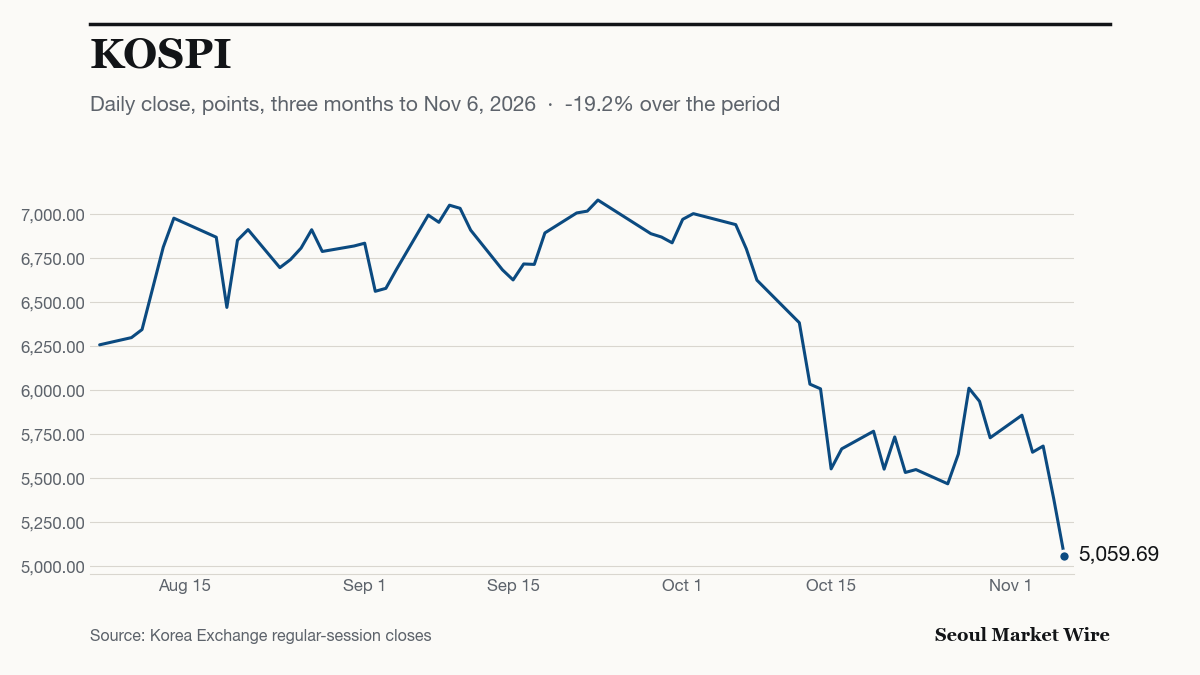
Market data: Korea Exchange regular-session close & Hana Bank USD/KRW reference rate, 2026-11-06 (KST)
Korea’s headline inflation eased to 2.8% in October from 2.9% in September. But neither annual core measure declined, and both core price indices rose 0.4% from the previous month.
The Bank of Korea had already held its base rate at 3.00% on Oct. 22. That decision preceded the Nov. 3 inflation release; it was not a response to October’s softer headline reading.
What did the slowdown capture?
Consumer prices increased 0.2% from September, according to the official October release. Fresh food prices fell 6.2% year on year and 3.8% month on month. Within that category, fresh vegetables and fruit became cheaper than a year earlier, while fresh fish and seafood prices rose.
The finance ministry estimated that the petroleum price cap lowered October’s headline inflation rate by 0.8 percentage points. Without it, the ministry estimated annual inflation would have been 3.6%. That estimate concerns October’s annual rate, not the contribution to its slowdown from September.
The two core baskets also differ. Under the official definitions, one excludes food and energy; the other excludes agricultural products other than grains, city gas and petroleum products. Fresh seafood remains in the agricultural-products-and-petroleum core basket, although it is excluded from the food-and-energy measure.
Only the agricultural-products-and-petroleum measure recorded a higher annual rate, rising from 2.7% to 2.8%. Its food-and-energy counterpart stayed at 2.8%, according to the finance ministry’s comparison table.
Both core indices rose 0.4% from September, compared with a 0.2% increase in the headline index. October’s lower headline annual rate did not mean consumer prices fell during the month.
What does the BOK’s hold establish?
In its Oct. 22 decision, the central bank cited uncertainty over the Middle East and major economies’ policies, alongside a need to assess the effects of two earlier rate increases. All seven board members supported holding rates.
Its guidance also retained the possibility of further increases, with their timing and pace dependent on inflation, domestic economic conditions and financial stability. The statement identified oil prices, the exchange rate, domestic demand and wage increases as uncertainties for inflation.
Could external pressures ease?
Lower oil prices are one possible source of relief. In its Nov. 5 analysis, iM Securities judged that WTI crude could fall into the $70s per barrel if Iran-related risks eased. This was a conditional forecast rather than an observed price.
Financial-market stress could prompt softer Fed commentary despite continued inflation concerns, according to Kiwoom Securities’ Nov. 6 analysis. The brokerage did not expect such comments to change its forecast for another Fed rate increase in December.
The BLS calendar schedules U.S. October CPI for Nov. 10 and PPI for Nov. 13, both at 10:30 p.m. KST.
Sources
- Ministry of Data and Statistics — October 2026 consumer price trends (Nov. 3, 2026) mods.go.kr
- Ministry of Data and Statistics — CPI classifications and types mods.go.kr
- Ministry of Finance and Economy — Consumer Price Index climbed by 2.8% in October (Nov. 3, 2026) english.mofe.go.kr
- Bank of Korea — Monetary policy decision and opening remarks (Oct. 22, 2026) bok.or.kr
- Kiwoom Securities — Weekly Macro: AI investment expectations reset; focus on inflation and the Fed (Nov. 6, 2026) stock.naver.com
4 more sources
- Kiwoom Securities — Weekly Macro original report (Nov. 6, 2026) bbn.kiwoom.com
- iM Securities — Why U.S. financial markets cheered the blue wave (Nov. 5, 2026) stock.naver.com
- iM Securities — Public report copy (Nov. 5, 2026) imfnsec.tistory.com
- U.S. Bureau of Labor Statistics — November 2026 release calendar bls.gov