Kyobo drops bearish wind stance after US midterms
Kyobo's wind recovery case rests on permitting relief for projects with existing tax credits, while its CS Wind buy rating and 77,000-won target remain unchanged. Other research examines Texas grid constraints and recovering Gulf exports.

Market data: Korea Exchange regular-session close & Hana Bank USD/KRW reference rate, 2026-11-09 (KST)
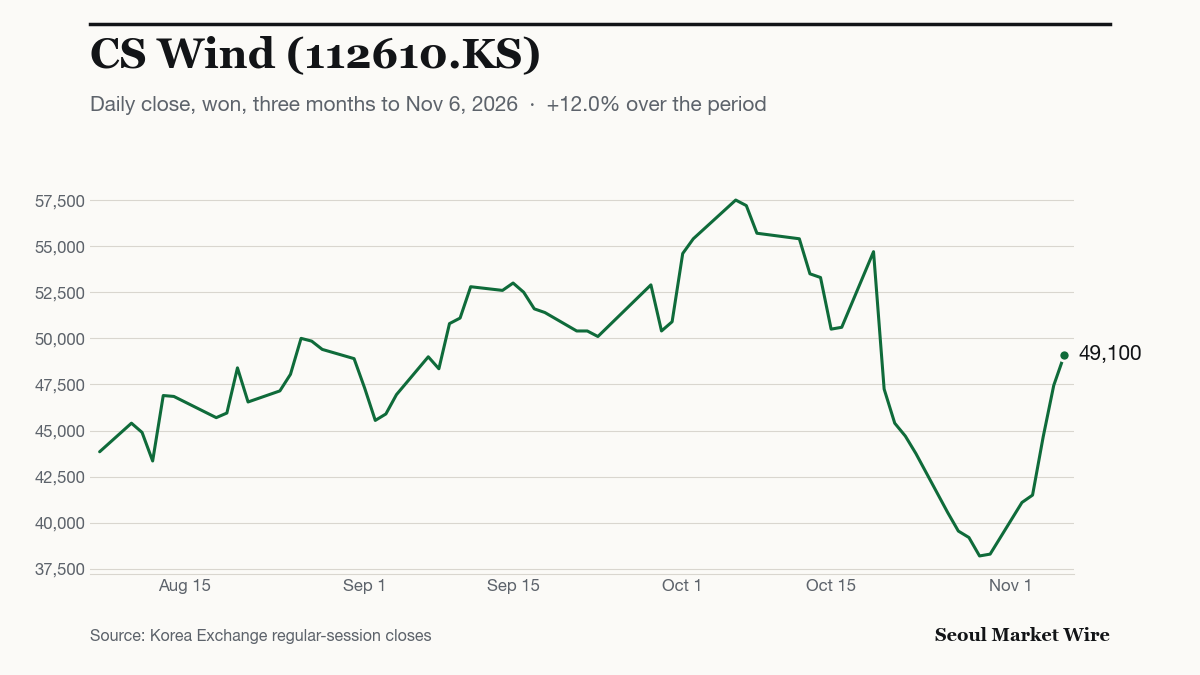
The change in Kyobo Securities’ Nov. 5 wind assessment was its sector view: the brokerage dropped its bearish stance after the US midterms while maintaining its buy rating and 77,000-won price target for CS Wind (112610). Its case for recovering equipment orders rests mainly on permitting relief for projects that already secured tax credits.
That distinction separates a possible restart of delayed investment from a reversal of President Donald Trump’s tax policy. The analysts consider restoration of wind tax credits politically difficult during his term.
What could restart wind orders?
The restrictions began with Trump’s Jan. 20, 2025 memorandum. It directed federal agencies to stop issuing new or renewed wind approvals pending review and withdrew federal offshore areas from new wind leasing.
Stronger congressional oversight could help projects with existing tax credits proceed, in Kyobo’s assessment, with equipment orders benefiting first. The incoming Congress’s term begins at noon on Jan. 3, 2027, so the expected effect of that oversight is a condition of the brokerage’s recovery case.
Another element is the proposed Bipartisan American Affordability and Jobs Act of 2026 (BAAJA). A sponsor’s fact sheet describes provisions to prevent administrations from blocking permitting for entire classes of energy projects. The brokerage treats legislative protection as potential support for investment, rather than an approval already granted to delayed projects.
Tax-credit restoration would require legislation. If Trump vetoed such a bill, overriding him would require two-thirds of members voting in each chamber, as the Congressional Research Service explains.
Tariffs remain a separate constraint. The Oct. 22 wind-import proclamation directed negotiations following the Section 232 investigation, left existing metal tariffs unchanged and preserved the possibility of further action. Permitting relief would therefore leave an additional source of uncertainty for equipment suppliers.
How do state rules affect data centres?
State governments can alter power, environmental, water and tax policies. DS Investment & Securities’ Nov. 5 election report highlighted those powers. It treated the Senate result as decided but House control as still pending, reflecting the report’s assessment at that time.
In Texas, the Electric Reliability Council of Texas (ERCOT), the state’s main grid operator, responded to Governor Greg Abbott’s Aug. 3 directive by pausing Batch Zero studies and approvals to energise new data-centre and crypto-mining loads of at least 75 MW.
The roughly 200 GW cited by DS should not be read as new data-centre demand alone. Batch Zero classifications cover existing and proposed large loads, including facilities already connected to the grid. They do not measure operating capacity taken offline by the pause.
ERCOT’s September board update distinguished eligibility verification from community-impact review and recorded provisional classifications issued on Sept. 3. Those steps continued despite the pause on energising new qualifying facilities.
What did recovering Gulf exports change?
More Gulf crude reaching the market reduced supply-related upward pressure on prices, according to Hana Securities’ Nov. 4 analysis. Its analysts linked the narrowing Oman-Dubai spread to recovering exports and identified progress in US-Iran talks or lower Saudi official selling prices as possible sources of further downward pressure.
The report put combined October crude exports from Saudi Arabia, the UAE, Iraq and Kuwait at 15.53 million barrels a day, up 10% from September. That total excluded Iran.
Sources
- Kyobo Securities — Blue Wave: time to drop the short bias on wind (Nov. 5, 2026) stock.naver.com
- DS Investment & Securities — US midterm elections and their sector impact (Nov. 5, 2026) stock.naver.com
- Hana Securities — Falling oil prices as a catalyst for short-term rotation within the sector (Nov. 4, 2026) stock.naver.com
- US Constitution — Twentieth Amendment govinfo.gov
- White House — Wind leasing and permitting memorandum (Jan. 20, 2025) whitehouse.gov
4 more sources
- Senator Martin Heinrich — Bipartisan American Affordability and Jobs Act fact sheet (Sept. 30, 2026) heinrich.senate.gov
- White House — Wind turbine imports proclamation (Oct. 22, 2026) whitehouse.gov
- Congressional Research Service — Introduction to the Legislative Process in the US Congress congress.gov
- ERCOT — Batch Zero Update (September 2026) ercot.com