Korea's stronger growth outlook hinges on US AI spending and borrowing costs
Korea's 2026 growth forecasts are approaching 4%, according to IBK Investment & Securities. The brokerage links the stronger outlook to US AI investment, while iM flags construction risks following the US midterms.
Market data: Korea Exchange regular-session close & Hana Bank USD/KRW reference rate, 2026-11-10 (KST)
Major forecasters are raising their estimates for Korean growth as AI-related investment supports exports, with 2026 forecasts approaching 4% and 2027 forecasts approaching 3%, according to an IBK Investment & Securities outlook posted on Naver on Nov. 10.
But Korea’s semiconductor cycle depends more on US investment and US interest rates than on domestic conditions, the brokerage argues. Stronger growth forecasts therefore leave Korea exposed to changes in American companies’ spending plans and market borrowing costs.
Concerns about that spending surfaced after the US midterms. A Nov. 9 brief from iM Securities linked the election results to fears of data-centre construction delays. Korean shares rebounded on Nov. 10, when the KOSPI closed at 5,239.13, up 4.39%.
What is driving the growth upgrades?
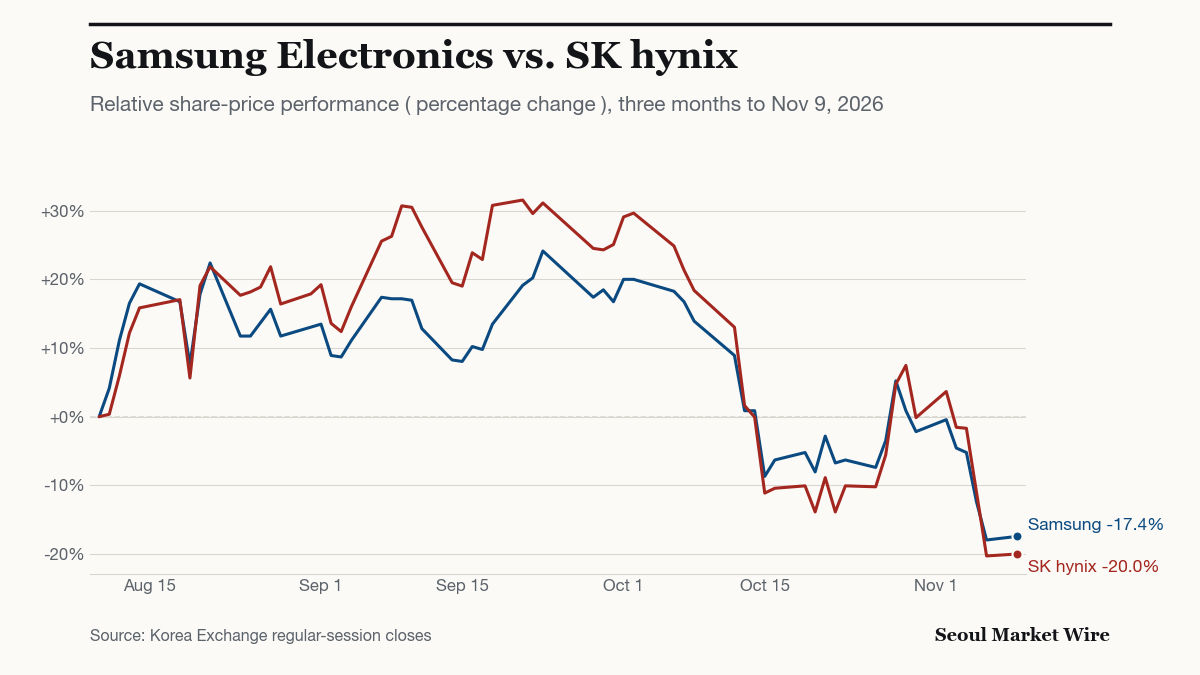
Competition among US AI companies has increased American demand for capital goods. IBK argues that Korea’s export industries have been major beneficiaries, with the US investment cycle shaping the outlook for chipmakers including Samsung Electronics and SK hynix.
Fiscal spending provides another source of support in the brokerage’s 2027 outlook. IBK expects fiscal spending growth in Korea and Taiwan in 2027 to exceed rates seen during the pandemic.
The benefits of investment-led growth have been uneven in the United States. Since the pandemic, US corporate profits and GDP have accelerated relative to their earlier trends, while employment has not shown a comparable acceleration, according to IBK. Its analysis concerns the gap between those trends, rather than an absence of job creation.
Despite the upward revisions, the brokerage sees Korea’s economic cycle as likely to slow in 2027 from its 2026 peak.
How do the construction and capex forecasts compare?
For 2026, iM’s table puts US data-centre construction spending at $85 billion and hyperscaler capital expenditure at $789.6 billion, a ratio of about 11%. That compares two spending totals for a specific forecast year. It is not an accounting breakdown of individual hyperscalers’ expenditure or a measure of the share of capex exposed to construction delays.
The table projects US data-centre construction spending of $95 billion–$110 billion in 2027, up about 12%–29% from 2026. It projects hyperscaler capex of about $1.1 trillion, up roughly 40%. These are forecasts, rather than confirmed spending commitments by the companies.
Permitting concerns following the midterms could slow investment, in the brokerage’s assessment. It favours delays or partial reductions over a halt to the AI investment cycle; its report does not establish that new restrictions have already taken effect.
iM interprets the sell-off as reflecting the risk of lower spending forecasts, rather than evidence that the investment boom has ended.
Where do rates and earnings pose risks?
Lower AI spending forecasts or persistently high US market rates could weaken support for Korea’s growth outlook. The interest-rate risk does not require yields to keep rising, and market borrowing costs are distinct from the Fed’s policy rate.
After strong October payrolls, Shinhan Securities’ Nov. 9 report treated a 25-basis-point Fed hike in December as effectively a given. That was the brokerage’s assessment, not a policy decision. Its analysts nevertheless expected the Fed to remain cautious about further hikes.
Currency movements provide another channel. In a separate Nov. 9 brief, iM linked the won’s weakness in the preceding week to AI investment concerns and foreign selling of Korean shares. It identified further AI-stock moves as a key near-term influence on foreign flows and the currency, while expecting the won to strengthen if Korean stocks rebounded.
In its Nov. 9 strategy report, Hana Securities attributed the index decline to technology-sector credit risk and fears of lower chip earnings forecasts. Its analysts said chip earnings estimates were still rising, while share prices were already pricing in the risk of cuts.
Sources
- IBK Investment & Securities: IBKS Economy Outlook, Cognitive Dissonance: which will prove right, hopes or fears? (posted on Naver Nov. 10, 2026) stock.naver.com
- iM Securities: AI investment fears overdone, a question of growth speed (Nov. 9, 2026) stock.naver.com
- iM Securities: The won's exposure to weaker AI sentiment (Nov. 9, 2026) stock.naver.com
- Shinhan Securities: AI-led hiring, cooling domestic demand (Nov. 9, 2026) stock.naver.com
- Hana Securities: Hwasubun equity strategy (Nov. 9, 2026) stock.naver.com
1 more sources
- Naver Pay Securities: KOSPI index data finance.naver.com