Kyobo raises Hanmi MASH drug value; SK stresses global launches
Kyobo raises efinopegdutide's valuation from 1.4 trillion won to 1.5 trillion won and expects Phase 3 advancement. SK also argues for a sector rebound, emphasizing successful direct entry into global markets.
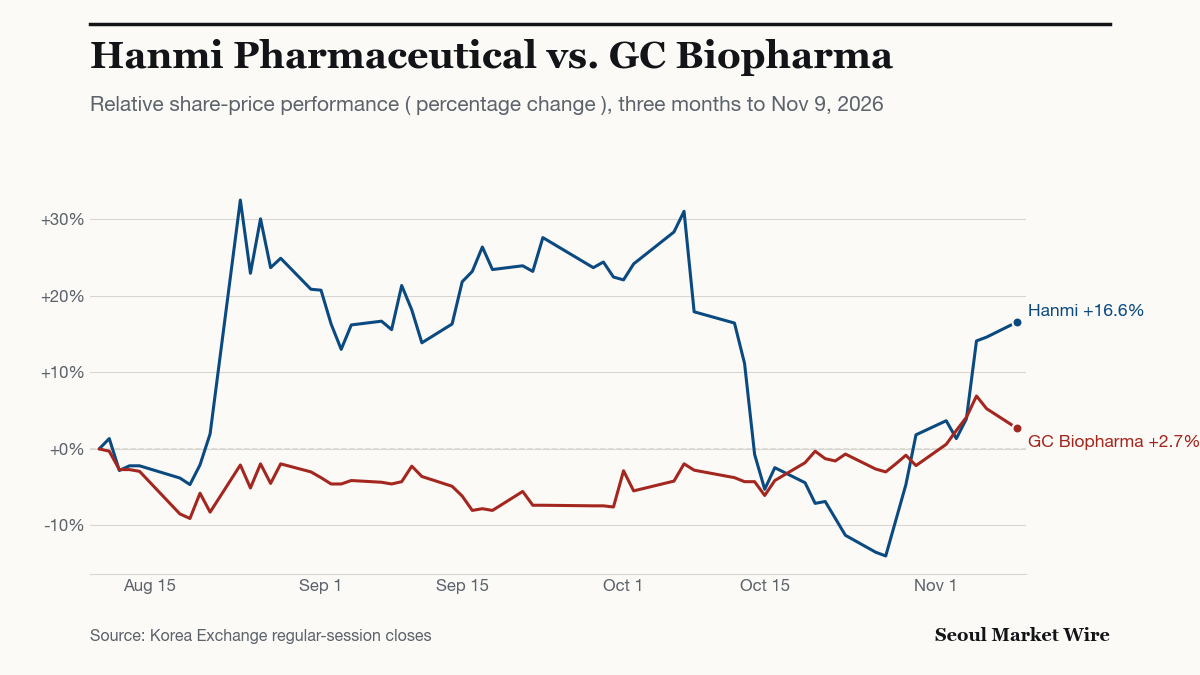
Market data: Korea Exchange regular-session close & Hana Bank USD/KRW reference rate, 2026-11-09 (KST)
Kyobo Securities raised its valuation of Hanmi Pharmaceutical’s efinopegdutide to 1.5 trillion won in its Nov. 6 assessment, from 1.4 trillion won in its Oct. 30 report. The brokerage expects the Phase 2b results to support advancement into Phase 3.
Both Kyobo and SK Securities argued for a sector rebound. SK’s Nov. 6 report, posted on Naver on Nov. 9, emphasized successful direct entry into global markets as a condition for sustained growth, while Kyobo highlighted clinical and commercial catalysts.
Efinopegdutide, licensed to MSD, targets GLP-1 and glucagon receptors. It is being developed for metabolic dysfunction-associated steatohepatitis (MASH), an inflammatory liver disease that can cause fibrosis, or scarring.
What did the trial establish?
The study enrolled 381 adults with biopsy-confirmed MASH and F2–F3 fibrosis. Participants were randomly assigned to once-weekly subcutaneous efinopegdutide, targeting 4 mg, 7 mg or 10 mg, placebo, or open-label semaglutide targeting 2.4 mg.
The endpoints used different modified intention-to-treat populations after baseline biopsies were reread. The MASH analysis required a baseline NAFLD activity score (NAS) of at least 3 on rereading, with every component scoring above zero; the fibrosis analysis required stages F1–F4. These were separate analysis populations, rather than all 381 participants. Missing end-of-treatment biopsies counted as nonresponses.
At 52 weeks, MASH resolution without worsening fibrosis reached 63% with 7 mg, versus 13% with placebo and 53% with semaglutide. The key secondary endpoint, at least a one-stage fibrosis improvement without worsening steatohepatitis, reached 52%, versus 21% and 25%, respectively. Both 7 mg results were statistically significant against placebo. The 10 mg group did not show a statistically significant benefit over placebo on the fibrosis endpoint.
Adverse-event-related discontinuation rates were 3–4% in the lower-dose efinopegdutide groups, versus 11% at 10 mg. Gastrointestinal events were most frequent at the highest dose.
Response rates with 7 mg were numerically higher than in the open-label semaglutide arm; the official abstract did not establish superiority. Kyobo identified 7 mg as the best balance of efficacy and tolerability.
The brokerage also stressed timely entry into late-stage trials. Competition includes survodutide, whose Phase 3 MASH program began in 2024.
What supports the recovery case?
Recent commercial results and licensing activity underpinned Kyobo’s Oct. 30 view that the sector was passing its low point.
One commercial indicator was Keytruda Qlex, the subcutaneous formulation using Alteogen’s technology. MSD reported third-quarter sales of $830 million and nine-month sales of $1.42 billion in its earnings release.
Another was BioMarin’s agreement with Hanmi and GC Biopharma for HM15421/GC1134A, a long-acting enzyme replacement therapy designed for subcutaneous treatment of Fabry disease. The candidate is in Phase 1/2 development. The official agreement announcement specifies a $70 million upfront payment and up to $405 million in development and commercial milestones, plus tiered royalties. The milestone payments are conditional.
Demand for obesity treatments also featured in Kyobo’s recovery case. Lilly reported third-quarter Mounjaro and Zepbound sales of about $10.7 billion and $5.4 billion, respectively, alongside total company revenue of $24.4 billion. It raised full-year revenue guidance to $91–92 billion from $85–87 billion in its results announcement.
What would distinguish a lasting rebound?
Successful direct launches abroad carry more weight than licensing announcements in SK’s analysis. Its report treats licensing as a way to finance drug development and argues that market attention has become tied to short-term deal news.
The brokerage highlighted broader participation by unlisted Korean companies and global drugmakers. It interpreted this as a sign that Korean technologies were meeting global drugmakers’ standards. Licensing activity had expanded beyond listed Korean companies and transactions with smaller Chinese and U.S. biotech firms.
In its tally of licensing activity, SK put cumulative deal value at $30 billion in 2015–2020 and $58.6 billion from 2021 through September 2026. These are the brokerage’s deal-value estimates, not verified totals of cash received.
Sources
- SK Securities — Research Signature #4: Conditions for a rebound (Nov. 6, 2026) stock.naver.com
- Kyobo Securities — AASLD 2026 abstract comment: Hanmi delivers (Nov. 6, 2026) stock.naver.com
- Kyobo Securities — Good news keeps coming for the sector (Oct. 30, 2026) stock.naver.com
- ClinicalTrials.gov — Efinopegdutide Phase 2b study NCT05877547 clinicaltrials.gov
- AASLD 2026 — Late-breaking abstract 5015, efinopegdutide Phase 2b results aasld.org
6 more sources
- Boehringer Ingelheim — Survodutide Phase 3 MASH trials (Oct. 8, 2024) boehringer-ingelheim.com
- Hanmi Pharmaceutical — BioMarin licensing agreement (Oct. 30, 2026) hanmi.co.kr
- MSD — Third-quarter 2026 financial results sec.gov
- Eli Lilly — Third-quarter 2026 financial results investor.lilly.com
- Merck — Efinopegdutide licensing agreement with Hanmi merck.com
- Alteogen — Official pipeline alteogen.com