Kiwoom points to shareholder returns as a draw for Korean bank stocks
Kiwoom identified banks' shareholder returns as a possible draw during the semiconductor sell-off. Its market-wide warning concerns earnings and valuations failing to support prices.
Market data: Korea Exchange regular-session close & Hana Bank USD/KRW reference rate, 2026-11-06 (KST)
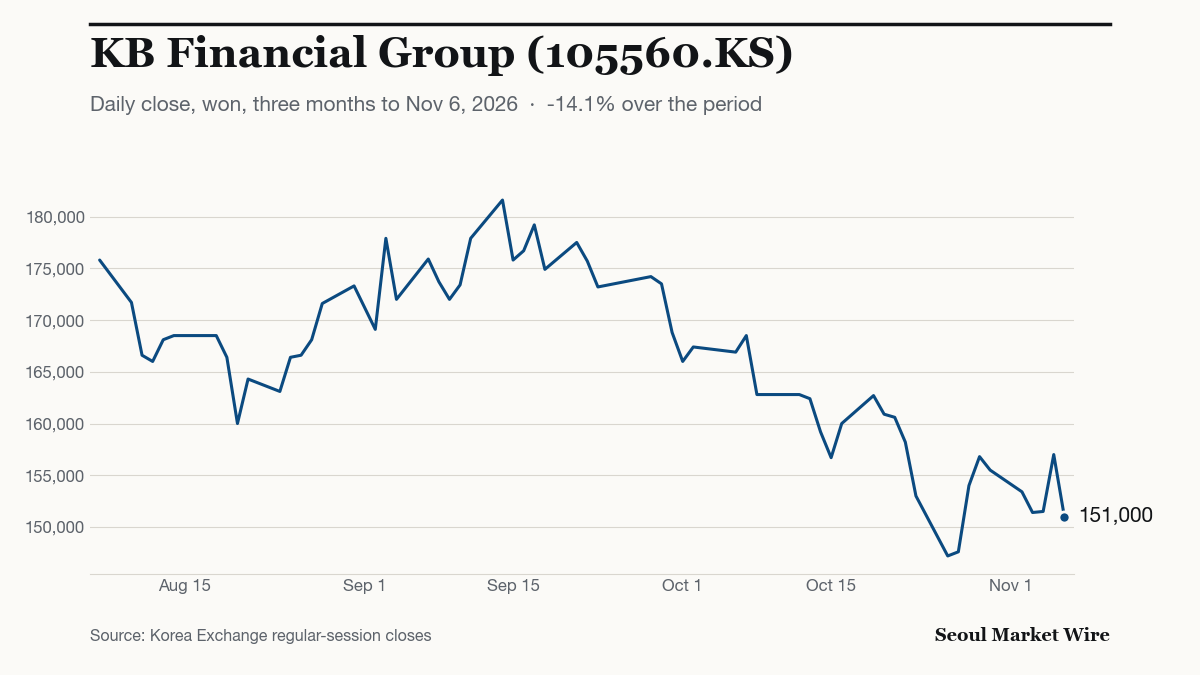
Shareholder returns could draw investors to Korean banks during the semiconductor sell-off, according to Kiwoom Securities’ Nov. 6 strategy report.
But the same report warned that earnings upgrades and very low valuations were failing to support Korean share prices, while repeated chip-stock declines weakened sentiment across the market.
Why single out banks?
The brokerage identified banks and holding companies as sectors where shareholder-return momentum remained intact. Its analysts suggested buying could spread to industries less exposed to uncertainty over U.S. artificial-intelligence policy. The report described possible buying beyond semiconductors; it did not track proceeds from chip-stock sales into banks.
Written by analyst Han Ji-young and research assistant Yoo Ji-yoon, the report linked the selling to concerns about U.S. data-centre regulation following the midterm elections. Its domestic-market review covered the Nov. 5 session, while its forecast addressed Nov. 6 trading.
The sector comparison was specific: semiconductors accounted for about 4.6 percentage points of the KOSPI’s roughly 5.3% fall on Nov. 5, with other industries contributing about 0.7 percentage point, by the analysts’ calculation. They argued that the shock need not affect all industries equally.
Banks were one of several potential destinations the report identified. Construction and transport featured because of continued foreign buying, while biotechnology featured because of easing interest-rate pressure. The bank discussion did not quantify individual lenders’ future dividends or buybacks.
What could change the semiconductor assessment?
The analysts distinguished fears about investment from confirmed changes in spending. They argued that the scope of regulation, actual project delays and a decline in AI demand had yet to be established, and that restrictions could affect 2028 projects more than those scheduled for 2027.
Their proposed checks were changes to U.S. hyperscalers’ capital-spending plans, both at home and abroad, and cuts to semiconductor companies’ 2028 earnings estimates. Those checks concern the AI investment cycle; the report did not present them as measures of banks’ payout capacity.
The KOSPI closed at 5,059.69 on Nov. 6, down 6.02% from the previous session, according to Korea Exchange figures reported by NewsPim.