Korean memory outlook splits between HBM growth and weaker demand
Kiwoom's semiconductor outlook pairs rapid HBM growth with weaker conventional-memory demand. The distinction matters for interpreting earnings forecasts after Samsung Electronics and SK hynix fell on Nov. 16.
Market data: Korea Exchange regular-session close & Hana Bank USD/KRW reference rate, 2026-11-17 (KST)
Rapid growth in high-bandwidth memory earnings sits alongside a weaker conventional-memory outlook in Kiwoom Securities’ semiconductor research. The brokerage forecasts a much larger HBM market through 2028, while expecting smartphone manufacturers to reduce memory capacity per handset in 2027 and conventional-memory prices to decline in 2028.
That split provides an earnings framework for Korea’s two major memory producers after a sharp decline in their shares. It separates the projected expansion of one business from the demand and pricing assumptions affecting the rest of their memory operations.
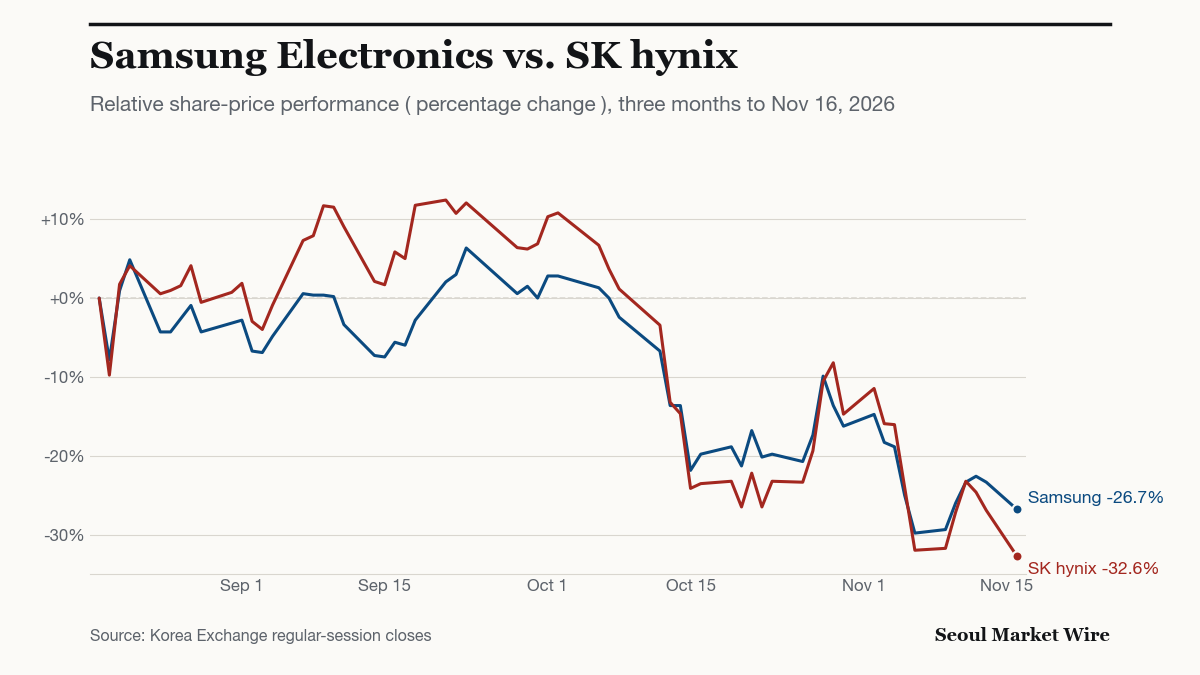
At the Nov. 16 close, Samsung Electronics fell 4.47% to 196,800 won and SK hynix lost 7.89% to 1,120,000 won. The KOSPI declined 3.59% to 5,100.50, while the KOSDAQ dropped 4.86% to 665.65.
HBM growth and conventional-memory risks
The HBM market reaches 450 trillion won in 2028 under Kiwoom’s forecast, compared with an estimated 81 trillion won in 2026. That would make the market about 5.6 times its estimated 2026 size, an increase of 369 trillion won over two years.
For Samsung Electronics and SK hynix together, the analysts project HBM operating profit rising from 39 trillion won in 2026 to 240 trillion won in 2028. Both figures are estimates for the HBM business. They exclude profits or losses elsewhere in the two companies.
The distinction also separates two different measures within the forecast. The 450 trillion won figure describes the projected HBM market, whereas 240 trillion won represents projected operating profit for the two Korean producers’ HBM operations. Neither figure is a forecast of their combined company-wide revenue.
Conventional memory follows a different path in the outlook. Higher memory costs put pressure on smartphone and PC manufacturers, creating an incentive to reduce the specifications of the devices they sell. The brokerage expects average memory capacity per smartphone to fall 2% year on year for DRAM and 1% for NAND in 2027.
Those forecasts refer to memory capacity per handset, not handset shipments or total memory sales. A reduction in capacity per device changes one component of demand; the number of devices sold is another. The per-handset estimates therefore cannot be read directly as percentage changes in the smartphone industry’s total memory purchases.
The analysts also forecast lower conventional DRAM and NAND prices in 2028. Their outlook consequently combines expanding HBM profits with pressure on another part of the memory business. Assessing the net effect on company-wide earnings requires conventional-memory volumes, prices and costs alongside the HBM projections.
What does the selling show?
The Nov. 16 share-price declines were larger than the KOSPI’s fall for both chipmakers. Samsung Electronics underperformed the index by 0.88 percentage points and SK hynix by 4.30 percentage points, calculated from the reported daily returns.
Investor flows show a difference between the two stocks. Foreign investors were net sellers of 3,105,597 Samsung Electronics shares, while institutions bought a net 852,610 shares. At SK hynix, both groups sold: foreigners disposed of a net 159,701 shares and institutions a net 694,134 shares.
The provisional data put the approximate value of foreign net selling in Samsung Electronics at 605.6 billion won, against institutional net purchases of 166.3 billion won. For SK hynix, the corresponding estimates were 178.5 billion won of foreign net selling and 776.0 billion won of institutional net selling.
These are stock-specific flows for Nov. 16. They show institutional buying against foreign selling in Samsung Electronics, but selling by both groups in SK hynix. They do not identify whether the trades reflected HBM expectations, conventional-memory concerns or other considerations.
Where does the non-AI argument fit?
A separate question is how to assess businesses outside the direct AI supply chain. In its Nov. 16 report, Hanwha Investment & Securities examines Korea’s AI dependence and identifies consumer goods and biotechnology as alternatives to direct AI exposure.
The brokerage describes Korea’s AI-related export exposure as concentrated in memory, while Taiwan’s extends across servers and non-memory chips. Its argument concerns the composition of that exposure: different product mixes connect exporters to different parts of AI investment spending.
That is distinct from the memory earnings question. Kiwoom’s projections compare business lines within the semiconductor industry; Hanwha’s alternatives shift the analysis to other industries. A forecast for HBM profits and a proposal to examine biotechnology address different sources of earnings.
The Nov. 16 closing data also contain examples of gains outside the two chipmakers, although individual stocks cannot establish sector-wide performance. KB Financial Group rose 1.64% to 161,600 won, with institutions buying a net 35,607 shares.
Samsung Biologics gained 0.85% to 1,423,000 won. Institutions bought a net 5,264 shares, while foreign investors sold a net 307 shares.
Sources
- Kiwoom Securities — Semiconductor outlook: When spring comes stock.naver.com
- Hanwha Investment & Securities — AI dependence and non-AI (Nov. 16, 2026) stock.naver.com
- Naver Pay Securities — KOSPI index data finance.naver.com
- Naver Pay Securities — KOSDAQ index data finance.naver.com
- Naver Pay Securities — Samsung Electronics prices and investor flows finance.naver.com
3 more sources
- Naver Pay Securities — SK hynix prices and investor flows finance.naver.com
- Naver Pay Securities — KB Financial Group prices and investor flows finance.naver.com
- Naver Pay Securities — Samsung Biologics prices and investor flows finance.naver.com