KOSPI plunge triggers circuit breaker after US chip rout
Korean stocks remained sharply lower after a circuit breaker and selling curbs. US chip losses followed the midterms as investors feared delays to AI investment.
Market data: Korea Exchange intraday and session figures on 2026-11-06 (KST)
South Korea’s KOSPI fell more than 8% within minutes of Friday’s open, triggering a circuit breaker that halted trading for 20 minutes. A US chip-stock rout after the midterm elections, driven by fears of tighter data-centre regulation and delayed artificial intelligence investment, hit Korean semiconductor shares.
At 09:46 KST on Nov. 6, the KOSPI was down 393.90 points, or 7.32%, at 4,989.90. The KOSDAQ fell 40.10 points, or 5.91%, to 638.31. Both remained sharply lower despite recovering some early losses.
The KOSPI also triggered a sell-side sidecar after trading resumed, while the KOSDAQ activated its own programme-selling curb early in the session.
Trading resumes above early low
The Korea Exchange activated the KOSPI’s first-stage circuit breaker at 09:03 KST, when the index was down 8.52% at 4,924.61. The benchmark touched an early low of 4,911.91, down 8.76%, before recovering towards 5,000.
At 09:34 KST, continued futures losses triggered the KOSPI sell-side sidecar. KOSPI 200 futures were down 6.77% at 781.00 when the measure took effect. Unlike the market-wide circuit breaker, the sidecar suspends programme sell orders for five minutes.
The KOSDAQ’s sell-side sidecar was activated at 09:06 KST, with KOSDAQ 150 futures down 7.84% and the KOSDAQ 150 cash index down 8.10%. Those measures track a subset of stocks and are separate from the broader KOSDAQ benchmark.
Chipmakers lead large-cap losses
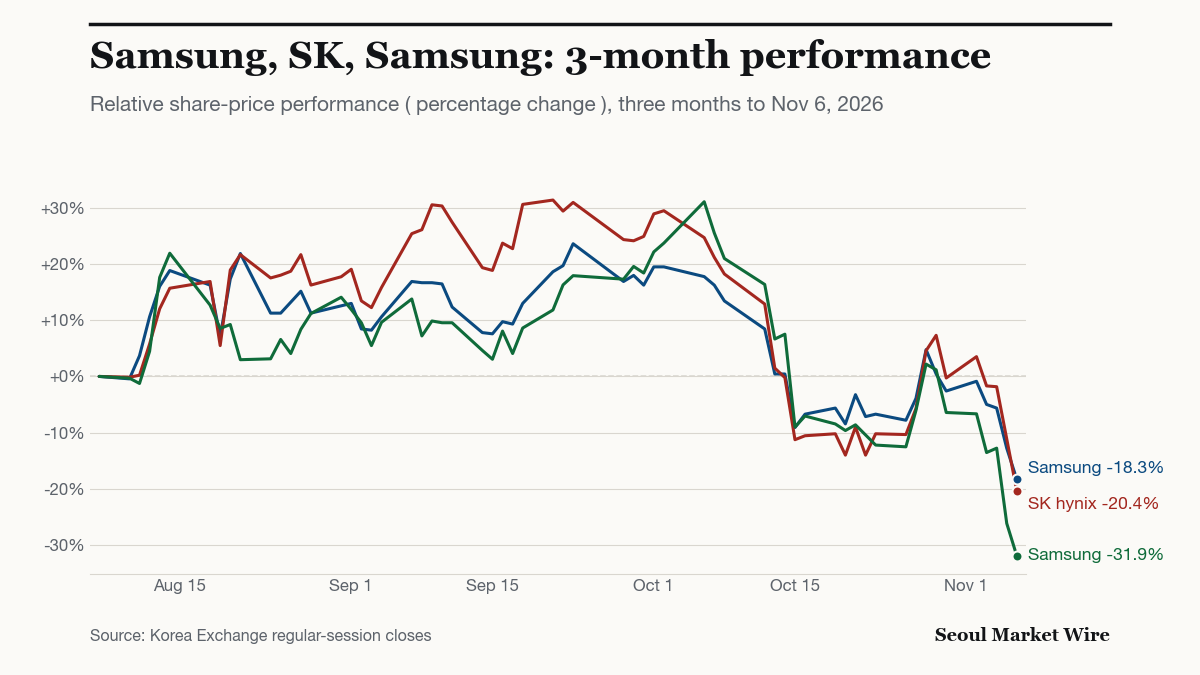
At 09:46 KST in KRX regular-session trading, Samsung Electronics fell 7.64% to 186,100 won, while SK hynix dropped 9.57% to 1,143,000 won. Both had pared steeper declines recorded shortly after the open.
The selloff extended beyond the two memory-chip producers. Samsung Electro-Mechanics slid 11.86% to 832,000 won, and Hyundai Motor lost 7.50% to 271,500 won.
LG Energy Solution fell 2.75% to 336,500 won. Samsung Biologics was comparatively steady, down 0.20% at 1,517,000 won. All six stock moves were intraday figures at 09:46 KST.
Hana Bank’s Nov. 6 USD/KRW reference rate stood at 1,356.20 won per dollar, down 0.06%. That bank reference rate is distinct from an onshore spot-market closing rate.
Second day of heavy losses
The decline followed Thursday’s 5.28% KOSPI fall to 5,383.80. The KOSDAQ had lost 5.11% to close at 678.41 on Nov. 5.
Foreign investors sold a net 3.4 trillion won of KOSPI shares on Nov. 5, according to provisional exchange data. Those flows refer to the previous session.
Friday’s KOSPI circuit breaker was the 11th this year and the first since Oct. 15. The sell-side sidecars on both markets followed similar curbs on Thursday.
The overnight US selloff included a 5.52% Nasdaq decline, and Kiwoom Securities put the fall in the Philadelphia semiconductor index at 12.3%. Nvidia fell 9.26% as investors reassessed AI infrastructure spending after the Democrats’ midterm victory.
Kiwoom distinguishes investment fears from confirmed cuts
Kiwoom Securities’ Nov. 6 strategy report linked the selling to concerns that tighter data-centre rules could slow the AI investment cycle. It said the scope of regulation, actual project delays and any decline in AI demand had yet to be established.
In its separate Weekly Macro report dated Nov. 6, the brokerage judged widespread construction stoppages unlikely because data centres support local economies, tax revenue and employment. Its analysts identified the sharing of electricity and environmental costs as a central source of policy uncertainty.
The Korean stock and index figures are intraday levels at 09:46 KST. Seoul Market Wire will follow this story with its closing report.
Sources
- News1 — KOSPI circuit breaker followed by sell-side sidecar, Nov. 6, 2026 n.news.naver.com
- Kiwoom Securities — Strategy report (Korean; Nov. 6, 2026) stock.naver.com
- Kiwoom Securities — Weekly Macro report (Korean; Nov. 6, 2026) stock.naver.com