KOSPI drops 11.7% on the week as foreign investors dump chipmakers
The KOSPI lost 11.71% in the week ended Nov. 6. Brokerages cited AI policy and financing risks, while Kiwoom linked Thursday's auto-share gains to tariff relief hopes.
Market data: Korea Exchange regular-session close & Hana Bank USD/KRW reference rate, 2026-11-06 (KST)
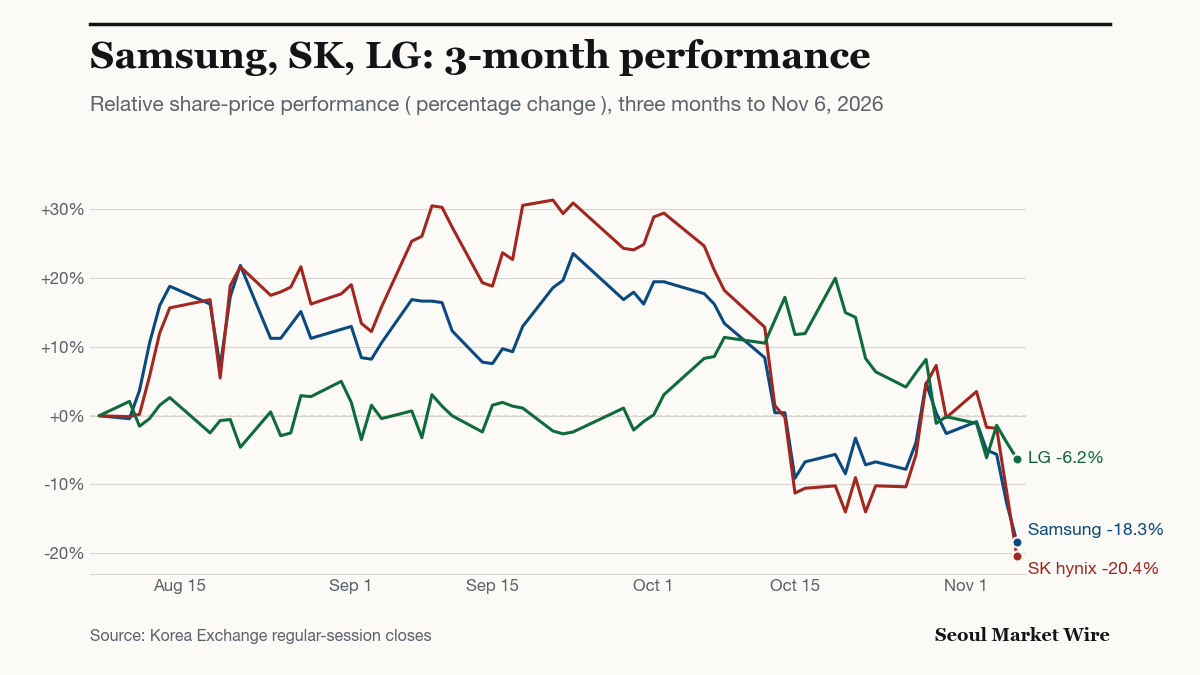
The KOSPI fell 11.71% to 5,059.69 in the week ended Nov. 6 as chip shares slumped. Korean brokerages cited concerns about potential US data-centre restrictions and AI financing as factors behind the sell-off.
The benchmark had closed at 5,730.74 on Oct. 30. The KOSDAQ fell 11.06% over the same period, from 724.38 to 644.27. Weekly returns below compare Oct. 30 and Nov. 6 regular-session closes.
How far did chip shares fall?
Over the week, SK hynix lost 20.17%, closing at 1,132,000 won against 1,418,000 won the previous Friday. Samsung Electronics common shares fell 16.13%, to 188,700 won from 225,000 won.
Among other large stocks, LG Energy Solution declined 6.12%, ending at 337,500 won from 359,500 won.
The KOSPI closed at 5,859.08 on Nov. 2, then fell to 5,648.79 on Nov. 3. It recovered to 5,683.80 on Nov. 4 before falling 5.28% to 5,383.80 on Nov. 5 and another 6.02% to 5,059.69 on Nov. 6.
What risks did brokers identify?
Potential restrictions on data centres were a focus of Kiwoom Securities’ Nov. 6 strategy report. It linked the Nov. 5 US semiconductor sell-off partly to fears that tighter rules would slow AI investment. Its analysts cautioned that the scope of restrictions, actual project delays and any decline in AI demand had not been confirmed.
AI financing was a separate concern in Daishin Securities’ report, dated Nov. 3. Plans for bond issues by large US technology companies had renewed concerns about financing AI infrastructure, the brokerage argued. Higher memory prices supported earnings expectations for Samsung Electronics and SK hynix, but financing worries limited how far those expectations could lift Korean equities. Our chip-sector research recap covers the policy and financing arguments.
Why did automakers rally on Thursday?
Hopes of weaker US tariff pressure supported auto shares on Nov. 5, according to Kiwoom’s Nov. 6 Morning Letter. Hyundai Motor rose 3.53% that day, then lost 4.77% on Friday, ending the week down 0.89% at 279,500 won against 282,000 won on Oct. 30.
Kia rose 5.22% on Thursday, then fell 0.50% on Friday to 100,300 won.
Tariff relief was not assured. In its Nov. 5 Global Markets Monitor, IBK Securities expected the administration’s tariff stance to continue, citing Section 232 of the Trade Expansion Act of 1962 and Section 301 of the Trade Act of 1974. Our automaker research recap explains that distinction.
Who were Friday’s net buyers?
Naver Pay Securities’ Nov. 6 investor-flow snapshot showed net foreign selling on the KOSPI, while institutions and individuals were net buyers. These figures cover Friday alone, not the full week.
On the KOSDAQ, foreigners and individuals were net sellers, while institutions were net buyers.
Sources
- Kiwoom Securities — AI Panic Selling Driven by Fears of a Shrinking Investment Cycle (Han Ji-young, Yoo Ji-yoon); Nov. 6, 2026, p. 1 stock.naver.com
- Daishin Securities — AI 자금조달 우려 재점화, 미 중간선거를 앞둔 경계심리까지; 이경민, 안범수; dated Nov. 3, 2026, p. 1 stock.naver.com
- Kiwoom Securities — 11/06, Kiwoom Morning Letter, Nov. 6, 2026, pp. 1–2 stock.naver.com
- IBK Securities — Global Markets Monitor: Blue Wave Implications (Kim Ye-seul); Nov. 5, 2026, p. 1 stock.naver.com