iM flags AI financing risks after Huang's Nvidia exit
iM Securities sees limited risk to Nvidia's earnings after Jensen Huang's resignation, but questions whether GPU-backed financing for specialist AI cloud providers will continue without disruption.

Market data: Korea Exchange regular-session close & Hana Bank USD/KRW reference rate, 2026-11-16 (KST)
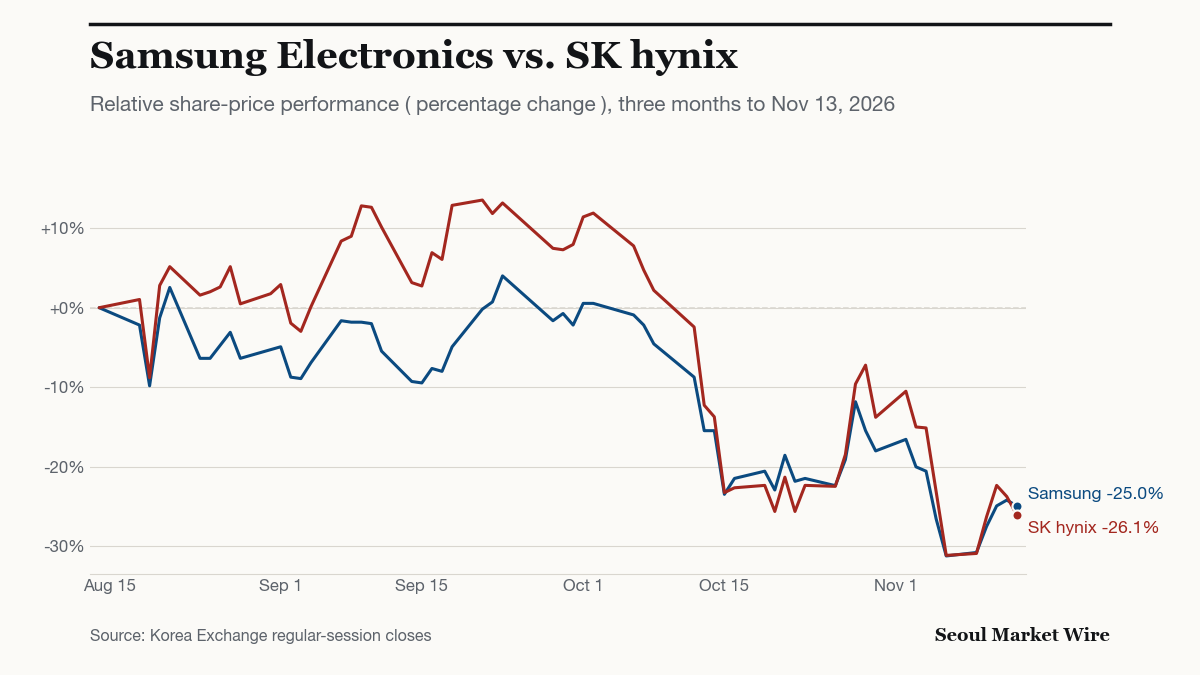
The risk to Nvidia’s earnings from Jensen Huang’s Nov. 12 resignation as CEO is limited, in iM Securities’ assessment, but the brokerage questions whether the financing supporting AI investment will remain available. Its Nov. 16 brief puts the risk of a repeat of the dot-com collapse at very low while identifying uncertainty over Nvidia-centred funding arrangements.
For holders of Samsung Electronics and SK hynix, the concern is how financing constraints could affect spending on computing infrastructure. The report focuses on payment guarantees and other funding plans involving Nvidia GPUs as collateral for neo-cloud operators, specialist providers of AI computing capacity. If financing becomes harder to obtain, these providers could delay infrastructure spending.
The debate comes after the KOSPI fell 3.59% to 5,100.50 on Nov. 16. The market decline provides context for the report’s warning, but does not identify which concerns drove selling.
Why does financing matter separately from earnings?
The report first compares Nvidia’s share-price performance since 2020 with Cisco Systems’ performance from 1995. The brokerage sees similarities in the price patterns but considers a repeat of the dot-com collapse unlikely. Its relatively benign earnings assessment rests on Nvidia’s operations remaining sound, even if management becomes more cautious after Huang’s resignation.
The concern is whether funding arrangements supporting customers’ expansion remain available. The report questions the continuity of GPU-backed borrowing and related guarantees, without documenting disrupted contracts or establishing that individual agreements depend on Huang’s leadership.
Demand and financing require separate evidence. Orders can support a supplier’s revenue outlook while leaving open how customers will pay for equipment and computing infrastructure. Disclosed delays, reductions or repricing of funding commitments would provide more concrete evidence of financing pressure.
What do CoreWeave’s results establish?
CoreWeave’s Nov. 10 earnings release provides a company-level example of that distinction. Third-quarter revenue was $3.661 billion, with non-GAAP adjusted operating income of $379 million. Revenue backlog reached $132.5 billion at Sept. 30, and annual revenue guidance stood at $13.0 billion to $13.3 billion.
The same release reported a $709 million net loss and $846 million in net interest expense. Annual capital-expenditure guidance was $37 billion to $39 billion, with the lower end raised from $35 billion. Those figures show substantial investment plans alongside financing costs, even as the company reports positive adjusted operating income.
A capex-to-revenue ratio measures investment intensity. It cannot establish the proportion financed externally: revenue differs from operating cash flow, and capital expenditure recognised in a period need not equal cash paid during that period.
The company identifies operating cash flow, customer prepayments and contract-backed financing among its funding sources. Assessing dependence on new borrowing requires examining the timing of those funds against cash payments and debt obligations.
Revenue backlog reflects amounts the company expects to recognise under committed contracts, subject to delivery and service-availability requirements. It gives a measure of contracted business, while cash-flow disclosures show when funds become available to meet spending and debt payments.
Which indicators distinguish demand from funding stress?
The reports suggest three areas to monitor: business continuity, credit pricing and Korean semiconductor exports.
Business continuity can be assessed through Nvidia’s earnings disclosures and changes to customers’ funding or investment plans. Sales and guidance provide evidence about demand; financing commitments and their terms show how customers intend to fund expansion. Strong sales alone leave the latter question open.
Credit pricing provides a separate measure of lenders’ assessment of risk. The iM brief reported that credit default swap spreads for major hyperscalers had remained stable or narrowed following the Nvidia news, supporting its assessment of limited immediate credit stress among those companies. Specialist cloud operators require separate scrutiny because stable credit pricing for large technology groups does not guarantee equivalent funding conditions for smaller borrowers.
Korean semiconductor export performance measures whether shipments continue to support the industry’s growth. The brokerage argues that sustained export momentum and sound Nvidia operations could help share prices diverge from the historical comparison. That assessment depends on business activity holding up through the management transition.
How could interest rates add pressure?
Persistently high rates would add to financing pressure. Even with lower policy rates, borrowers could face higher costs if lenders demanded wider credit spreads, reduced commitments or required stronger guarantees. These mechanisms explain how funding conditions can change independently of the Fed’s direction.
The iM analysis regards a December Fed rate increase as highly likely and places weight on whether further increases follow in 2027. This remains the brokerage’s forecast; the Fed has not announced that decision. For individual AI borrowers, the relevant evidence is the cost and availability of their own financing.
How does the won change the return?
The report’s second section examines Korea’s equity-market underperformance against Japan and Taiwan in the second half of 2026 through Nov. 13. Its analysts link that weakness partly to won appreciation and heavier foreign selling, suggesting that the stronger currency may have encouraged profit-taking and weighed on corporate earnings.
Currency translation works differently for shareholders. For unhedged dollar-based investors, won appreciation can cushion losses on Korean shares because each won of holdings converts into more dollars. Won depreciation can deepen those losses.
Foreign selling alone determines neither currency outcome. A stronger won’s possible effect on exporters’ earnings and its translation benefit for dollar investors are distinct channels, with potentially opposing effects on returns.
Scheduled releases
The advance estimate of US October retail sales is scheduled for 22:30 KST on Nov. 17, equivalent to 08:30 US Eastern Standard Time, according to the Census Bureau’s release calendar.
Nvidia’s third-quarter fiscal 2027 results are scheduled for approximately 06:20 KST on Nov. 18, equivalent to 13:20 Pacific Standard Time on Nov. 17. The company’s earnings call follows at 07:00 KST.
The Federal Reserve’s next scheduled policy meeting is Dec. 8–9, 2026.
Sources
- iM Securities — Two uncomfortable charts: Nvidia and the KOSPI (Nov. 16, 2026) stock.naver.com
- iM Securities — Report text and charts imfnsec.tistory.com
- NVIDIA — CEO transition and earnings announcement schedule nvidianews.nvidia.com
- CoreWeave — Third-quarter 2026 results investors.coreweave.com
- Naver Pay Securities — KOSPI index finance.naver.com
2 more sources
- Federal Reserve — FOMC meeting calendars federalreserve.gov
- US Census Bureau — Retail sales release schedule census.gov