Kiwoom expects brief Nvidia fallout, warns oil and yields may cap KOSPI gains
Kiwoom Securities expects Jensen Huang's resignation to cause mainly short-term volatility for Korean chipmakers. Its assessment depends on existing production and supply plans, while oil and US Treasury yields remain risks.

Market data: Korea Exchange regular-session close & Hana Bank USD/KRW reference rate, 2026-11-13 (KST)
Kiwoom Securities expects Jensen Huang’s resignation to cause mainly short-term volatility for Korean chipmakers, with limited risk of a broader slowdown in AI demand.
But its Nov. 13 strategy report warned that higher oil prices and US Treasury yields could limit Korean stocks’ gains, even if the leadership shock proves brief.
The KOSPI closed Nov. 13 down 0.98% at 5,290.53.
What moved US markets on Nov. 12
Nvidia fell more than 14% early in the session before closing down 4.3%, according to the strategy report’s market review. AMD rose 5.9% and Broadcom gained 5.5%. The analysts read the divergence as a reassessment of Nvidia’s dominance rather than evidence of weaker AI spending across the industry.
Higher yields complicated that assessment. The report’s market table, timestamped 6:30 a.m. KST on Nov. 13, recorded the US 10-year Treasury yield at 5.123%, up 13.1 basis points on the day. In a currency report published the same day, Kiwoom linked the dollar’s rise to oil and yield increases driven by Middle East tensions, as well as safe-haven demand during the technology-stock sell-off.
What supports the expectation of brief fallout
Existing production plans and customer agreements formed the basis of the brokerage’s assessment. It judged that Nvidia’s Vera Rubin production schedule and major customer supply agreements were largely settled, leaving limited risk of disruption to those plans over the next one to two years.
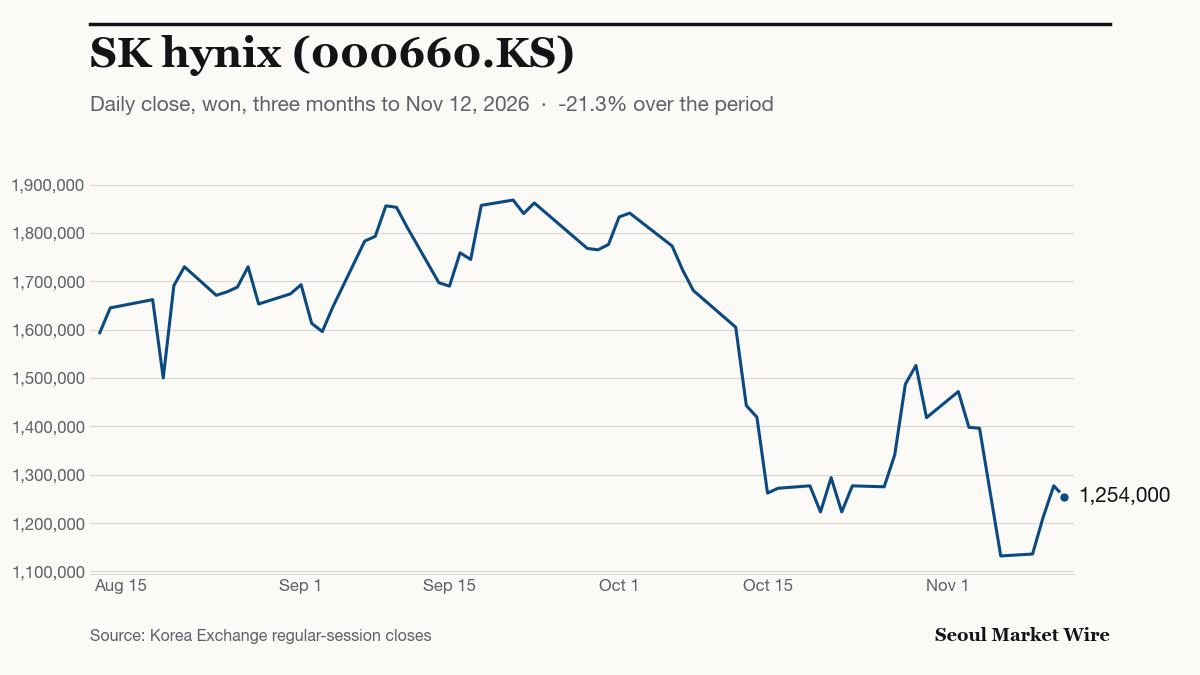
That did not rule out changes affecting individual suppliers. The report identified SK hynix as exposed to temporary selling pressure and warned that new management could adjust supplier allocations or joint-development schedules.
Nvidia announced Huang’s immediate resignation on Nov. 12, appointing chief financial officer Colette Kress interim CEO while it searches for a permanent successor. The appointment was one reason Kiwoom saw less risk of a prolonged management gap, rather than proof that the transition’s market impact had ended.
Succession delays remained a caveat. The analysts cited Intel’s experience after Brian Krzanich resigned in June 2018. Intel named Bob Swan permanent CEO on Jan. 31, 2019, after seven months in the interim role.
Export rules present a separate issue. The US Bureau of Industry and Security has extended through Jan. 10, 2027, the suspension of a rule expanding certain end-user controls to affiliates of listed entities. That date concerns the rule’s suspension, rather than the US-China trade truce as a whole.
Why oil and yields remain risks
US core CPI rose a seasonally adjusted 0.3% month on month in October, matching August and September, according to the Bureau of Labor Statistics’ Nov. 10 release.
Monthly core CPI growth would need to slow to around 0.2% before the hiking cycle could end, Eugene Investment & Securities argued in its Nov. 11 report. A CME FedWatch snapshot reproduced there assigned an 88.5% probability to a 25-basis-point December hike and 11.5% to a 50-basis-point increase. Those figures reflected market pricing, not a Fed commitment; the report did not specify an intraday observation time.
A larger December move was also considered unlikely in Daishin Securities’ Nov. 11 assessment, partly because oil prices had fallen after the US midterm elections. Its analysts nevertheless saw greater risk of further tightening in early 2027 and warned that November US core CPI could reach 2.9% year on year.
Slower consumption offered a possible restraint on yields. The Nov. 13 Weekly Macro report expected US October retail-sales growth to slow from September. It also warned that hawkish Fed comments and the forthcoming minutes of the Oct. 27–28 FOMC meeting could limit a decline in yields.
The Fed held its target range at 3.75–4.00% on Oct. 28. Those meeting minutes remained unpublished as of Nov. 13; the central bank releases regular-meeting minutes three weeks after the policy decision.
Sources
- Kiwoom Securities — 젠슨 황 해임으로 불확실성은 진정됐으나, 유가와 금리 부담은 공존 (한지영, 유지윤; Nov. 13, 2026; pp. 1–3) stock.naver.com
- Kiwoom Securities — 소비 둔화와 연준 긴축 경계감의 공존, Weekly Macro (김유미, 김정현; Nov. 13, 2026; p. 1) stock.naver.com
- Kiwoom Securities — 달러, 긴축 경계에 상승 (김유미, 안예하, 심수빈; Nov. 13, 2026; p. 1) stock.naver.com
- Eugene Investment & Securities — 10월 물가: 근원 +0.3%, 12월 인상 확률 100% (방인성; Nov. 11, 2026; p. 1) stock.naver.com
- Daishin Securities — 미국 CPI: 뒤늦은 전쟁의 대가 (이정훈; Nov. 11, 2026; p. 1) stock.naver.com
7 more sources
- Nvidia — Nov. 12, 2026: CEO transition investor.nvidia.com
- Intel — Brian Krzanich resigns; Bob Swan appointed interim CEO intc.com
- Intel — Jan. 31, 2019: Robert Swan named CEO intc.com
- BIS — Extension of suspension of end-user controls for affiliates of listed entities public-inspection.federalregister.gov
- Federal Reserve — Oct. 28, 2026 FOMC statement federalreserve.gov
- Federal Reserve — FOMC meeting calendar and minutes release policy federalreserve.gov
- Bureau of Labor Statistics — October 2026 CPI, Nov. 10 archived release bls.gov