Shinhan model puts chip excess-profit duration near two years
The brokerage forecasts KOSPI operating-profit growth slowing to 9.5% in 2028. It identifies financing conditions as a key constraint on the AI investment cycle.

Market data: Korea Exchange regular-session close & Hana Bank USD/KRW reference rate, 2026-11-09 (KST)
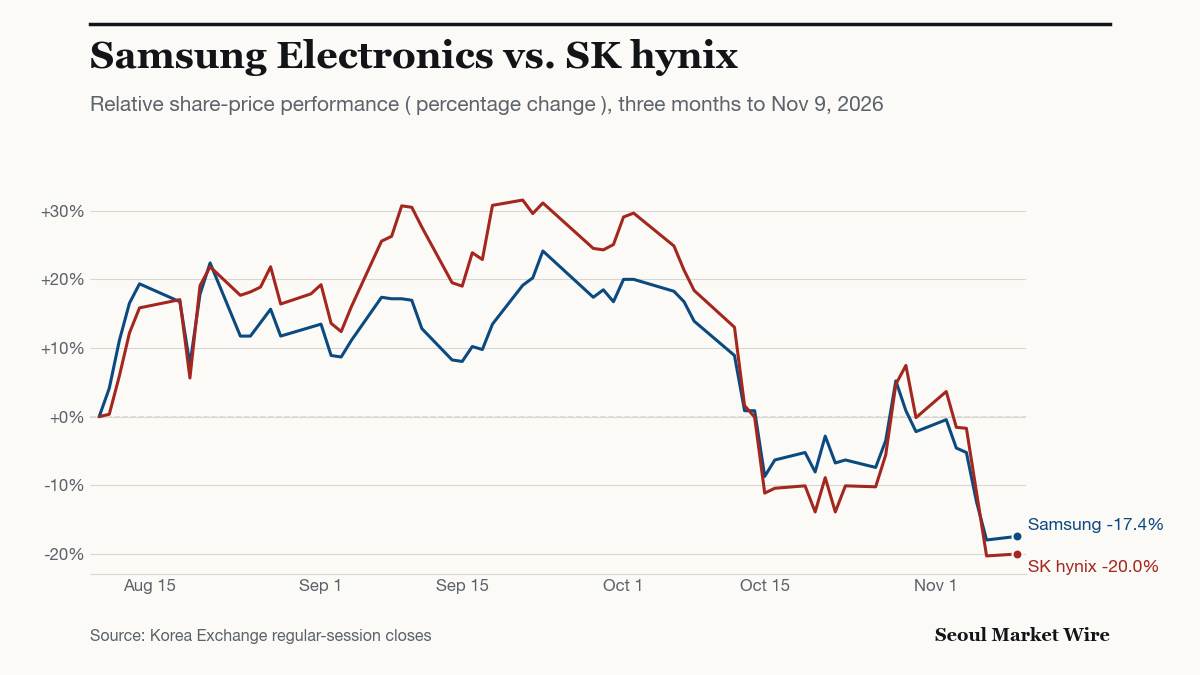
An October valuation snapshot implies about two years of excess profit for Samsung Electronics and SK hynix combined, down from nearly ten years at the June peak, according to Shinhan Securities’ Korean equity outlook dated Nov. 6.
Its strategists interpret the decline as a reduction in how long investors expect high returns to last: chip shares fell in the second half of 2026 even as earnings forecasts improved.
At the Nov. 9 KST regular-session close, the KOSPI fell 0.81% to 5,018.85. Samsung Electronics rose 0.64% to 189,900 won, while SK hynix gained 0.35% to 1,136,000 won. Those closes are separate from the October inputs used in the valuation model.
What does the valuation model imply?
The model combines the two companies’ market values, including Samsung preferred shares and excluding treasury shares. It compares a combined market value of about 2,222 trillion won with forecast end-2026 book equity of about 1,100 trillion won, using a 10% annual capital charge.
Here, excess profit is net income minus a charge equal to 10% of book equity at the start of each year. The analysts discount those future excess profits to present value, then calculate how many years are needed to account for the market-value premium above forecast book equity.
In the October snapshot, that premium is matched by the discounted excess profit forecast for FY2027 and 89% of FY2028’s. Under these assumptions, the model assigns no excess-profit premium to FY2029 onward.
For the June comparison, the model takes forecast FY2027 and FY2028 excess profit in sequence and holds it at the FY2028 level from FY2029 onward. On that basis, the June peak implied an excess-profit duration of about 9.6 years.
The strategy team separately estimates the KOSPI’s 2027 shareholder yield, defined as dividend yield plus net buyback yield, at 4.1%. It compares that forecast with recent actual yields of 3.2% in Japan and 2.4% in the United States.
How long does the earnings run last?
For 2027, the quant team forecasts KOSPI operating profit of 1,338 trillion won, up 38.2% from its 2026 estimate and led by semiconductors. Growth would slow to 9.5% in 2028, taking operating profit to about 1,465 trillion won.
In 2028, non-chip operating-profit growth is forecast at 11.2%, compared with 9.0% for semiconductors. The analysts also see weakening momentum for further upward earnings revisions.
Why do funding conditions matter?
The economists put major hyperscalers’ combined capital expenditure at about $1.07 trillion in 2027, based on guidance and consensus estimates. Year-on-year growth would slow from 109% in the fourth quarter of 2026 to 20% a year later. The annual increase would shrink from about $400 billion in 2026 to about $290 billion in 2027: spending would still rise, but at a slower pace.
In their view, external borrowing will remain necessary until investment returns cover spending, making funding conditions central to the cycle’s duration. They warn that delayed returns on AI investment, combined with weaker lending capacity, could transmit credit risk to sectors outside AI.
A separate weekly economics report argues that the Democrats’ congressional election victories could increase data-centre permitting delays and power-related costs. Its authors expect those constraints to slow investment execution rather than reverse its direction.
For Microsoft, Meta, Amazon, Alphabet and Oracle, the overseas equities team forecasts a combined free-cash-flow trough in 2027. Its analysts warn that a later or deeper trough could require more borrowing than markets can absorb. Stress could then spread through weak links in the AI investment network into credit markets.
The team’s separate calendar-year GAAP capital-spending consensus for those five companies is about $1.14 trillion in 2027, up 42%. This measure is distinct from the economists’ hyperscaler estimate.
Related coverage: chip-share valuation debate, SK hynix target-price differences and Shinhan’s won outlook.
Sources
- Shinhan Securities — 2027 Korean equity strategy: How long excess profits last (Nov. 6, 2026) stock.naver.com
- Shinhan Securities — 2027 quant/ETF outlook: The next wave of earnings (Nov. 6, 2026) stock.naver.com
- Shinhan Securities — 2027 economic outlook: Time of Tempering (Nov. 6, 2026) stock.naver.com
- Shinhan Securities — 2027 overseas equities outlook: AI capex is 70% of the way up; time for the test (Nov. 6, 2026) stock.naver.com
- Shinhan Securities — Shinhan Econ Check-up (Nov. 6, 2026) stock.naver.com
4 more sources
- Shinhan Securities — Official 2027 economic and financial-market outlook (Nov. 6, 2026), pp. 10, 21, 87–88, 94, 119–120 and 211 bbs2.shinhansec.com
- Naver Pay Securities — KOSPI historical closes, Nov. 9, 2026 regular session finance.naver.com
- Yahoo Finance — Samsung Electronics historical prices, Nov. 9, 2026 regular-session unadjusted close finance.yahoo.com
- Yahoo Finance — SK hynix historical prices, Nov. 9, 2026 regular-session unadjusted close finance.yahoo.com