Yuanta warns of AI export risks despite stronger-won forecast
Exporter dollar sales have supported the won, according to iM Securities. Yuanta warns that AI chip restrictions and slower investment could weaken export prices and volumes, but lower receipts do not automatically mean fewer dollars converted into won.
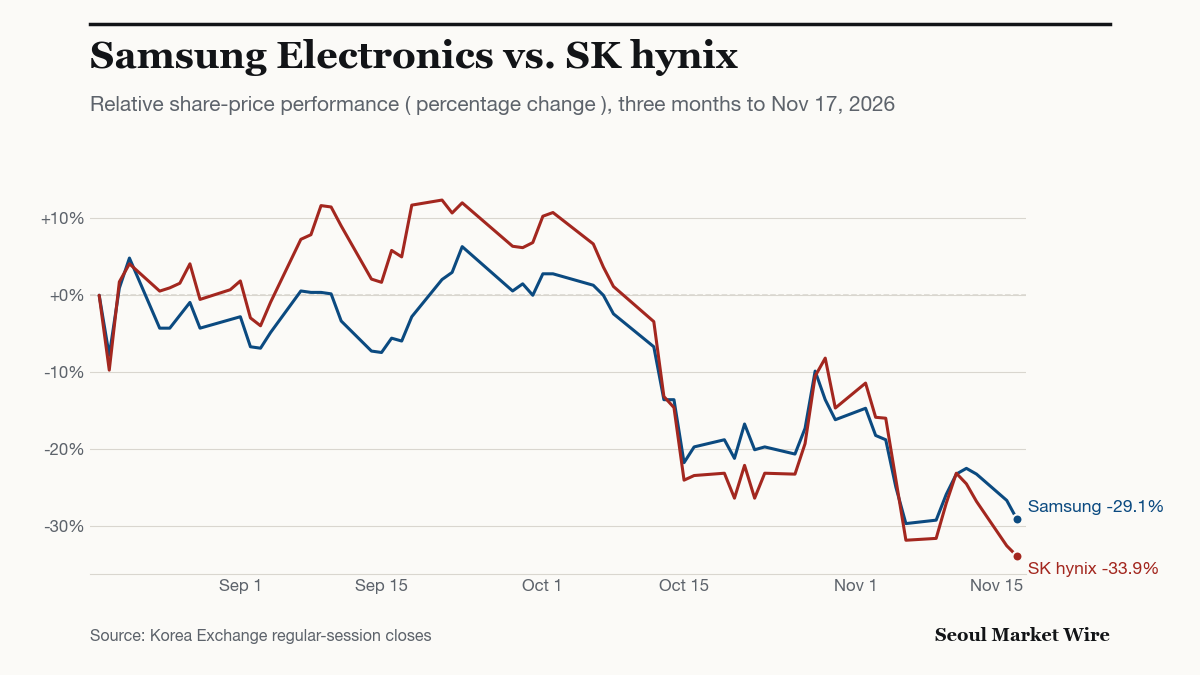
Market data: Korea Exchange regular-session close & Hana Bank USD/KRW reference rate, 2026-11-17 (KST)
Exporter dollar sales have supported the won, according to iM Securities, but the export revenue behind those sales is exposed to changes in AI demand. A decline in receipts would not automatically reduce currency support: exporters could convert a larger share of their earnings or sell dollars accumulated earlier.
The export risk is explicit in Yuanta Securities’ Nov. 16 report. Its summary warns that tighter US controls on AI chip exports to China and slower AI investment could weaken Korea’s export prices and shipment volumes simultaneously. The brokerage presents this as a risk to monitor, alongside its forecast for a stronger won. Yuanta report, p. 2
This article examines the link between that warning and currency support. The distinction is between the dollars exporters earn, the dollars they sell and the exchange rate at which the market absorbs those sales.
How export receipts become currency support
In its Nov. 16 currency report, iM Securities identified increased exporter dollar selling and strong exports during the first 10 days of November as factors supporting the won. It also described a strengthening relationship between US Treasury yields and the dollar. iM report, p. 1
Those forces can operate in opposite directions. Exporters selling dollars for won add dollar supply to the domestic market, while higher US yields can support demand for the US currency. Evidence of exporter selling therefore explains one source of support without measuring its strength against other currency flows.
Export receipts and corporate profits answer different questions. Profit reflects costs as well as sales; neither figure establishes how much foreign currency a company converts into won during a particular period. Even a rise in dollar-denominated export revenue need not produce an equivalent increase in dollar selling.
The same distinction applies when revenue falls. Lower prices or shipment volumes can reduce export receipts if gains elsewhere do not offset the loss. Whether that reduces exporters’ dollar sales also depends on how much of those receipts they convert into won and when. Sales from existing foreign-currency balances can further separate current export performance from current conversion flows.
For a given product, lower prices reduce revenue if shipment volumes are unchanged, and fewer shipments reduce revenue if prices hold steady. A simultaneous fall in prices and volumes would deepen the decline. None of these cases, by itself, determines the direction of the won.
Where AI dependence creates exposure
The product mix matters because a change in AI spending need not affect every export category equally.
In its Nov. 16 analysis, Hanwha Investment & Securities identifies memory semiconductors as the core of Korea’s AI-related exports. Taiwan’s exposure is spread across non-memory chips and computing equipment and components, including servers. The comparison concerns the composition of the two economies’ exports, rather than a claim that all semiconductor shipments serve AI applications. Hanwha report, pp. 3–5
The report defines its AI-related grouping to include memory, non-memory semiconductors and computing equipment or components associated with AI infrastructure. Its warning is that concerns about AI investment can affect both economic activity and asset markets in Korea and Taiwan.
For export receipts, the relevant mechanism is a change in orders, prices or both. Concentration in memory makes developments in that product group particularly relevant to Korea. The size of any revenue loss would still depend on the products affected and on gains or losses elsewhere in the export mix.
HBM growth and lower smartphone memory content
A different demand constraint appears in Kiwoom Securities’ semiconductor outlook, dated Nov. 16 on its cover. Higher memory costs raise device production costs and can encourage manufacturers to reduce memory specifications.
On page 5, the brokerage forecasts that smartphone memory content will decline in 2027, with DRAM content down 2% year on year and NAND content down 1%. These figures measure memory installed per device, not memory prices or smartphone shipment volumes. Total memory requirements depend on both the number of devices and the amount installed in each. Kiwoom report, p. 5
The same outlook forecasts HBM market revenue of 81 trillion won in 2026, 234 trillion won in 2027 and 450 trillion won in 2028. These are market-wide revenue estimates, rather than Korean export receipts or measures of memory capacity per smartphone. Kiwoom report, p. 23
| Brokerage report (date) | Metric cited | Reported projection / observation | Scope and currency caveat |
|---|---|---|---|
| iM Securities (Nov. 16) | Early-November FX supply | Stronger 10-day exports and exporter dollar selling | Does not measure conversion share of future receipts |
| Kiwoom Securities (Nov. 16) | 2027 smartphone memory per device | DRAM content -2% YoY; NAND content -1% YoY | Capacity per handset, not total export value |
| Kiwoom Securities (Nov. 16) | Global HBM market revenue | 81 tn won (2026), 234 tn won (2027), 450 tn won (2028) | Global market in KRW, not Korea-only USD exports |
| Yuanta Securities (Nov. 16) | End-2027 USD/KRW baseline | 1,300 won per dollar | Flags US AI chip controls and capex slowdown as downside risks |
The two forecasts cannot establish whether HBM growth will offset weaker conventional-memory demand in Korea’s exports. That calculation would require revenue estimates over matching periods, assumptions about device shipments and memory prices, and the portion attributable to Korean exports. A global market measured in won also needs a common currency basis before comparison with dollar export receipts.
What Yuanta’s warning does—and does not—assume
The policy warning is conditional. Yuanta’s discussion of AI chip export controls says licensing and enforcement rest with the US administration and that alternative demand affects the outcome. It explicitly cautions that there is insufficient basis to conclude that tighter controls will shrink Korean semiconductor exports. Yuanta report, p. 14
That qualification matters for the currency argument. Export restrictions would first have to affect relevant sales; changes in receipts would then have to translate into changes in dollar conversion. This transmission analysis is separate from the brokerage’s exchange-rate forecast, which is not a shared forecast across the reports cited here.
Yuanta’s baseline incorporates improved semiconductor-led trade conditions and Bank of Korea rate increases that preserve the policy-rate gap with the United States. It forecasts 1,300 won per dollar at the end of 2027. Yuanta report, pp. 2 and 15
What to watch next
Investors tracking whether semiconductor export momentum translates into actual dollar supply in the Seoul onshore FX market can monitor two bellwether memory exporters and upcoming trade releases:
- Samsung Electronics (
005930.KS) and SK hynix (000660.KS): Memory contract pricing and HBM shipment mix updates against smartphone DRAM/NAND content trends. - Korea Customs Service 20-day November trade data (Nov. 21, 2026 KST): Early test of whether semiconductor export growth sustains the pace recorded in the first 10 days of November.
- Bank of Korea residentes’ foreign-currency deposit data and Monetary Policy Board meeting (Nov. 26, 2026 KST): Evidence on whether exporters are converting dollar receipts into won or accumulating onshore USD deposits.
Sources
- Yuanta Securities — 경제의 판도를 움직이는 변수들: 공급 병목이 만든 가격에 보폭을 키울 필요는 없다 (Nov. 16, 2026) stock.naver.com
- Yuanta Securities — report PDF, pp. 2, 14–15 stock.pstatic.net
- Hanwha Investment & Securities — AI 의존도와 Non-AI (Nov. 16, 2026) stock.naver.com
- Hanwha Investment & Securities — report PDF, pp. 3–5 stock.pstatic.net
- iM Securities — 다시 강화된 달러와 미 국채 금리간 상관관계 (Nov. 16, 2026) stock.naver.com
3 more sources
- iM Securities — report PDF, p. 1 stock.pstatic.net
- Kiwoom Securities — 반도체 산업 전망: 봄이 오면 (Nov. 16, 2026; date on PDF cover) stock.naver.com
- Kiwoom Securities — report PDF, cover and pp. 5, 23 stock.pstatic.net