Rising US yields test support for the won from exporter dollar sales
Shinhan Securities identifies exporter dollar sales as support for the won. But iM Securities sees a renewed link between US Treasury yields and the dollar, complicating the case for continued resilience.
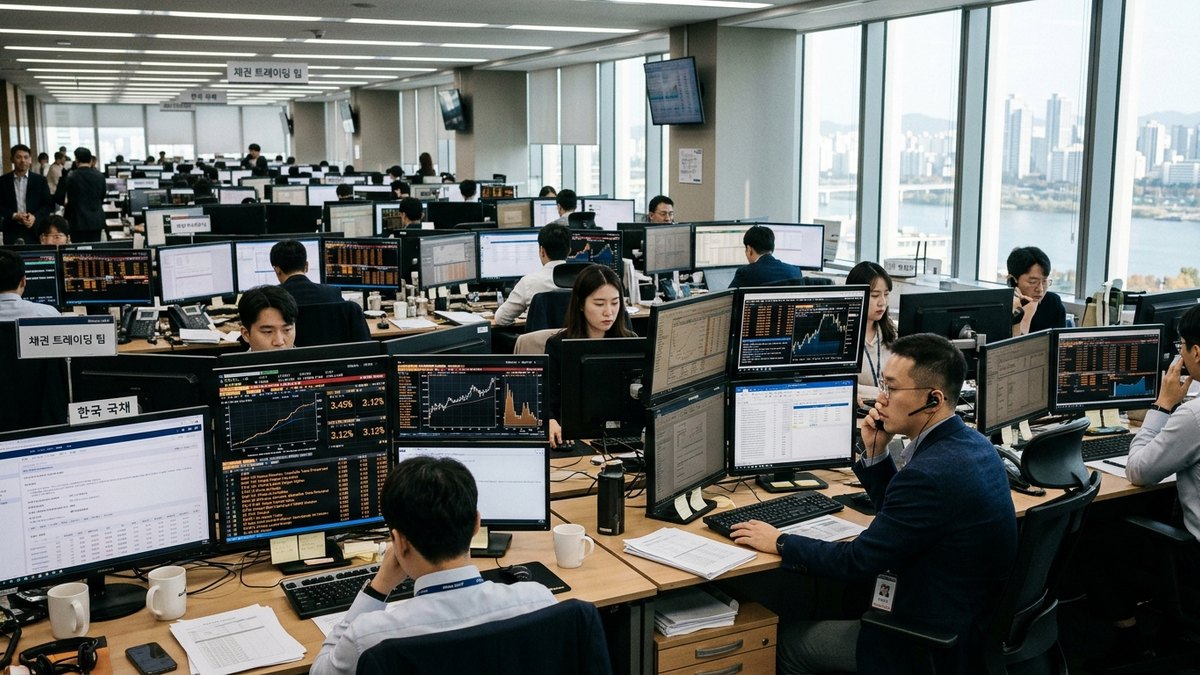
Market data: Korea Exchange regular-session close & Hana Bank USD/KRW reference rate, 2026-11-13 (KST)
Dollar sales by Korean exporters have supported the won, according to Shinhan Securities’ FX Check-up. But that support faces a competing influence: iM Securities’ Nov. 16 currency brief identifies a renewed positive relationship between US Treasury yields and the dollar.
The two assessments describe different forces acting on the exchange rate. Exporters selling dollars create demand for won; a stronger dollar can put pressure on the Korean currency. Neither assessment alone establishes how much one force can offset the other.
Can export receipts keep supporting the won?
Korea shipped $33.46 billion of goods during Nov. 1–10, up 111.9% from a year earlier, according to preliminary customs figures. Exports per working day rose 97.7%, adjusting for 7.5 working days this year against seven a year earlier. Korea Customs Service
Export receipts support the won when companies sell dollars for the currency. Shipment data do not show the timing or scale of those sales.
For exporter selling to provide continuing support, companies would need to keep converting dollar receipts into won. The customs release cannot establish whether that is happening at the same pace as shipments, or whether the resulting supply of dollars is sufficient to offset other demand. The brokerage’s assessment of currency flows and the official export figures therefore answer separate questions.
What do higher Treasury yields establish?
The risk identified by iM is that Treasury yields and the dollar are moving more closely together again. That is the brokerage’s assessment, not a relationship independently established by the yield figures cited here. iM Securities
The 10-year constant-maturity Treasury yield rose 24 basis points, from 4.86% on Nov. 6 to 5.10% on Nov. 12, according to the Federal Reserve’s Nov. 13 H.15 release. Those observations establish the rise in yields; they do not measure its effect on the dollar or the won. Federal Reserve H.15
Inflation provides context for the interest-rate discussion. US consumer prices excluding food and energy rose a seasonally adjusted 0.3% in October, matching the monthly increases in August and September. That reading measures price changes, rather than determining the Fed’s next decision. Bureau of Labor Statistics
What does this mean for holders of Korean shares?
For an unhedged investor measuring returns in dollars, a weaker won reduces the dollar value of Korean shares, all else equal. Currency movements can add to or offset the return generated by the share price itself.
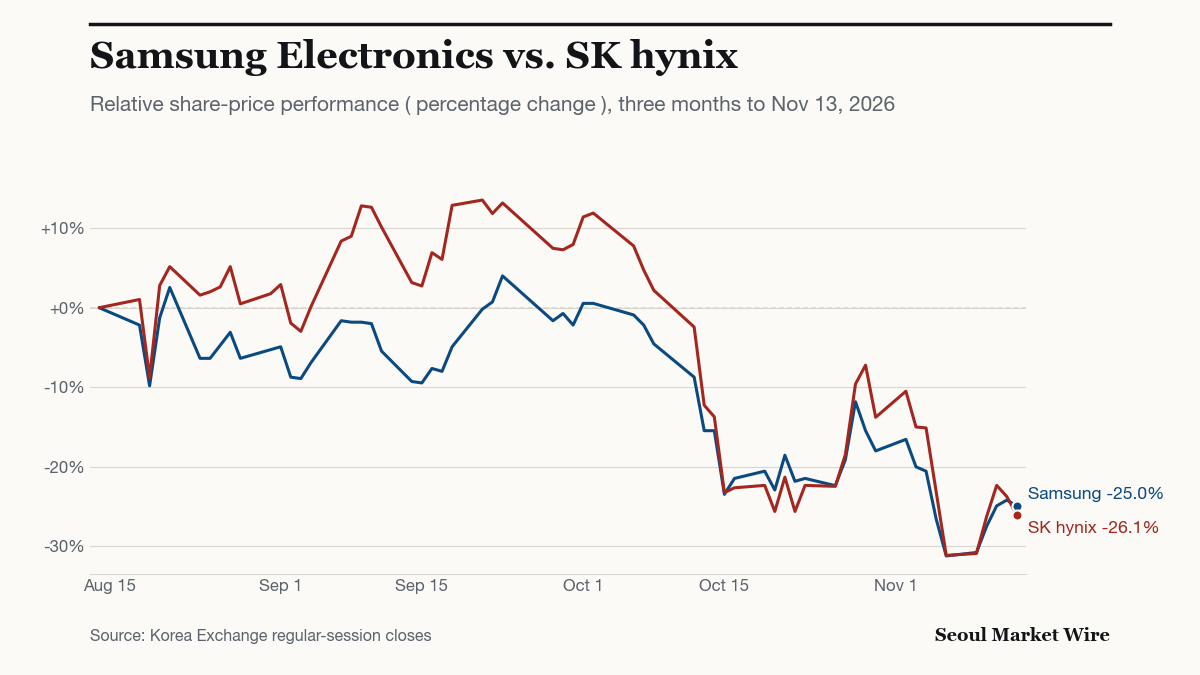
At the Nov. 13 close, the KOSPI stood at 5,290.53, down 0.98% on the day. Samsung Electronics fell 0.96% to 206,000 won, while SK hynix declined 3.03% to 1,216,000 won. These are local-currency price changes, not dollar returns, and do not by themselves establish a currency-driven cause for the declines. MTN closing report
US industrial production is scheduled for Nov. 17 at 11:15 p.m. KST. Minutes of the Fed’s Oct. 27–28 meeting are due on Nov. 19 at 4 a.m. KST. Federal Reserve calendar
Sources
- iM Securities — The dollar's correlation with US Treasury yields strengthens again (Nov. 16, 2026) stock.naver.com
- Shinhan Securities — Shinhan FX Check-up stock.naver.com
- Korea Customs Service — Preliminary exports and imports for Nov. 1–10, 2026 customs.go.kr
- Federal Reserve — H.15 Selected Interest Rates, Nov. 13, 2026 release federalreserve.gov
- Bureau of Labor Statistics — October 2026 Consumer Price Index bls.gov
2 more sources
- MTN — Korean stock market closing report, Nov. 13, 2026 news.mtn.co.kr
- Federal Reserve — November 2026 calendar federalreserve.gov