Kiwoom flags market turmoil ahead of BOK's Nov. 26 rate decision
Shinhan forecasts a quarter-point hike, while Kiwoom describes that move as the prevailing expectation. Market turbulence and uneven growth complicate the case for subsequent increases.

Market data: Korea Exchange regular-session close & Hana Bank USD/KRW reference rate, 2026-11-20 (KST)
A quarter-point Bank of Korea rate increase on Nov. 26 is the prevailing expectation described in Kiwoom Securities’ Nov. 20 Weekly Macro, while Shinhan Securities forecasts a rise to 3.25% in its preview published the same day. But equity-market turbulence complicates the policy response, and both reports leave room for caution over subsequent guidance. Kiwoom, p. 1, Shinhan, pp. 1-2.
Growth and inflation favour tightening, while market volatility could temper guidance on subsequent increases. The Weekly Macro still anticipates another increase in early 2027 and warns that stronger growth and persistent inflation could prolong the tightening stance. Its concern about market instability qualifies that forecast rather than replacing it with a call for a hold. Weekly Macro, p. 1.
What supports another increase?
The starting point is a 3.00% base rate, retained on Oct. 22. The BOK’s August forecasts put growth at 3.3% in 2026 and 2.9% in 2027. By October, the central bank expected both outcomes to be considerably higher, making the August figures a benchmark for revisions rather than its latest assessment of economic momentum. BOK October decision.
More recent institutional projections show the scale of that reassessment. KDI projects growth of 3.8% in 2026 and 3.9% in 2027. IMF staff project 3.9% and 3.3%, respectively, according to the Korean government’s Nov. 17 account of the consultation mission. KDI outlook, government account of the IMF mission.
| Metric / Series | November analyst forecasts and institutional projections | BOK: October policy rate; August growth forecasts |
|---|---|---|
| Base rate | Shinhan: 3.25% on Nov. 26; Kiwoom describes a quarter-point increase as the prevailing expectation | 3.00%, retained on Oct. 22 |
| 2026 GDP growth | KDI: 3.8%; IMF staff: 3.9% | 3.3%, August forecast |
| 2027 GDP growth | KDI: 3.9%; IMF staff: 3.3% | 2.9%, August forecast |
The inflation argument also predates the November meeting. In October, the BOK expected inflation to remain above target for a considerable period and made the timing and pace of further increases dependent on economic and financial conditions. Its statement supported further tightening without committing to a November move. BOK policy statement.
Annual growth forecasts, not realised results. Source: KDI Economic Outlook, second half of 2026.
How broadly are the growth gains spreading?
Higher aggregate growth does not mean every sector can absorb higher borrowing costs equally. In Kiwoom’s Nov. 18 Macro Snapshot, economist Kim Yu-mi described limited transmission of semiconductor gains to other industries and domestic demand. Higher household and corporate financing costs could constrain consumption and investment, the report warned. Macro Snapshot, p. 1.
The concentration is substantial in the KDI projections discussed by iM Securities economist Park Sang-hyun on Nov. 18. Semiconductor production, related equipment investment and factory construction account for roughly half of projected 2026 growth and two-thirds of projected 2027 growth in his account. Those proportions measure contributions to growth, not the industry’s share of total GDP. iM growth report, p. 1.
Private consumption is projected to grow by 1.8% in 2026 and 2.4% in 2027 in KDI’s outlook. That is an acceleration, though consumption growth remains below the projected pace of the economy in both years. KDI economic outlook.
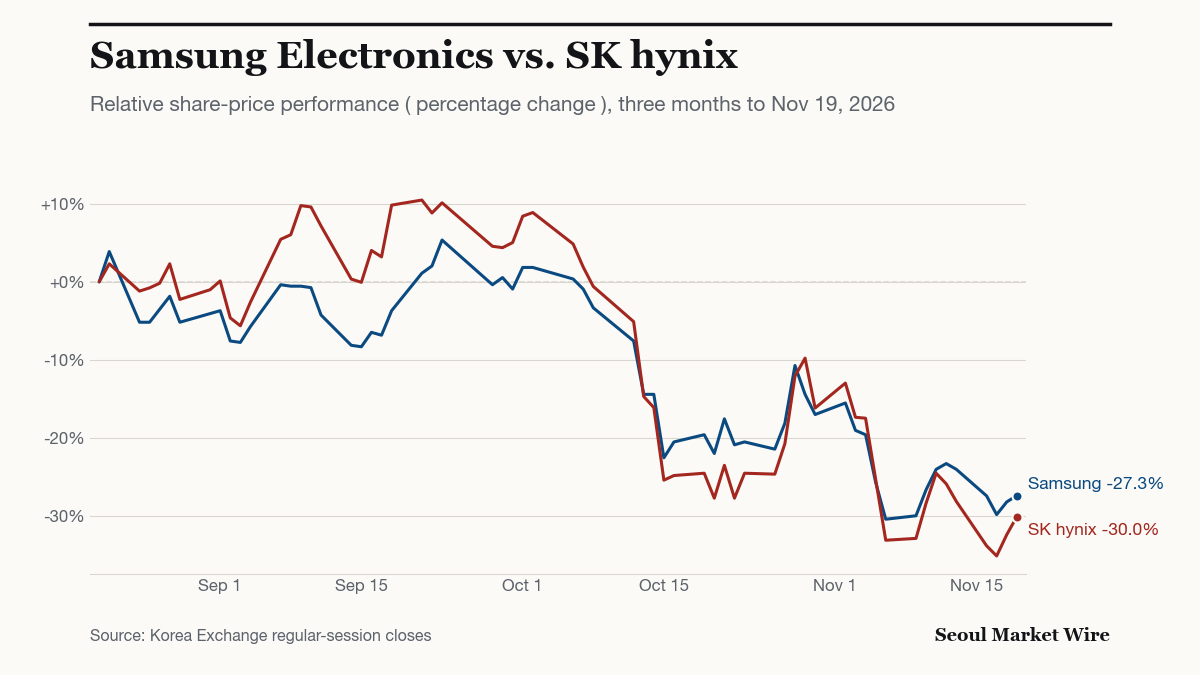
At the Nov. 19 regular-session close, the KOSPI rose 1.39% to 5,137.89. Samsung Electronics gained 1.13%, while SK hynix added 3.41%. These are previous-session closing figures, not Nov. 20 intraday prices. KOSPI closing report, Samsung and SK hynix closing report.
Could a hike come with cautious guidance?
The November meeting could weaken expectations that the rate cycle will end at 3.25% or give way to cuts in late 2027, according to Shinhan’s preview. Its analysts nevertheless expect a neutral press conference. They cite possible spillovers from falling share prices and uncertainty over demand-driven inflation as reasons the governor may avoid stronger tightening language. Shinhan preview, pp. 1 and 3.
The brokerage forecasts a unanimous quarter-point increase but does not rule out a dissent in favour of holding rates. Its reading of the October minutes identified hesitation over further tightening by one board member; subsequent growth data strengthened its case for an increase. The vote forecast therefore includes an explicit reservation about unanimity. Shinhan preview, p. 2.
An earlier assessment provides a global-market comparison. In his Nov. 18 report, Park assessed the risk of equity volatility spreading into broader financial instability as low. He pointed to stabilising US credit spreads and limited evidence of a broad flight to safety. That assessment concerned US and global markets at that date; it did not forecast the BOK’s response. iM global-market report, pp. 1-2.
For the BOK, this article draws a conditional inference: broader credit or funding stress could argue for more cautious guidance. If the selloff remains contained and growth and inflation pressures persist, the tightening case would retain more support. The severity of the decline and its transmission to financing conditions would matter alongside the direction of share prices.
Why does the guidance matter for the won?
The Nov. 18 snapshot identifies two potential supports for the won: a narrower Korea-US interest-rate gap and greater foreign-currency supply associated with strong exports. It also argues that growth upgrades and expectations of additional rate increases could limit declines in Korean market interest rates. Kiwoom snapshot, p. 1.
Less hawkish guidance than investors expect could weaken interest-rate support for the won. The differential would also depend on US rates, so a Korean increase alone would not determine its direction. Export-related currency supply provides a separate channel through which semiconductor strength could support the won.
What to watch next
The following are macroeconomic catalysts for the listed indicators and KRX shares, not company earnings dates.
| KRX ticker / Indicator | Key sensitivity | Next catalyst & date |
|---|---|---|
| USD/KRW | US inflation and growth evidence relevant to the Korea-US rate differential | Nov. 25, 2026, 22:30 KST: October Personal Income and Outlays, including PCE price indexes, and the second estimate of third-quarter US GDP. BEA calendar |
| Korean interest rates / USD/KRW | The base-rate decision and accompanying policy language | Nov. 26, 2026, KST: BOK policy-setting meeting. BOK calendar |
| Samsung Electronics — 005930.KS | Semiconductor growth assumptions and domestic financial conditions | Nov. 26, 2026, KST: BOK policy-setting meeting. BOK calendar |
| SK hynix — 000660.KS | Semiconductor growth assumptions and domestic financial conditions | Nov. 26, 2026, KST: BOK policy-setting meeting. BOK calendar |
Sources
- Kiwoom Securities — Weekly Macro (Nov. 20), p. 1: US inflation and Korea's rate meeting stock.naver.com
- Kiwoom Securities — Macro Snapshot (Nov. 18), p. 1: Korea's growth outlook raised despite AI investment worries stock.naver.com
- Shinhan Securities — November MPC preview (Nov. 20), pp. 1-3 stock.pstatic.net
- iM Securities — 3.9% growth in 2027: KDI's bold forecast (Nov. 18), p. 1 stock.naver.com
- iM Securities — Turbulent markets, but still orderly turbulence (Nov. 18), pp. 1-2 stock.naver.com
8 more sources
- iM Securities — Global financial-market assessment, original report text (Nov. 18) imfnsec.tistory.com
- Bank of Korea — Monetary Policy Decision and opening remarks, Oct. 22, 2026 bok.or.kr
- KDI — Economic Outlook, second half of 2026 kdi.re.kr
- Korean government — IMF staff's Korea growth projections, Nov. 17, 2026 korea.kr
- Newsis — KOSPI closing level and daily change, Nov. 19, 2026 newsis.com
- Newsis — Samsung Electronics and SK hynix closing changes, Nov. 19, 2026 files.newsis.com
- Bank of Korea — Monetary Policy Board meeting dates bok.or.kr
- US Bureau of Economic Analysis — Release schedule bea.gov