Yuanta finds gaps in Korea's listed AI server supply chain, points to Taiwan
Yuanta Securities says no Korean listed company specialises in eight of 23 AI server supply-chain segments. It recommends Taiwanese chip suppliers and data-centre hardware makers for 2027.

Market data: Korea Exchange regular-session close & Hana Bank USD/KRW reference rate, 2026-11-20 (KST)
Yuanta Securities identified eight AI server supply-chain segments with no Korean listed company specialising in them. In a 2027 Taiwan strategy report dated Nov. 20, the brokerage divided the AI server supply chain into 23 segments and checked each for a listed company whose main business is in that segment. By its count, Taiwan has a leading listed company in most of the 23.
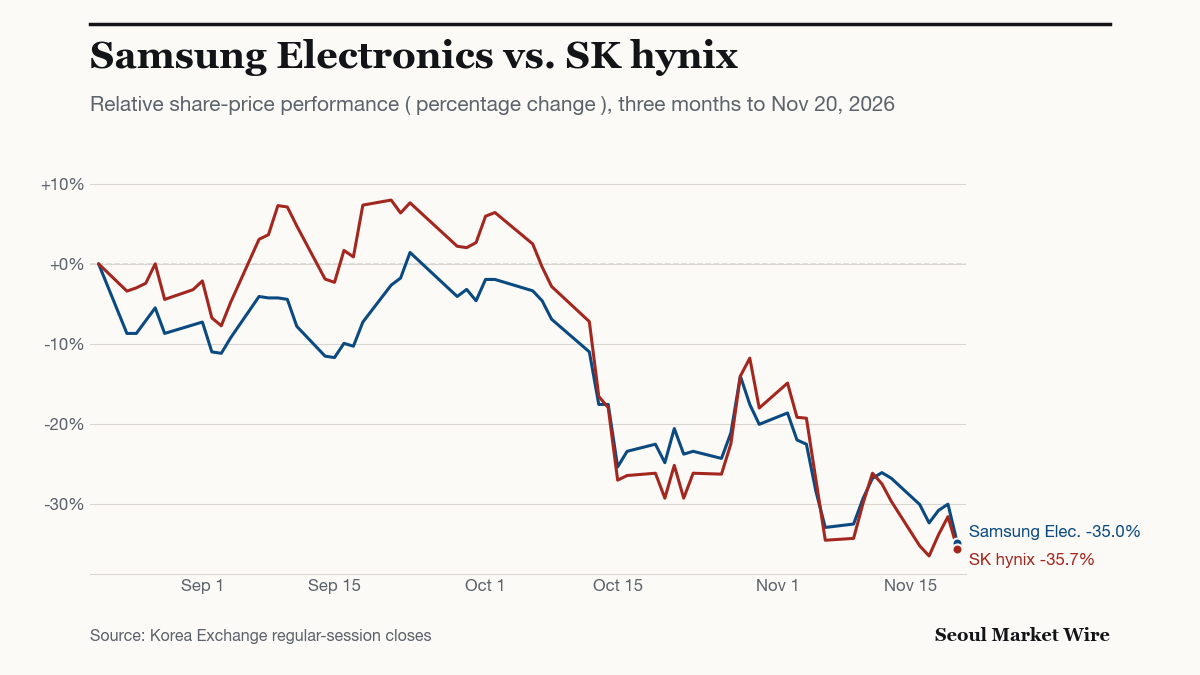
Yuanta published the strategy during a sharp sell-off in Korean equities. At the KST close on Nov. 20 the KOSPI was down 5.21% at 4,869.96. Samsung Electronics (005930.KS) fell 7.01% to 183,100 won, and SK hynix (000660.KS) lost 5.92% to 1,113,000 won. Foreign investors sold a net 1.096 trillion won of KOSPI shares that day, according to a combined KRX and NXT tally that may still be revised. At the Hana Bank reference rate of 1,346.5 won per dollar, that is about $814 million. The index ended the week down 7.95%.
Source: Yuanta Securities, Nov. 20, 2026.
Taiwan’s listed exposure runs beyond its largest chipmaker
Concentration is the first objection the brokerage addresses. Samsung Electronics, SK hynix and TSMC dominate their home indices, so owning Korea and Taiwan together can look like making the same bet twice. Yuanta’s answer is that Taiwan offers listed exposure beyond its largest semiconductor company, with companies covering most of the server build. The brokerage argues that bottlenecks in the AI supply chain keep moving and that money rotates between segments as they do.
In a historical simulation, Yuanta compared a 70% KOSPI/30% TAIEX allocation with a KOSPI-only benchmark. The mixed allocation had an annualised return 2.8 percentage points higher, volatility 4.75 percentage points lower and a maximum drawdown 5.31 percentage points smaller.
Taiwan’s earnings estimates rose while its shares fell
Earnings are the second part of the case. Yuanta puts estimated year-on-year EPS growth for the MSCI Taiwan Index at 69.5% for 2026, 32.3% for 2027 and 27.8% for 2028. Estimates kept rising even as sentiment toward AI soured. In the three months before the report, the index’s 2027 EPS estimate rose 19.5% and its 2028 estimate rose 20.3%. Yuanta said the 2027 revision was the largest among 47 country markets. It concludes that Taiwan’s recent share-price fall reflects investors cutting risk and that the earnings outlook is intact. Seoul Market Wire has reported separately on Korea’s falling share of global earnings upgrades.
Shareholder returns and trading rules complete the comparison. The TAIEX averaged a dividend payout ratio of 59.6% over the past 10 years, against 30.3% for the KOSPI, by Yuanta’s figures. Regular stock trades in both markets settle two business days after the trade date (T+2).
| Metric | Taiwan | Korea (KOSPI shares) |
|---|---|---|
| Daily price limit | ±10% | ±30% |
| Taxes on stock sales | 0.3% securities transaction tax (0.15% on qualifying same-day trades) | 0.20% total: 0.05% securities transaction tax plus 0.15% special tax for rural development |
| 10-year average dividend payout ratio | 59.6% (TAIEX) | 30.3% (KOSPI) |
Taiwan’s standard daily price limit is narrower than Korea’s. Its general transaction tax on stock sales is 0.3%. The reduced 0.15% rate applies only to qualifying same-day trades, and under current law it runs until Dec. 31, 2027. In Korea, the 0.20% charge on KOSPI share sales combines a 0.05% securities transaction tax with a 0.15% special tax for rural development.
Two groups of stocks: chip suppliers and data-centre hardware
For 2027 the brokerage expects the TAIEX to trade between 39,600 and 54,500 points. It splits its stock picks into two groups.
The first group is suppliers that Yuanta sees benefiting from demand for both GPUs and custom AI chips: TSMC (2330), ASE Technology Holding (3711) and Chroma ATE (2360). Yuanta expects custom chips, known as ASICs, to take share from Nvidia, whose share of AI chips it sees falling from 48.8% in 2026 to 35.1% in 2027. In the brokerage’s view TSMC benefits either way, because Google’s TPUs and Amazon’s in-house accelerators are made at TSMC on advanced processes, as Nvidia’s GPUs are. ASE is an outsourced chip packaging and testing company. Chroma ATE supplies semiconductor test equipment and systems.
The second group covers AI data-centre hardware segments that, by Yuanta’s count, have no specialist listed in Korea. Its picks are Asia Vital Components (3017), Accton Technology (2345) and King Slide Works (2059).
The quant team sees Korea’s earnings growth slowing in 2027
In a separate Nov. 20 screen, the brokerage’s quant team made a related point about Korea. It expects year-on-year growth in 12-month forward EPS to slow in 2027, partly because of the high 2026 comparison base. It said that would weaken earnings and share-price momentum in the sectors that have led the KOSPI. In the week covered by the screen, full-year 2027 operating-profit estimates for its 200-stock universe rose 1.3%.
Seoul Market Wire covered other brokerages’ Nov. 20 warnings on Nvidia’s China exposure and AI circular financing in its Nov. 21 report on Korea’s 2027 profit upgrades.
What to watch next
Upcoming macroeconomic releases and policy meetings for holders of Samsung Electronics (005930.KS) and SK hynix (000660.KS):
- Nov. 23, 23:45 KST: U.S. S&P Global flash manufacturing, services and composite PMIs for November.
- Nov. 25, 22:30 KST: The second estimate of U.S. third-quarter GDP, and the October PCE and core PCE price indices.
- Nov. 26: The Bank of Korea’s rate decision and revised economic outlook. Kiwoom Securities wrote on Nov. 20 that a 25-basis-point hike was the prevailing expectation. In its August 2026 outlook, the Bank of Korea projected growth of 3.3% for 2026 and 2.9% for 2027.
- Dec. 8–9, U.S. time: The Federal Reserve’s policy meeting. Daol Investment & Securities pointed to it in its Nov. 20 weekly as the event that makes the PCE data important.
Sources
- Yuanta Securities — Beyond Memory, Taiwan: Completing the AI portfolio with a 2027 Taiwan strategy (Nov. 20, 2026) stock.naver.com
- Yuanta Securities — QWER, third week of November: Screening for a cyclical downturn (Nov. 20, 2026) stock.naver.com
- Kiwoom Securities — Weekly Macro: U.S. inflation and the Bank of Korea's MPC (Nov. 20, 2026) stock.pstatic.net
- Daol Investment & Securities — Market Weekly Check ME up! (Nov. 20, 2026) stock.pstatic.net
- Taiwan Ministry of Finance — Securities Transaction Tax Act law-out.mof.gov.tw
8 more sources
- Taiwan Stock Exchange — Trading system twse.com.tw
- Korea Exchange — Guide to trading in the Korean stock market global.krx.co.kr
- Korea Exchange — Daily price limits global.krx.co.kr
- National Assembly Budget Office — 2026 Korean Taxation nabo.go.kr
- U.S. Bureau of Economic Analysis — Release schedule bea.gov
- Federal Reserve — FOMC meeting calendars federalreserve.gov
- Bank of Korea — Economic Outlook (August 2026) bok.or.kr
- Korea Exchange — KOSPI and stock closing data global.krx.co.kr