Korea calls emergency F4 meeting after chip-stock rout
The Philadelphia semiconductor index fell 10.73% after Seoul's Nov. 20 close, and KOSPI 200 night futures fell 6.99%. Broker reports written earlier in the week each looked at a different risk: credit markets, AI financing and chip demand.
Market data: Korea Exchange intraday and session figures on 2026-11-20 (KST)
South Korea’s finance minister called an emergency meeting of the country’s top economic and financial officials for the afternoon of Nov. 22. A fall in U.S. chip stocks threatened to deepen a selloff that had already pushed the KOSPI below 5,000. Broker reports published earlier in the week examined three risks relevant to the selloff: credit-market stress, AI financing and chip demand. All were written before the U.S. rout.
Lee Hyung-il, the deputy prime minister and minister of finance and economy, convened the market-conditions meeting, known as the F4. The announced participants were Bank of Korea Governor Hyun Song Shin, Financial Services Commission Chairman Lee Eog-weon and Financial Supervisory Service Governor Lee Chan-jin. The ministry said the meeting would assess the effect on financial and foreign-exchange markets and discuss responses. The four agency heads gather when outside shocks raise volatility.
What hit markets before the meeting
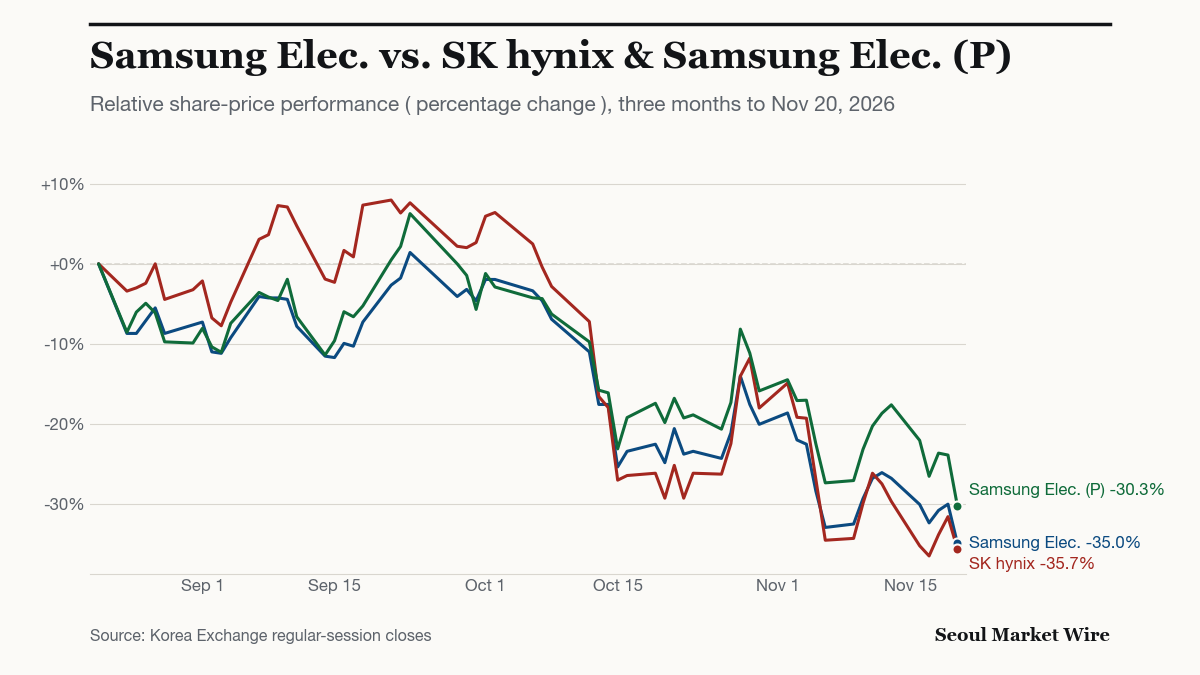
The KOSPI fell 5.21% to close at 4,869.96 on Nov. 20 and ended the week down 7.95%. The KOSDAQ fell 5.71% to 645.68. Samsung Electronics dropped 7.01% to 183,100 won, and its preferred shares lost 8.38% to 144,300 won. SK hynix declined 5.92% to 1,113,000 won. Korean cash-equity figures are for the Nov. 20 close. U.S. figures are for the Nov. 20 New York session, with KOSPI 200 night futures reported separately.
For the week to Nov. 20, Financial News reported foreign net selling of about 4.5 trillion won of KOSPI shares, roughly $3.3 billion at the Hana Bank reference rate of 1,346.5 won per dollar. Seoul Economic Daily reported that foreign investors sold more than 2.7 trillion won of Samsung Electronics and SK hynix shares over the same week. The two reports did not say whether they covered the same trading hours, so this story does not express one figure as a share of the other.
The table compares market readings for the Nov. 19 and Nov. 20 sessions. The research notes discussed below were published on different dates.
| Metric / Series | Nov. 19 session | Nov. 20 session |
|---|---|---|
| KOSPI close | 5,137.89 | 4,869.96 (-5.21%) |
| USD/KRW, Hana Bank reference rate | 1,335.5 | 1,346.5 |
| Samsung Electronics close (won) | 196,900 | 183,100 (-7.01%) |
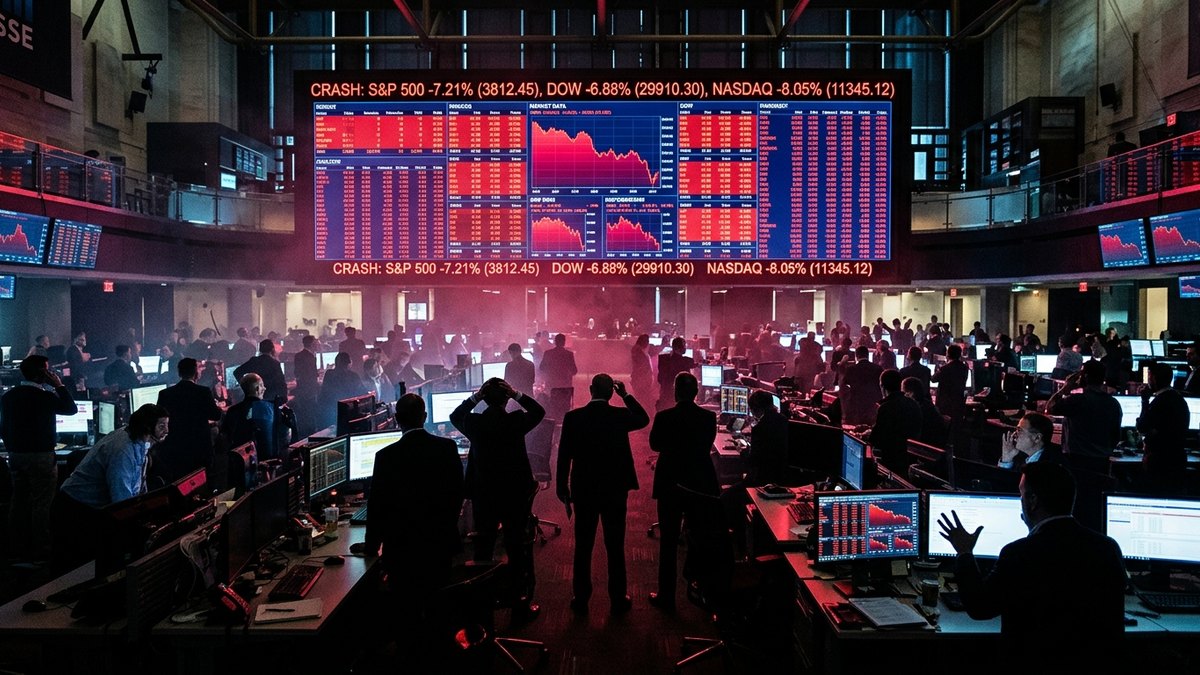
The trigger for the weekend meeting came after Seoul closed. The Nasdaq Composite fell 5.28% on Nov. 20 in New York and gave up all its gains for the year. The Philadelphia semiconductor index dropped 10.73%, and Nvidia lost about 14%. KOSPI 200 night futures fell 6.99%. Earlier coverage of the week is in our weekly market review and our Nov. 20 closing report.
What the earlier reports examined
Credit markets were the first question. In a Nov. 18 note, iM Securities argued that the turmoil remained orderly. Spreads on Nvidia’s credit default swaps had narrowed, and the brokerage saw little risk that equity volatility would spread into broader financial markets. Its view came with conditions: oil prices would need to stabilise further and the U.S. Federal Reserve would need to end its rate-hiking cycle. If both happened, the stock decline would do limited damage to the U.S. economy. The note was dated Nov. 18, before the Nov. 20 U.S. selloff. That gap is the subject of our look at iM’s orderly-selloff call.
The second question was how AI spending is funded. Shinhan Securities, writing on Nov. 20, examined circular financing among AI companies, in which suppliers help fund the customers that buy their products. It compared the current cycle with an earlier telecom-equipment boom. In that cycle, vendor financing pulled orders forward and later became a burden on suppliers once carriers cut their investment plans. Shinhan’s central point was the order of events. If customers cut spending after their orders have already been pulled forward, suppliers could face both lower sales and losses on loans to customers. The brokerage presented this as a risk that applies if final demand falls short, not as a forecast that it will. Our analysis of Shinhan’s AI financing report covers the argument in more detail.
The third question was chip demand. Kiwoom Securities published a separate Nov. 20 report on U.S. export curbs. It argued that supply, not orders, remained the main limit on AI chip sales. In Kiwoom’s reading, the demand lost to the China-related curbs would be small compared with the unmet orders already waiting, so chip sales would stay largely intact.
The Bank of Korea’s dilemma
The meeting comes four days before the BOK’s Monetary Policy Board decides on rates on Nov. 26. Kiwoom’s Nov. 20 weekly macro report expected a 25-basis-point increase at that meeting. It also expected the BOK to raise its growth forecasts, after the IMF lifted its projections for Korea to 3.9% for 2026 and 3.3% for 2027. Kiwoom called the central bank’s next move unusually uncertain: economic data are solid and inflation pressure persists, but equity markets are under strain. In the same report, the brokerage expected another hike in early 2027 and said tightening could last longer than that. Its analysts added that the BOK’s guidance on future policy may matter more for Korean bond yields than the Nov. 26 decision itself. Our preview of the Nov. 26 rate decision sets out the options.
U.S. data due the day before also bear on that decision. Kiwoom forecast annualised third-quarter GDP growth of 3.5% in the second estimate due Nov. 25. It expected October PCE inflation to slow month on month but rise year on year, with core PCE staying in the low 3% range. The brokerage said those readings would not ease the Fed’s inflation concerns.
What to watch next
- Nov. 23, 09:00 KST: KRX opens for the first session after the F4 meeting and the 6.99% fall in KOSPI 200 night futures. Tickers:
005930.KS,000660.KS,005935.KS. - Nov. 23 (U.S. time): HPE holds its fiscal fourth-quarter earnings call, an early read on AI server demand.
- Nov. 23, 23:45 KST: S&P Global releases flash U.S. manufacturing, services and composite PMIs for November.
- Nov. 25, 22:30 KST: The U.S. releases October PCE and core PCE price indexes and the second estimate of third-quarter real GDP.
- Nov. 26: Bank of Korea rate decision and revised economic forecasts.
- Dec. 8–9: U.S. Federal Open Market Committee meeting.
Sources
- News1 — Deputy Prime Minister Lee Hyung-il convenes emergency F4 meeting after U.S. chip-stock slump (Nov. 22, 2026) n.news.naver.com
- Kiwoom Securities — Weekly Macro: U.S. inflation and the BOK's Monetary Policy Board in focus (Nov. 20, 2026) stock.naver.com
- iM Securities — Financial markets in turmoil, but so far an orderly one (Nov. 18, 2026) stock.naver.com
- Shinhan Securities — M.R.I.: AI circular financing, growth fuel or financial weak link (Nov. 20, 2026) stock.naver.com
- Kiwoom Securities — U.S. AI chip curbs: no empty seats at a restaurant with a queue (Nov. 20, 2026) stock.naver.com
8 more sources
- Financial News — KOSPI falls 7.95% for the week on about 4.5 trillion won of foreign net selling (Nov. 22, 2026) n.news.naver.com
- Seoul Economic Daily — Philadelphia semiconductor index falls 10.73%, KOSPI 200 night futures down 6.99% (Nov. 22, 2026) n.news.naver.com
- Chosun Ilbo — U.S. tech-stock sell-off shock: is a 'Black Monday' coming for Korean stocks? (Nov. 22, 2026) n.news.naver.com
- JoongAng Ilbo — Nasdaq gives up its gains for the year as chip stocks slide (Nov. 22, 2026) n.news.naver.com
- Bank of Korea — Monetary Policy Board meeting schedule, 2026 bok.or.kr
- U.S. Bureau of Economic Analysis — Release schedule bea.gov
- Federal Reserve — FOMC meeting calendars federalreserve.gov
- Hewlett Packard Enterprise — Investor relations investors.hpe.com