U.S. PCE data arrive before the BOK's Nov. 26 decision, putting the won in focus
Shinhan, Kiwoom and Daol expect a 25-basis-point hike to 3.25% on Nov. 26. U.S. inflation and growth data due the night before could move rate expectations and the won first, after a Nov. 20 selloff took the KOSPI down 5.21%.
Market data: Korea Exchange regular-session close & Hana Bank USD/KRW reference rate, 2026-11-20 (KST)
The Bank of Korea’s Monetary Policy Board meets on Nov. 26. Shinhan Securities, Kiwoom Securities and Daol Investment & Securities all expect a 25-basis-point increase that would lift the base rate to 3.25% from 3.00%, according to their Nov. 20 research. In its preview, Shinhan said some market participants expect 3.25% to be the terminal rate. U.S. data due the night before the decision could test that expectation.
At 8:30 a.m. Eastern time on Nov. 25, or 22:30 KST, the U.S. Bureau of Economic Analysis publishes October personal income and outlays, the release that carries the PCE price indexes. The second estimate of third-quarter GDP comes out at the same time. Both land less than two weeks before the Federal Reserve’s Dec. 8–9 meeting.
The two central banks bear on the won in different ways. With the Fed’s target range unchanged, a 25-basis-point BOK hike would narrow the policy-rate gap with the U.S. by 25 basis points. A rise in expected U.S. rates could offset some of that support.
Markets go into the week from a weak base. On Nov. 20 the KOSPI closed at 4,869.96, down 5.21%. Hana Bank’s USD/KRW reference rate, as quoted on Naver at the Nov. 20 close, was 1,346.5, against 1,335.5 at the Nov. 19 close. Provisional investor-flow figures from Naver Pay Securities, compiled from KRX data and released after the Nov. 20 close, showed foreign investors as net sellers of about 1.10 trillion won of KOSPI shares and institutions as net sellers of about 933 billion won. Those figures can change when final data are published.
U.S. inflation and GDP data before the BOK decision
Personal income and outlays carries two price measures: headline PCE and core PCE, which strips out food and energy. Each is reported as a month-on-month change and a year-on-year rate, and the two bases can move in opposite directions in the same release. GDP for the third quarter is revised alongside it.
An unexpected change in either country’s rate outlook could move the won. Safe-haven demand for the dollar, and how it complicates the export case for a stronger won, was the subject of a Nov. 21 piece.
Where the BOK’s own forecasts fit
The bank’s August 2026 projections were 3.3% growth for 2026 and 2.9% for 2027. KDI’s second-half 2026 outlook projects 3.8% and 3.9%. The IMF’s consultation mission put the figures at 3.9% and 3.3%, according to a government summary of its statement published on Nov. 17, a revision covered in an earlier Seoul Market Wire story.
| Forecast year | BOK (Aug. 2026) | KDI (H2 2026 outlook) | IMF (mission statement, summarised Nov. 17) |
|---|---|---|---|
| 2026 | 3.3% | 3.8% | 3.9% |
| 2027 | 2.9% | 3.9% | 3.3% |
These forecasts were published at different times and reflect different information sets.
An earlier Second Look covered Shinhan’s argument that an upgrade could weaken bets on 3.25% as the peak. It also covered how much of KDI’s projected growth comes from chip production and investment.
What could support a pause after November
An in-line PCE reading could reduce the risk of an inflation-driven rise in U.S. yields before the board meets. A softer-than-expected figure would point the same way. Neither would rule out repricing after the GDP revision or other news, and neither would establish 3.25% as the BOK’s peak rate.
Exports are a second input. Daol sees export growth passing its peak in the fourth quarter, even though export values remain high. Cumulative exports for the year passed $1 trillion on Nov. 19, according to the trade ministry’s provisional count. Slower export growth could strengthen the case for a pause, but it would not by itself determine the BOK’s next move. In its Oct. 22 statement, the BOK said it would assess inflation, growth and financial stability when deciding the timing and pace of further rate increases. Any pause after November would have to be weighed against that stated tightening stance.
Market strain is a third. Kiwoom’s Weekly Macro said the BOK faces solid economic data and inflation pressure at a time of financial-market instability, which leaves its policy response highly uncertain.
What could support further tightening
The opposite case starts with a PCE surprise. A stronger-than-expected inflation reading could lift U.S. rate expectations and weigh on the won just as the BOK decides how firmly to signal its own path.
On the domestic side, Shinhan wrote that the BOK’s revised outlook could dilute hopes that 3.25% is the terminal rate and that an easing cycle begins in late 2027. Its analysts also expect the post-meeting press conference to stay neutral, with in-principle remarks on the need to keep a tightening stance, given higher uncertainty over the outlook. A stronger growth forecast could support further tightening if it also implied more persistent inflation pressure. The size of the growth revision alone would not determine the rate path. Background on the bank’s process is in our explainer on how the Bank of Korea sets its base rate, and an earlier story on Daishin’s call set out a case for two more hikes.
Nov. 20 market snapshot
Closing prices are KRX regular-session closes. Flow figures are provisional Naver Pay Securities data for Nov. 20.
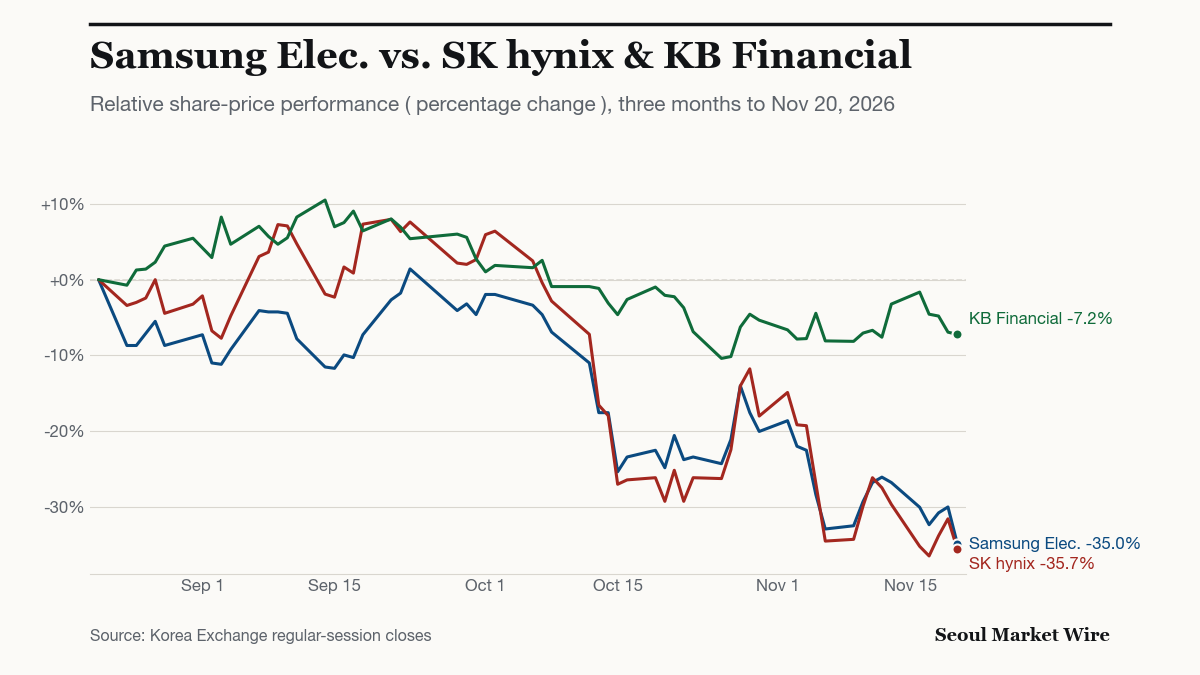
- 005930.KS (Samsung Electronics): closed at 183,100 won, down 7.01%. Foreign investors net sold about 416 billion won of the stock and institutions about 346 billion won.
- 000660.KS (SK hynix): closed at 1,113,000 won, down 5.92%. Net selling came to about 185 billion won from foreign investors and about 259 billion won from institutions.
- 105560.KS (KB Financial Group): closed at 152,400 won, down 0.33%. Institutions net bought about 17.7 billion won, while foreign investors net sold about 14.1 billion won.
What to watch next
- Nov. 25, 22:30 KST: U.S. October personal income and outlays, including PCE and core PCE prices, and the second estimate of third-quarter GDP.
- Nov. 26: Bank of Korea rate decision. Shinhan expects the bank’s revised economic outlook at the same meeting.
- Dec. 8–9 (U.S. time): FOMC meeting.
Sources
- Kiwoom Securities — Weekly Macro: focus on U.S. prices and the BOK's Monetary Policy Board (Nov. 20, 2026) stock.naver.com
- Daol Investment & Securities — Market Weekly Check ME up! (Nov. 20, 2026) stock.naver.com
- Shinhan Securities — November MPC Preview (Nov. 20, 2026) stock.pstatic.net
- U.S. Bureau of Economic Analysis — Release schedule bea.gov
- Federal Reserve — FOMC meeting calendars federalreserve.gov
6 more sources
- Bank of Korea — Monetary Policy Board meeting dates bok.or.kr
- Bank of Korea — Monetary policy decision (Oct. 22, 2026) bok.or.kr
- Bank of Korea — Economic Outlook (August 2026) bok.or.kr
- KDI — Economic Outlook, second half of 2026 kdi.re.kr
- Korea.kr — Government summary of the IMF consultation mission statement (Nov. 17, 2026) korea.kr
- Ministry of Trade and Industry — Annual exports pass $1 trillion (provisional) motir.go.kr