Brokers assess KOSPI downside as Seoul prepares stabilization fund
Four Korean brokerages set out KOSPI downside scenarios built on different valuation assumptions. Their notes cover book-value support, AI earnings risks and the potential market impact of preparations for a stabilization fund.
Market data: Korea Exchange regular-session close & Hana Bank USD/KRW reference rate, 2026-11-23 (KST)
Four Korean brokerages set out downside scenarios for the KOSPI in research published on Nov. 23, using different valuation assumptions and different measures of past market declines. The scenarios include Shinhan Investment’s base case near 4,500 and Yuanta Securities’ extreme undershoot range of 4,100–4,600. The government said on Nov. 22 that it would begin preparations to activate the stock market stabilization fund if needed.
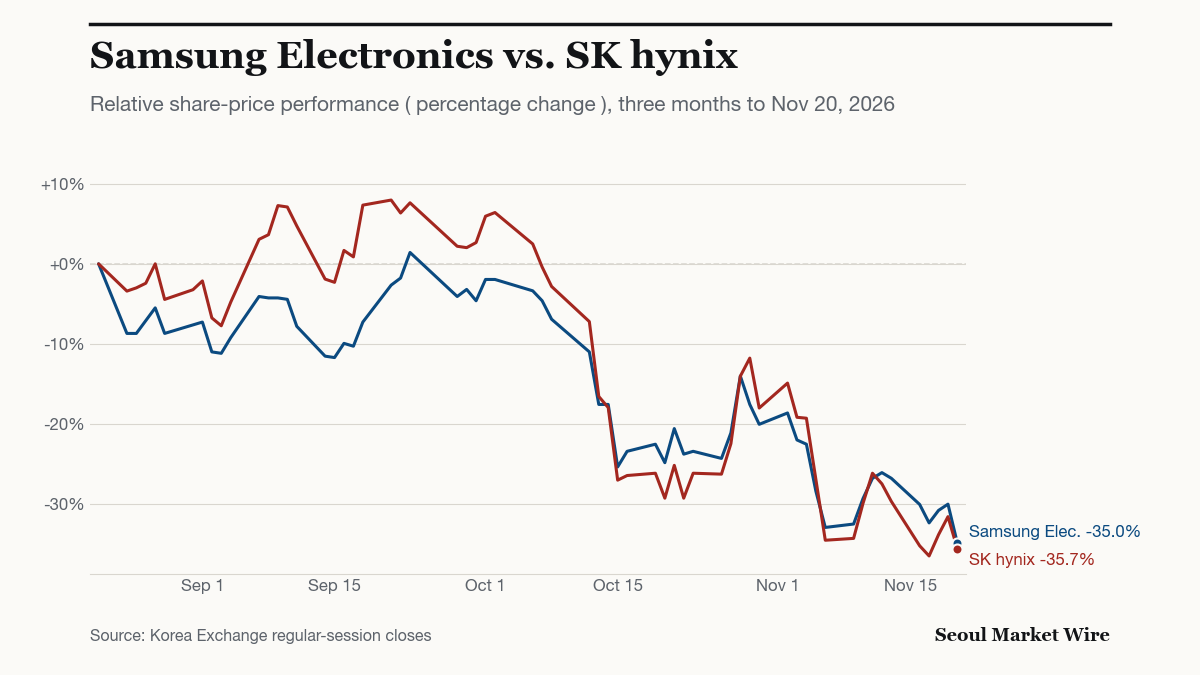
The KOSPI closed at 4,869.96 on Nov. 20, down 5.21%. Samsung Electronics fell 7.01% to 183,100 won and SK hynix lost 5.92% to 1,113,000 won. Kiwoom Securities and Korea Investment & Securities both measured the index’s fall from its peak at 46.6%. On Nov. 23, the index opened at 4,734.90, down 2.77% from Friday’s close.
Authorities begin preparations for the fund
According to Korea Investment & Securities, the government and financial regulators held an emergency market meeting on Nov. 22 and began preparations so that the stabilization fund could be used if needed. They did not decide whether to put money in. We covered the emergency F4 meeting and Daishin’s view on the fund and U.S. yields earlier.
Kim Dae-jun, a strategist at Korea Investment & Securities, said external shocks and selling pressure had pushed the market into oversold territory, and that the decline did not reflect weaker corporate fundamentals. He pointed to a gap between equity and credit gauges. The KOSPI 200 volatility index (VKOSPI) rose to 53.2 on Nov. 20, while Korea’s sovereign credit default swap spread stayed in the low-to-mid-20-basis-point range. In his reading, the stock slide has not turned into a wider credit problem.
Kim said the fund calmed markets in 2020 and 2022 without buying any shares, and he expects the policy signal to help again. He expects the initial effect to be a slower decline, with a rebound coming later. Kiwoom’s Han Ji-young made a similar point: a strong enough signal from the authorities that the fund can be used could steady sentiment before any money is spent.
Three brokers use book value to estimate downside
Three of the four estimates come from price-to-book (P/B) multiples, the ratio of market value to net assets. Two of them apply the 2008 low. Kiwoom put the KOSPI’s forward P/B at about 0.91x. A fall to 0.8x, the low of the 2008 global financial crisis, would mean an index of 4,200–4,300, which the brokerage treats as its worst case. iM Securities analyst Kim Jun-young applied the 2008 forward P/B low of 0.81x to projected book value to arrive at a level near 4,300. He also pointed to past episodes in which the KOSPI fell a further 4% to 17% after earnings passed their peak.
Shinhan’s Noh Dong-gil ran the multiple at different levels against expected book value. At 0.9x book the floor is about 4,800. At 0.85x it is about 4,500, which Shinhan treats as its base case. Yuanta’s Kim Yong-gu used past drawdowns instead, putting the extreme of the undershoot at 4,100–4,600, equal to a 50% to 55% fall from the index’s two-year high.
Yuanta’s annual view is a separate exercise. The firm cut its 2027 KOSPI range to 4,000–7,300 from the 6,000–10,000 it set on Oct. 13, and sees the index climbing quarter by quarter: 4,000–5,500 in the first quarter, 5,000–6,000 in the second, 5,500–6,400 in the third and 6,000–7,300 in the fourth. Yuanta said the cut reflects irrational moves in prices, valuations and flows. It did not change its earnings outlook.
| Broker and scenario | Estimated KOSPI level | Decline from Nov. 20 close (4,869.96) |
|---|---|---|
| Kiwoom worst case (0.8x P/B) | 4,200–4,300 | 13.76% at 4,200; 11.70% at 4,300 |
| iM lower bound (0.81x P/B) | about 4,300 | 11.70% |
| Shinhan base case (0.85x P/B) | about 4,500 | 7.60% |
| Yuanta extreme undershoot | 4,100–4,600 | 15.81% at 4,100; 5.54% at 4,600 |
Earnings estimates rose while prices fell
Two firms set the selloff against earnings forecasts. Shinhan said the KOSPI fell 46.2% from June 19 while 12-month forward earnings-per-share estimates rose 36.3%. The fall in prices and the rise in forecast EPS both reduced the forward P/E ratio. Kiwoom put the KOSPI’s 12-month forward price-to-earnings ratio at about 3.4x, against a 2008 low of 6.27x.
Kiwoom also compared the speed of the fall with past crashes. The index took 4.5 months to fall 40% from its peak. The same decline took 8.4 months after the dot-com bubble burst, 11.5 months in the global financial crisis and 25.3 months in the 1997 Asian financial crisis. Han said the speed of the fall could itself support a rebound. Given how oversold the market is and the chance that the fund is used, the brokerage sees little likelihood of its worst case.
AI economics and chip prices could push levels lower
iM’s case centers on AI economics. Kim Jun-young said growing AI demand does not mean better AI profitability. He argued that AI revenue growth has not offset falling token prices, and that costlier memory and other hardware could weaken the case for further AI infrastructure spending by big technology companies. He compared AI infrastructure built on big-tech credit support to the financing ties between Nortel and start-up telecom carriers during the dot-com era.
Shinhan ran the numbers on the chip cycle. According to Shinhan, TrendForce brought forward its forecast for the start of NAND flash price declines to the first quarter of 2027 from the second half of 2027. Shinhan estimated that NAND prices 20% below market expectations would cut KOSPI companies’ expected earnings per share by 5% to 6% but reduce book value by only about 1%. That would lower its floor by about 48 points. The larger risk is the market applying a bigger discount to book value, from 0.9x to 0.85x. Shinhan still sees little chance of the index staying below 0.85x for long, because corporate profitability is higher than in past periods of low valuations. Our earlier report on chip stress tests has the supply forecasts behind the NAND debate.
Kiwoom listed concerns about AI profitability and more foreign selling as the main threats. Yuanta named four conditions for stabilization: less uncertainty over inflation, tightening and high rates; less uncertainty after the U.S. midterm elections over Democratic-backed AI regulation and export controls on China; an early, stable succession at Nvidia; and strong market policy, including use of the fund and short-selling rules.
What to watch next
- Nov. 25, 22:30 KST (08:30 EST): U.S. third-quarter GDP second estimate and October personal income and outlays, including the PCE price index. The data come ahead of the Bank of Korea decision.
- Nov. 26: Bank of Korea rate decision.
- Dec. 1 (U.S. date): Three House committee chairmen requested a closed-door, transcribed interview with former Nvidia CEO Jensen Huang on this date. Yuanta calls the hearing the first test for AI sentiment.
- Dec. 10, 04:00 KST (Dec. 9, 14:00 EST): Federal Reserve rate decision. Yuanta said easing concern about further tightening after the decision is a condition for a rebound.
- Expected in January 2027: Samsung Electronics (005930.KS) and SK hynix (000660.KS) results. Shinhan named these as the next check on the chip cycle and earnings forecasts.
Sources
- Hankyung TV — Kiwoom: KOSPI worst case of 4,200 possible, but room for a rebound (Nov. 23, 2026) n.news.naver.com
- Digital Daily — Korea Investment & Securities: KOSPI down 46%, but not the time to sell; stabilization fund in focus (Nov. 23, 2026) n.news.naver.com
- Yonhap — Shinhan Investment: KOSPI could fall to 4,500, but unlikely to stay there long (Nov. 23, 2026) n.news.naver.com
- Money Today — Yuanta cuts 2027 KOSPI range to 4,000–7,300; Huang hearing a first test for AI sentiment (Nov. 23, 2026) n.news.naver.com
- iM Securities — Between AI demand and profitability: considering the KOSPI's lower bound (Nov. 23, 2026) stock.naver.com
3 more sources
- U.S. House committee chairmen — Letter to Jensen Huang requesting a transcribed interview (Nov. 12, 2026) foreignaffairs.house.gov
- Federal Reserve — December 2026 calendar federalreserve.gov
- BEA — Release schedule bea.gov