KOSPI drops below 4,600 as iM flags China chip-curb risk to exports
A sell-side sidecar was triggered in the KOSPI market for a second consecutive trading session on Nov. 23. iM Securities says tighter US curbs on chip trade with China put at risk the chip exports behind Korea's export strength.

Market data: Korea Exchange regular-session close & Hana Bank USD/KRW reference rate, 2026-11-20 (KST)
The KOSPI fell more than 5% and dropped below 4,600 in late-morning trade on Monday, Nov. 23. At 11:33 KST the Korea Exchange triggered a sell-side sidecar, which halts program sell orders for five minutes. It was the second consecutive trading session with a sell-side sidecar. KOSPI 200 futures were down 38.26 points, or 5.08%, at 714.50 when the pause began. The index had closed down 5.21% at 4,869.96 on Nov. 20, when a sell-side sidecar was also triggered.
iM Securities linked Korea’s strong exports and wider trade surplus to rising chip exports to China in a Nov. 23 economic brief. The brokerage’s main risk to that outlook is that US restrictions on high-tech trade with China could tighten further.
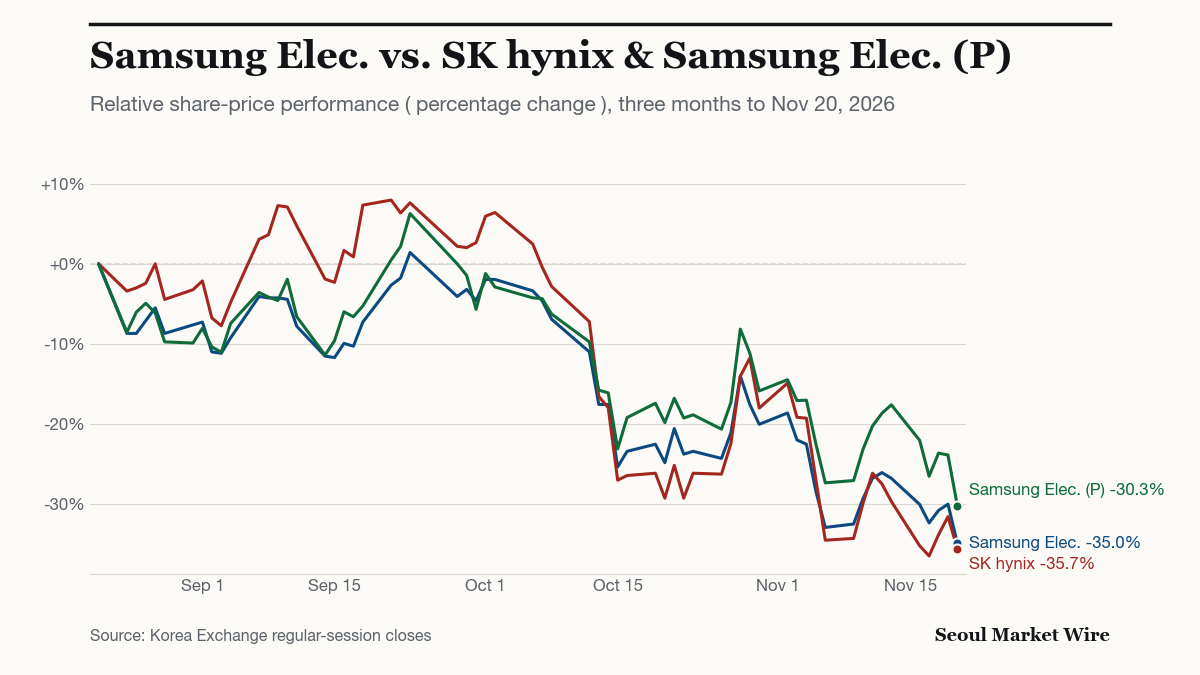
What changed on Nov. 16
A rule announced by the US Commerce Department’s Bureau of Industry and Security on Nov. 16 tightened controls on remote access to data centres in third countries and on sales of certain advanced chips to Chinese customers, iM said, citing the Financial Times. According to iM’s reading of that report, the change made some previously available supply routes to Chinese buyers harder to use.
Samsung Electronics and TSMC had stopped some chip shipments to Chinese customers because of the tighter US export rules, KB Securities said in its closing comment for Nov. 20. The brokerage linked that day’s decline in Samsung Electronics to those halted shipments and said worries about production disruption had spread to power-equipment and nuclear stocks tied to AI infrastructure.
At the Nov. 20 KRX close, Samsung common shares were down 7.01% at 183,100 won. SK hynix fell 5.92% to 1,113,000 won, and Samsung’s preferred shares lost 8.38% to 144,300 won. Our Nov. 19 story covered how brokers first read the US AI controls.
How the shock reaches the won
The won’s decline over Nov. 16–20 came from falling chip stocks, foreign selling of Korean shares and safe-haven demand for the dollar, according to iM’s Nov. 23 currency brief. The brokerage expects the dollar to stay firm through the week and put the USD/KRW range for Nov. 23–27 at 1,330–1,370. Hana Bank’s basic dollar rate, as carried by Naver at the KST close, was 1,345.0 on Nov. 20, up 0.71% from 1,335.5 at the Nov. 19 close.
Foreign investors sold a net 2.30 million Samsung common shares on Nov. 20, according to Naver Pay Securities investor data that combine KRX and Nextrade trading. They also sold a net 167,982 SK hynix shares. Institutions were net sellers of both stocks, including 1.92 million Samsung common shares.
Foreign holdings stood at 45.85% of Samsung’s common shares and 49.38% of SK hynix on Nov. 20, based on the same Naver Pay Securities data.
| Measure | Broker view (firm, date) | Market data, Nov. 20; basis noted in each row |
|---|---|---|
| USD/KRW | iM (Nov. 23): 1,330–1,370 range for Nov. 23–27, dollar to stay firm | 1,345.0 (Hana Bank basic rate at KST close), +0.71% vs Nov. 19 close |
| Samsung Electronics (005930.KS) | KB (Nov. 20): fall linked to halted shipments to some Chinese customers | 183,100 won (KRX close), -7.01%; foreign net selling 2.30 million shares (KRX and Nextrade combined) |
| SK hynix (000660.KS) | KB (Nov. 20): pessimism on Samsung and SK hynix close to a peak | 1,113,000 won (KRX close), -5.92%; foreign net selling 167,982 shares (KRX and Nextrade combined) |
Broker assessments and unresolved risks
Market pessimism on Samsung Electronics and SK hynix was close to a peak, KB said on Nov. 20. Its analysts argued that much of the external risk was already reflected in share prices, citing the two companies’ solid fundamentals.
Exports and the wider economy were the focus of iM’s Nov. 23 brief. It identified two risks to Korea’s exports to China: tighter US technology restrictions and weak Chinese domestic demand. The brokerage described China’s October consumption and fixed-investment data as sharply weak and warned that the chip-led rise in Korea’s exports to China could stop suddenly. Its base case is that the economy’s fundamentals can absorb these shocks.
For Nov. 23–27, iM said two things could limit further share declines: less diversion of funds into Anthropic’s IPO, and steadier oil prices. It named a recovery in AI-related sentiment as the deciding factor.
A US 10-year Treasury yield above 5% was still weighing on stocks, Daishin Securities said on Nov. 20. iM had already set out a KOSPI downside estimate as Seoul prepared its stabilization fund. A separate story covers the government’s fund preparations.
What to watch next
- Samsung Electronics and SK hynix: company disclosures on whether the new US controls affect shipments to Chinese customers.
- Nov. 23, 23:45 KST: S&P Global US flash manufacturing, services and composite PMIs for November.
- Nov. 25, 22:30 KST: US third-quarter GDP (second estimate) and the October PCE and core PCE price indexes.
- Nov. 26: Bank of Korea base-rate decision, covered in our week-ahead calendar.
- USD/KRW against iM’s 1,330–1,370 range for Nov. 23–27.
Sources
- iM Securities — Everything Fall: major asset prices drop together (Nov. 23, 2026) stock.naver.com
- iM Securities — The stock market is shaking the currency market (Nov. 23, 2026) stock.naver.com
- KB Securities — KB Research closing comment for Nov. 20 (posted Nov. 23, 2026) stock.naver.com
- Daishin Securities — Hopes for an end to China's K-content curbs build ahead of Anthropic IPO (Nov. 20, 2026) stock.naver.com
- Yonhap — KOSPI falls more than 5%, gives up 4,600; sell-side sidecar triggered (Nov. 23, 2026) n.news.naver.com