Kakao's content decline and wider AI losses temper platform growth
Kakao's third-quarter revenue rose 6% and operating profit increased 7%. Platform growth faced a drag from weaker content sales and wider AI losses, while brokerages cut valuations.
Market data: Korea Exchange regular-session close & Hana Bank USD/KRW reference rate, 2026-11-13 (KST)
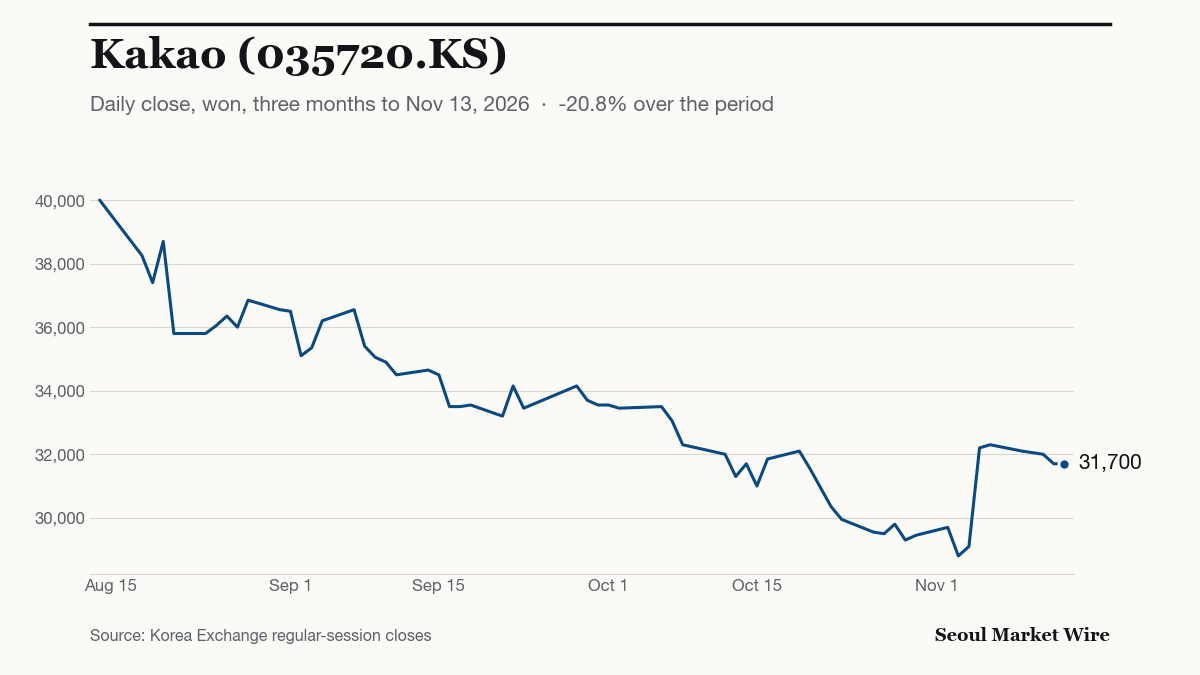
Several brokerages lowered their Kakao targets after third-quarter results, reflecting weaker earnings forecasts and uncertainty over AI monetisation. Platform revenue grew 17% year on year, but falling content sales and wider AI losses limited the benefit to earnings.
Revenue rose 6% year on year to 2.0867 trillion won, while operating profit increased 7% to 240.3 billion won. Kakao closed unchanged at 31,700 won on Nov. 13 on the Korea Exchange.
What drove growth, and what held it back?
Platform revenue reached 1.235 trillion won. KakaoTalk display advertising revenue rose 35%, while commerce revenue increased 16% to 241.3 billion won on transaction value of 2.3 trillion won.
The value of purchases for customers’ own use rose 33% year on year. Such purchases accounted for about 30% of reported commerce transaction value. Kakao changed the reporting scope in the third quarter to include only Gift and Talk Store, excluding Zigzag and Grip; the share therefore cannot be compared directly with earlier figures without adjusting the scope.
Content revenue fell 6% to 851.7 billion won. Music revenue declined about 10% to 508.3 billion won as major album releases and concerts decreased. Story revenue dropped 17%; Piccoma’s yen-denominated revenue fell 13%. Media revenue rose 49% to 142.8 billion won, helped by revenue recognised as productions progressed.
How much did valuations change?
The eight targets below range from 39,000 to 51,000 won, with an arithmetic mean of 45,000 won. The sample includes one report per brokerage listed on Naver on Nov. 6. It is not a market-wide consensus. The mean is approximately 42.0% above the Nov. 13 close.
| Brokerage | Naver listing date | Target price |
|---|---|---|
| Daishin Securities | Nov. 6, 2026 | 43,000 won |
| Kyobo Securities | Nov. 6, 2026 | 51,000 won |
| SK Securities | Nov. 6, 2026 | 50,000 won |
| IBK Securities | Nov. 6, 2026 | 48,000 won |
| Mirae Asset Securities | Nov. 6, 2026 | 44,000 won |
| Hanwha Investment & Securities | Nov. 6, 2026 | 43,000 won |
| Eugene Investment & Securities | Nov. 6, 2026 | 42,000 won |
| Shinhan Securities | Nov. 6, 2026 | 39,000 won |
The valuation changes involved both earnings estimates and multiples. Eugene cut its target from 58,000 to 42,000 won, applying 25 times forward earnings instead of 30 times to a reduced 12-month earnings forecast of 1,692 won per share. Daishin lowered its platform multiple to 22.6 times and its target from 47,000 to 43,000 won. At IBK, the target fell from 53,000 to 48,000 won.
Did earnings meet expectations?
Operating profit of 240.3 billion won was about 3.2% below the 248.3 billion won consensus cited in the reports.
Brokerages assessed the result against different benchmarks. Daishin recorded a 7.3% beat against its own forecast, while Hanwha described earnings as in line with consensus. Beating one firm’s estimate and missing the consensus are separate comparisons.
What explains the AI and infrastructure costs?
AI losses widened by approximately 18 billion won year on year, according to IBK’s estimate. That partly offset a roughly 36 billion won increase in standalone operating profit excluding AI.
Group-wide outsourcing and infrastructure costs rose 8% quarter on quarter but fell 2% year on year. Kakao attributed the quarterly increase to AI infrastructure demand and the annual decline to lower outsourcing costs for large music performances.
Depreciation and amortisation fell 3% year on year, reflecting greater use of Kakao’s own data centres and lower amortisation of content-related intangible assets. The consolidated expense figures do not isolate AI spending and are not directly comparable with IBK’s estimate of AI losses.
What remains unproven about AI revenue?
Delays in securing direct partner integrations prompted Kakao to supplement that approach with AI that operates a browser, Eugene explained. The brokerage tied its lower earnings multiple to the later validation of AI monetisation.
For Shinhan, Kanana Space’s convenience and user feedback are evidence needed to assess demand. Its analysts urged caution about assigning a higher valuation to AI agents before that evidence emerges.
Kakao plans to begin a Kanana Space pilot for preregistered users in December 2026.
Sources
- IBK Securities — Kakao: The shift to an AI platform gets under way (Naver listing: Nov. 6, 2026) stock.naver.com
- Eugene Investment & Securities — Kakao: A change in AI agent integration strategy (Naver listing: Nov. 6, 2026) stock.naver.com
- Kyobo Securities — Kakao: What must happen first to reach the target (Naver listing: Nov. 6, 2026) stock.naver.com
- Daishin Securities — Kakao: Growth and shareholder returns delivered; AI services about to launch (Naver listing: Nov. 6, 2026) stock.naver.com
- Shinhan Securities — Kakao: Core business steady, but AI agents must prove themselves (Naver listing: Nov. 6, 2026) stock.naver.com
6 more sources
- SK Securities — Kakao: Shares await AI results (Naver listing: Nov. 6, 2026) stock.naver.com
- Mirae Asset Securities — Kakao: Looking for a reversal after the split (Naver listing: Nov. 6, 2026) stock.naver.com
- Hanwha Investment & Securities — Kakao: Capital allocation and corporate value after the split (Naver listing: Nov. 6, 2026) stock.naver.com
- Kakao — Third-quarter 2026 earnings announcement kakaocorp.com
- Kakao — Third-quarter 2026 earnings presentation t1.kakaocdn.net
- Kakao — Share price information kakaocorp.com