Korea's 2027 profit forecasts rise as the 2028 AI spending outlook weakens
Yuanta reports upward revisions to Korean profit estimates for 2027. Its separate account of a lower 2028 AI accelerator spending forecast raises questions about growth beyond that year.
Market data: Korea Exchange regular-session close & Hana Bank USD/KRW reference rate, 2026-11-20 (KST)
Korean profit forecasts for 2027 are rising in Yuanta Securities’ latest research. But the brokerage’s Nov. 20 weekly report also cites a 28.1% downward revision to SemiAnalysis’s 2028 global AI accelerator spending forecast.
The two findings concern different years and different measures. Higher Korean earnings estimates can coexist with a lower forecast for subsequent customer spending, especially when that spending forecast still implies growth.
For holders of SK hynix and Samsung Electronics, the question is whether orders, memory prices and margins can sustain the expected profits. A revision to an industry spending forecast is not itself a change to either company’s earnings guidance.
What do the profit upgrades measure?
The weekly report records increases of 14.8 trillion won in KOSPI net-profit estimates for 2027 and 15.6 trillion won in its IT-sector aggregate. These are net-profit figures, rather than operating-profit figures.
They also come from a different dataset than the brokerage’s 200-company screening report. That screen records a 1.3% weekly increase in annual operating-profit estimates for 2027 and a 0.1% reduction for the fourth quarter of 2026.
| Earnings measure | Forecast period | Reported weekly revision | Coverage and basis |
|---|---|---|---|
| KOSPI net-profit estimates | Full-year 2027 | +14.8 trillion won | KOSPI aggregate in Yuanta’s weekly report; LSEG Workspace data |
| IT-sector net-profit estimates | Full-year 2027 | +15.6 trillion won | IT-sector aggregate in the same report; LSEG Workspace data |
| Operating-profit estimates | Full-year 2027 | +1.3% | Yuanta’s 200-company screening universe; estimates dated Nov. 18 |
| Operating-profit estimates | Fourth-quarter 2026 | −0.1% | Yuanta’s 200-company screening universe; estimates dated Nov. 18 |
Sources: Yuanta Securities, Nov. 20, 2026, weekly report, pages 2 and 5, and QWER screening report, page 6. The weekly report labels its comparison “current” versus “previous week” without specifying the two observation dates in the table. The screening report uses FnGuide Quantiwise data and labels its revisions as one-week changes.
The IT and KOSPI amounts are presented separately here. The table does not define the IT aggregate as a subset of the KOSPI aggregate, so subtracting the two would not establish a downgrade for non-IT KOSPI companies. Nor should the net-profit amounts be combined with the screening universe’s operating-profit percentages.
Within the 200-company screen, estimates for 2027 rose while those for the fourth quarter of 2026 edged lower. A weaker quarter can reflect delivery timing, prices or costs without determining the following year’s result.
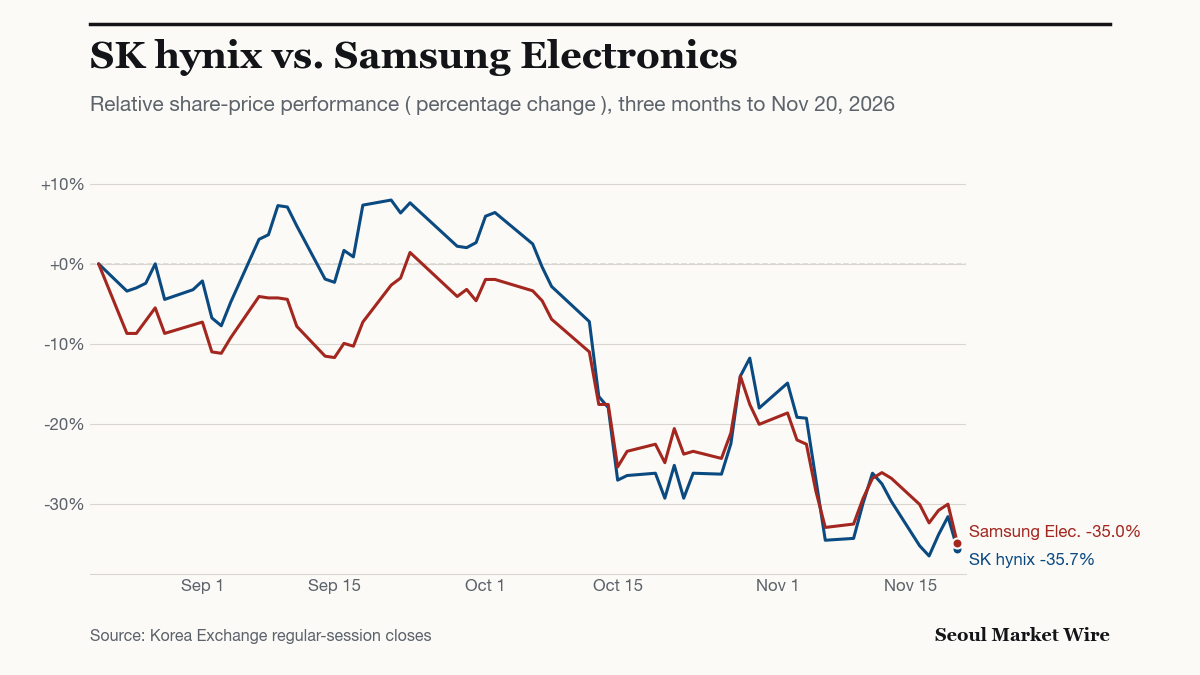
Chip shares fell on Nov. 20 despite forecast upgrades
The earnings revisions preceded another decline in Korean shares. On Nov. 20, the KOSPI closed at 4,869.96, down 5.21%. Samsung Electronics fell 7.01%, while SK hynix lost 5.92%.
| Market measure | Nov. 20 reading | Measurement basis |
|---|---|---|
| KOSPI | 4,869.96; −5.21% | Regular-session close; change from previous close |
| Samsung Electronics | 183,100 won; −7.01% | Regular-session close; change from previous close |
| SK hynix | 1,113,000 won; −5.92% | Regular-session close; change from previous close |
Sources: Naver Pay Securities for the index; Yahoo Finance historical prices for Samsung Electronics and SK hynix. Readings refer to the Nov. 20, 2026 regular-session close, rather than subsequent after-hours trading.
The daily price moves and weekly forecast revisions cover different intervals. Their coexistence shows that higher earnings estimates did not prevent those shares from falling; it does not isolate the reason for the selling.
What would support the upgrades?
Replacement demand offers one defence of chip sales when particular customers face restrictions. In its Nov. 20 report, Kiwoom Securities argues that customers waiting for supply could absorb Nvidia chips that would otherwise have gone to Chinese buyers.
The brokerage’s argument depends on available supply finding another buyer. Its analysis also distinguishes maintaining an existing sales forecast from retaining the ability to raise that forecast: replacement purchases can preserve sales while reducing the pool of unmet demand.
For Korean memory suppliers, the effect depends on the accelerators ordered, their memory content and the supplier selected. Prices and delivery dates determine the revenue contribution, while production costs determine how much becomes operating profit.
That makes customer substitution a narrower proposition than unchanged Korean earnings. Keeping accelerator shipments moving would support demand, but the product mix and commercial terms still matter for memory suppliers.
How could lower AI spending affect Korean chipmakers?
Page 8 of Yuanta’s weekly report attributes to SemiAnalysis a reduction in expected 2028 global AI accelerator spending from $1.054 trillion to $758 billion. The difference is $296 billion, or 28.1% after rounding.
The report does not give the original revision’s publication date or a detailed definition of included expenditure. The comparison therefore describes the accelerator-spending forecast reproduced by Yuanta, rather than all AI infrastructure investment or a newly announced cut to customer budgets.
Even after the reduction, the reproduced forecast projects spending growth of 59.9% in 2027 and 20.9% in 2028. The concern is slower expansion than previously expected; annual spending still rises in the forecast.
One possible effect is on valuation. If investors expect lower profits beyond 2027, they may pay less for a company’s shares even while its nearer-term earnings estimates rise. That mechanism could explain how the two measures diverge.
The operating effect would run through orders, memory content, selling prices and delivery schedules. Neither Yuanta comparison quantifies how the spending revision changes Samsung Electronics’ or SK hynix’s operating profit.
Financing adds a separate condition. In its Nov. 20 analysis, Shinhan Securities warns that supplier financing can accelerate purchases before customers generate sufficient independent cash flow. If final demand disappoints, the supplier can face both weaker equipment sales and deterioration in financing assets.
The report draws on telecom equipment financing in the late 1990s. It also cautions against treating that episode as identical to today’s AI market or assuming that financing caused the subsequent earnings deterioration.
What to watch next
| Indicator or security | Key sensitivity | Next scheduled event |
|---|---|---|
| US manufacturing and services PMIs | Business activity and prices relevant to demand and interest rates | S&P Global flash November releases on Nov. 23, according to its official preview |
| USD/KRW; 005930.KS; 000660.KS | Korean monetary policy and financing conditions | Bank of Korea policy-setting meeting on Nov. 26, according to its official calendar |
| USD/KRW; Korean equity valuations | US monetary policy and discount rates | Federal Reserve meeting on Dec. 8–9, US dates; its official calendar schedules the decision for Dec. 9 at 14:00 Eastern time, or Dec. 10 at 04:00 KST |
Sources
- Yuanta Securities — [QWER] November week 3: screening for a cyclical downturn (Nov. 20, 2026) stock.naver.com
- Yuanta Securities — Weekly: conditions for a Santa rally, November week 4 (Nov. 20, 2026) stock.naver.com
- Kiwoom Securities — [US Now] US AI chip rules: no empty seats at a restaurant with a queue (Nov. 20, 2026) stock.naver.com
- Shinhan Securities — Shinhan M.R.I: AI circular financing, fuel for growth or a financial weak link (Nov. 20, 2026) stock.naver.com
- Daishin Securities — Hopes for an end to China's Korea content ban rise ahead of the Anthropic IPO (Nov. 20, 2026) stock.naver.com
6 more sources
- Naver Pay Securities — KOSPI daily market data finance.naver.com
- Yahoo Finance — Samsung Electronics historical prices finance.yahoo.com
- Yahoo Finance — SK hynix historical prices finance.yahoo.com
- S&P Global — Five things to watch in the November flash PMIs spglobal.com
- Bank of Korea — Monetary Policy Board meeting dates bok.or.kr
- Federal Reserve — December 2026 calendar federalreserve.gov