Hana says Silicon2 price plan will test K-beauty's US pricing power
Silicon2 plans to adjust prices charged to retailers to recover currency-related margin losses, according to Hana Securities. Whether that leads to higher shelf prices depends on retailers' purchasing terms.

Market data: Korea Exchange regular-session close & Hana Bank USD/KRW reference rate, 2026-11-18 (KST)
Silicon2 plans to raise the prices it charges retailers to recover margins lost to won appreciation, according to Hana Securities’ Nov. 17 analysis. The proposed adjustment would test whether Korean indie beauty brands can retain their appeal if higher distribution prices reach shoppers.
This article draws on summaries of five brokerage reports dated Nov. 10–17, 2026, not on the full report texts. The sources link to the corresponding Naver Research listings.
Growing brands and constrained manufacturers explain the pressure to adjust prices. Neither establishes how consumers would respond to an increase.
How could a distributor’s price increase reach shoppers?
The currency mechanism begins with Silicon2’s purchasing costs. According to Hana, purchase prices have stayed unchanged while a falling USD/KRW rate has reduced the won value of the distributor’s sell-in prices. Selling a product on unchanged foreign-currency terms can therefore generate less revenue in won without a matching reduction in purchasing costs.
Raising sell-in prices could help recover that lost margin. The resulting profit change would depend on the adjustment, sales volumes and commercial terms. Recovering revenue per unit would not, by itself, establish that total profit had recovered.
Retail pricing introduces another condition. The brokerage describes retailers setting purchase prices as a percentage of retail prices, citing 65% and 70% as examples. If a retailer maintains its existing ratio after paying more to Silicon2, its shelf price would also have to rise. The final shelf price also depends on the retailer’s pricing decision.
The scope of Hana’s assessment is Korean indie brands that entered major US retail channels in 2025. Its analysts describe the proposed adjustment as a new pricing phase for those brands after a period of absorbing cost increases.
Those costs extend beyond currency translation. The summary describes freight and tariff pressure, alongside price increases by packaging suppliers and original design manufacturers, or ODMs, which develop and manufacture products for brands.
Source: summary of the SK Securities report. The selected brands’ weekly changes were −76, +47 and +34 points, respectively. These are brokerage ranking scores, not unit sales.
What do the demand indicators establish?
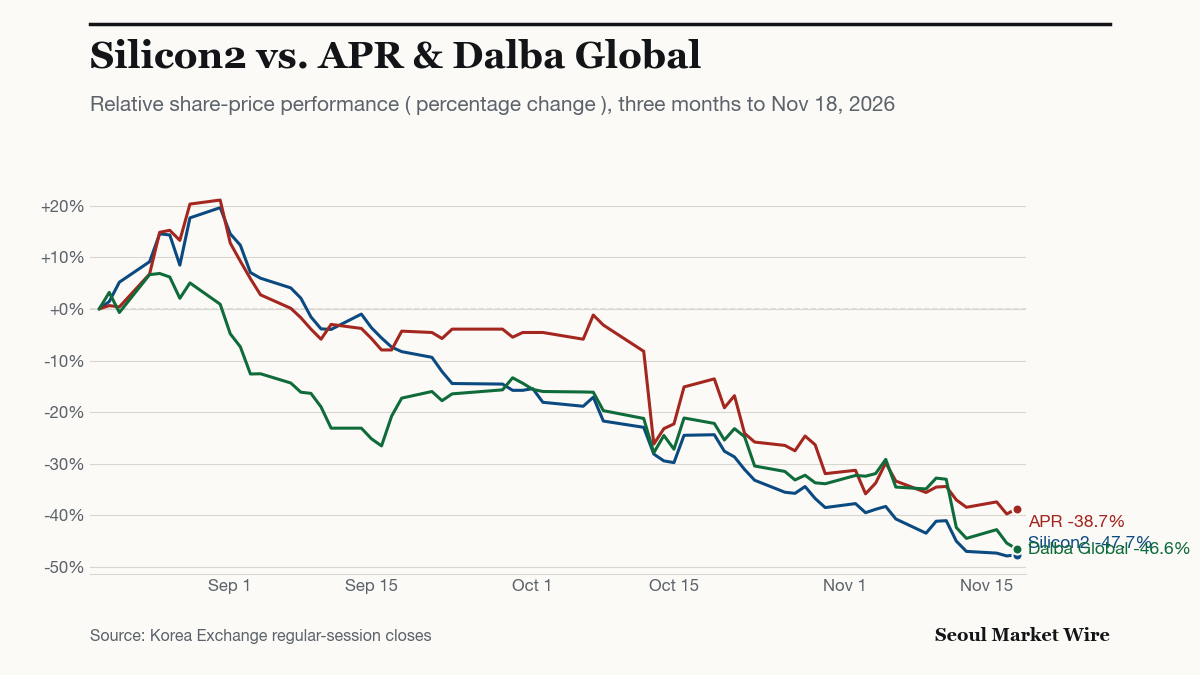
Indie-brand growth is a central theme of Kyobo Securities’ Nov. 16 outlook, which presents APR and Dalba Global as examples. The figures are not ranked against those of established beauty groups here because a comparable period and accounting basis have not been established.
The export argument addresses a different question. In its Nov. 12 outlook, Shinhan Securities identifies overseas expansion as the main reason it expects stronger revenue growth for cosmetics companies than for apparel companies in 2027. That is a forecast about where growth comes from.
For spending within Korea, the brokerage sees foreign visitors supporting cosmetics demand as consumption by Korean residents slows. It identifies a shift toward channels such as Olive Young. This interpretation concerns who is buying and where they shop.
Online rankings offer a more frequent but narrower observation. SK Securities’ Nov. 11 summary puts its composite Amazon bestseller-ranking score for its K-beauty universe at 1,843 points, down 79 points over the week. Brand movements differed, as the chart shows.
Without the scoring formula and coverage, the composite’s point change cannot be converted into a percentage change in purchases or used to measure demand across the whole sector.
The following comparison distinguishes the figures available in the summaries from the underlying evidence needed to verify them. No primary-data reconciliation or rounding check is claimed.
| Metric | Brokerage summary | Primary-data check | Supported use |
|---|---|---|---|
| Retailer purchase price relative to shelf price | Hana, Nov. 17: 65% and 70% as examples | Retailer contracts and transaction prices were not supplied | Illustrates conditional price transmission; not a verified industry range |
| Kolmar top-10 customer share of third-quarter sales | Hana, Nov. 10: 58%, up 3 percentage points year on year | Matching company disclosure and reporting scope were not supplied | An attributed observation about customer concentration |
| K-beauty Amazon composite score | SK, Nov. 11: 1,843 points, down 79 week on week | Underlying Amazon observations and the scoring formula are not given | Tracks the reported score, not sales growth |
How are manufacturers responding to capacity constraints?
Capacity shortages create a choice between taking additional orders and protecting profitability. Hana’s Nov. 10 manufacturing review describes packaging shortages in the first half of 2026 and tighter ODM capacity in the second. It reports that Cosmecca Korea and Kolmar Korea both missed third-quarter operating-profit expectations, but attributes their shortfalls to different operating choices.
For Cosmecca, the analysts describe an emphasis on attracting customers, expanding sales and meeting delivery deadlines, even at the expense of near-term margins. They suggest that accommodating the additional business probably required substantial outsourcing. The summary gives no figure for outsourcing’s share of the profit shortfall.
At Kolmar, sales below expectations increased the fixed-cost burden, according to the same analysis. The brokerage characterizes its approach as more selective about profitability and suggests it may have declined some indie-brand orders rather than fulfill them through lower-margin outsourcing. That suggestion is not a confirmed account of specific rejected orders.
Kolmar’s reported top-10 customer share also rose. Hana interprets the increase as greater concentration on major customers’ production needs.
Preparing external production capacity in advance was another approach. The review says Cosmax expanded its outsourcing capabilities during 2025 in preparation for higher production.
What could prevent higher prices from restoring margins?
Customer response is the main uncertainty in the pricing proposal. Hana identifies value for money and innovation as strengths of Korean indie brands. If higher sell-in prices reach shoppers, the price advantage could narrow.
Currency exposure also differs by channel. A stronger won can reduce the won proceeds of foreign-currency export sales. For visitors shopping in Korea, appreciation against their home currency can make unchanged won-denominated prices more expensive. Shinhan flags won strength as a risk to visitor spending.
For manufacturers, outsourcing adds an operational constraint alongside its cost. Hana identifies quality control as a principal difficulty when production moves to smaller manufacturers.
What to watch next
These are company-specific monitoring points, not a confirmed event calendar. The reports gave no dates for the disclosures below.
| KRX ticker | Key sensitivity | Next catalyst and date |
|---|---|---|
| Silicon2 — 257720.KQ | Sell-in prices, sales volumes and currency-related margins | Pricing implementation details; date not specified in the Nov. 17 summary |
| APR — 278470.KS; Dalba Global — 483650.KS | Revenue growth and profitability after changes in pricing or costs | Company disclosures separating price, volume and cost effects; dates not verified |
| Kolmar Korea — 161890.KS; Cosmecca Korea — 241710.KQ | Customer mix, outsourcing costs and operating margins | Results with comparable reporting scopes; dates not verified |
| Cosmax — 192820.KS | External production capacity and quality control | Disclosure of outsourcing performance and costs; date not verified |
For Silicon2’s proposed adjustment, the Nov. 17 summary specifies neither an implementation date nor the size of the increase, nor the products or retailers covered.
Sources
- Hana Securities: Cosmetics, will price adjustments succeed? (Nov. 17, 2026; Naver Research listing) stock.naver.com
- Kyobo Securities: 2027 Cosmetics Outlook: The Boom Is Real (Nov. 16, 2026; Naver Research listing) stock.naver.com
- Shinhan Securities: Domestic staying power plus export reach (Nov. 12, 2026; Naver Research listing) stock.naver.com
- SK Securities: Weekly Amazon Beauty Check (Nov. 11, 2026; Naver Research listing) stock.naver.com
- Hana Securities: Comparing third-quarter results of three cosmetics manufacturers (Nov. 10, 2026; Naver Research listing) stock.naver.com