Shinhan sees overseas expansion driving Korean food-sector earnings in 2027
Overseas expansion supports Shinhan's 2027 earnings outlook, but plant utilisation and input costs will determine profitability. KT&G's dividend plans offer a separate shareholder-return case.

Market data: Korea Exchange regular-session close & Hana Bank USD/KRW reference rate, 2026-11-16 (KST)
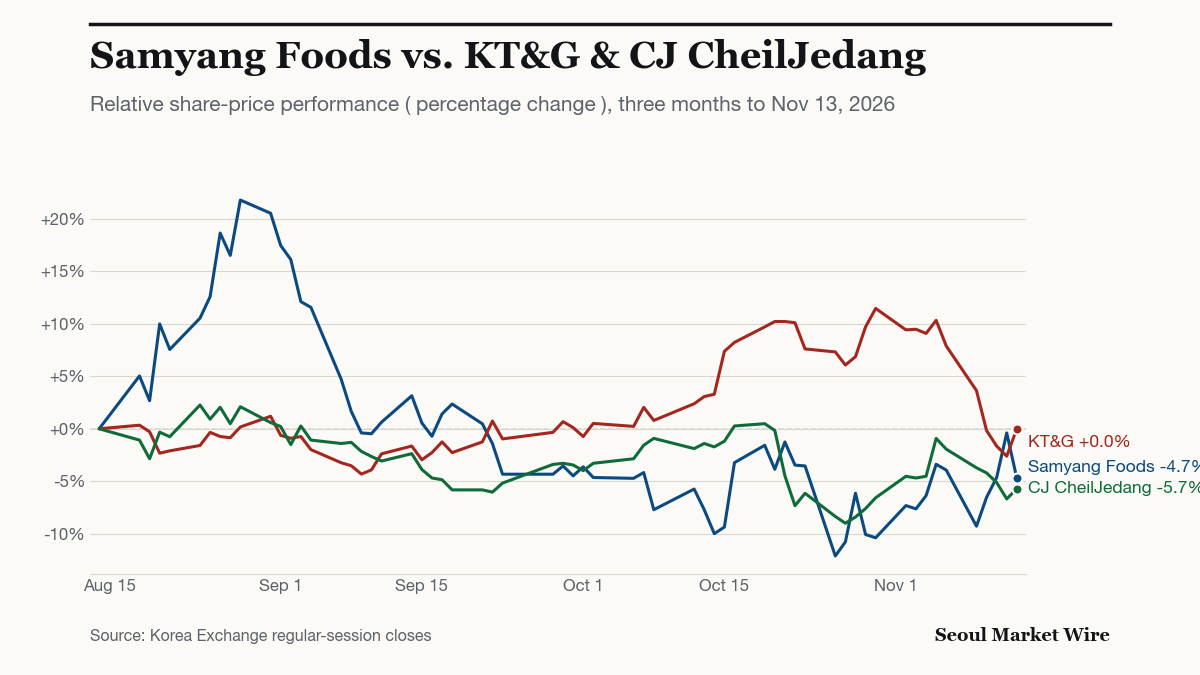
Overseas expansion could make earnings growth a stronger investment argument for Korean food stocks in 2027, Shinhan Securities argued in its Nov. 9 sector outlook. The shift depends on companies converting new production capacity into profitable sales, while recent share-price performance shows the limits of relying on the sector’s defensive appeal.
The food sector’s second-half outperformance against the KOSPI stood at 47.7 percentage points in Hana Securities’ Nov. 9 weekly review. Its Nov. 16 update reported a 9.4-point underperformance in the preceding week. These are relative returns over different periods, not absolute sector gains or a new cumulative performance calculation.
Shinhan’s sector-wide growth outlook for 2027 and Hana’s year-end defensive case for KT&G address different investment horizons. The former rests on operating expansion; the latter places greater weight on dividend visibility.
What would turn overseas expansion into earnings growth?
The growth argument begins with constraints at home. Shinhan identifies structural consumption weakness and demographic change as limits on domestic sales volumes. Overseas expansion offers access to additional customers, with new capacity expected to help food makers enter major retail channels and expand distribution.
After three to four years of investment, the earnings impact will depend on how quickly companies raise utilisation and sell the additional output profitably. A larger factory network provides room for growth, but the brokerage’s thesis also requires distribution gains and sufficient demand to absorb production.
Capital allocation is another part of the argument. Its analysts describe a shift from conservative investment and cash accumulation toward operating efficiency and shareholder returns. In their assessment, improved profitability can support larger distributions as companies make better use of capital.
A companion food and retail outlook, also dated Nov. 9, connects domestic earnings recovery to restructuring as well as consumer spending. The brokerage expects reduced competition and lower costs to amplify the profit contribution from modest revenue growth.
Semiconductor-sector bonuses and inbound tourism feature as potential sources of demand in that assessment. They sit alongside the overseas growth thesis rather than establishing that domestic consumption has already recovered.
How much capacity is planned, and when?
For Samyang Foods, the expansion schedule spans two countries and several years. Yuanta Securities’ Nov. 12 assessment describes a 218.6 billion won investment in a Vietnam plant targeted for completion in January 2029.
The building is intended to accommodate eight production lines, but the initial installation comprises one non-fried-noodle line. Seven subsequent lines are planned for fried noodles, including Buldak products. The initial completion schedule therefore covers a smaller operating footprint than the building’s eventual capacity.
China comes first. Yuanta projects annual global capacity of 3.78 billion servings in 2027, including 1.13 billion at Jiaxing. These figures are the brokerage’s capacity estimates, not forecasts of actual production or sales volumes.
The first Vietnam line is projected to add 120 million to 140 million servings annually in 2029, bringing global capacity to about 3.9 billion. Its estimated annual sales potential is 80 billion to 120 billion won. That estimate covers the initial line, not the full eight-line development.
Jiaxing falls within the sector’s 2027 earnings forecast. Vietnam’s first line is scheduled for 2029, so it falls outside that forecast year. Further expansion would add another phase whose timing should not be folded into the initial commissioning date.
What are KT&G’s shareholder-return targets?
Dividend expectations have already tested the defensive case. Hana warned on Nov. 9 that hopes for a 10,000-won dividend in 2027 could prompt disappointment. In its Nov. 16 update, the brokerage linked KT&G’s 7.3% weekly decline to that disappointment, while retaining its buy-and-hold stance. That explanation is the analysts’ interpretation of the selling.
The company’s targets are distinct from those market expectations. Under its Capital Markets Day plan, KT&G targets 5 trillion won of basic shareholder returns over 2027–2030, including dividends and share buybacks.
That allocation is 1 trillion won above the previous 4 trillion won basic programme. The comparison excludes the previous programme’s additional 400 billion won of returns.
For 2026, the company targets a dividend of 8,000 won per share, comprising a 2,000-won interim dividend and a targeted 6,000-won final dividend. The four-year plan also targets a payout ratio of at least 75% by 2030 and 1.2 trillion won of share buybacks and cancellations, equivalent to about 300 billion won annually.
Potential special returns depend on additional resources, including proceeds from non-operating assets. They are separate from the basic programme.
In its Nov. 9 assessment, Hana expected annual dividend increases of at least 1,000 won from the 2026 target. That was a brokerage expectation, not a company commitment to a particular 2027 payment. A minimum expected increase also does not establish a fixed 9,000-won forecast.
What changed after CJ CheilJedang’s results?
The recovery case now has a reported quarter behind it. CJ CheilJedang announced on Nov. 10 that third-quarter operating profit excluding CJ Logistics rose 6.9% year on year to 203 billion won. Revenue on the same basis increased 5.7% to 4.23 trillion won.
The food business showed the tension between sales growth and costs. Lifestyle food revenue rose 3.8% to 2.57 trillion won, while operating profit was unchanged at 118.7 billion won. The company cited raw-material and logistics expenses alongside growth in key products and distribution channels.
Following the release, Hana’s Nov. 11 earnings review continued to favour buying for a 2027 recovery. Its analysts expected a fuller contribution from selling-price increases, wider overseas distribution and improved lysine conditions.
The valuation reference also needs its date and forecast period. The Nov. 9 weekly put the shares at 0.4 times forecast 2027 book value; the subsequent earnings review cited 0.4 times 12-month forward book value. Both were report-date valuations based on the brokerage’s estimates, rather than multiples recalculated at the Nov. 16 close.
Where could operating performance fall short?
Input costs remain a condition of Shinhan’s growth thesis. Its sector outlook identifies inventories, a stronger won and earlier selling-price increases as potential offsets to raw-material pressure. Those assumptions do not establish that every producer will preserve its margin: the argument depends on how procurement costs and selling prices affect each company’s earnings.
The domestic recovery is conditional too. Fading subsidy effects and structural consumption weakness limit reliance on household spending alone. The brokerage’s assessment consequently draws on restructuring and overseas sales as additional sources of profit improvement.
At Samyang, shipment execution provides a concrete example of the gap between production capacity and recognised sales. Hana’s Nov. 9 review reported that third-quarter overseas sales rose 2.3% from the preceding quarter despite fewer working days and shipment delays estimated to have affected about 10 billion won of sales.
The brokerage forecast sequential overseas sales growth of 4%–5% in the fourth quarter. It also identified changes to European distributors as a potential source of growth in 2027, without presenting those changes as an established cause of the third-quarter slowdown.
Sources
- Shinhan Securities: Neon and Beyond (2027 food sector outlook), Nov. 9, 2026 stock.naver.com
- Shinhan Securities: Where is consumer spending heading? (2027 food and retail outlook), Nov. 9, 2026 stock.naver.com
- Hana Securities: Weekly comment, small and mid-cap Q3 reviews and October exports, Nov. 9, 2026 stock.naver.com
- Hana Securities: Weekly comment, Q3 earnings implications and Orion October review, Nov. 16, 2026 stock.naver.com
- Hana Securities: Nov. 16 weekly report, original PDF file.hanaw.com
4 more sources
- Yuanta Securities: Comment on Samyang Foods' new Vietnam plant, Nov. 12, 2026 stock.naver.com
- KT&G: Capital Markets Day shareholder-return plans ktng.com
- CJ CheilJedang: Third-quarter results, Nov. 10, 2026 m.cj.co.kr
- Hana Securities: CJ CheilJedang third-quarter earnings review, Nov. 11, 2026 file.hanaw.com