How Korea’s household-lending targets affect bank growth
Household-lending targets govern credit growth, while applicable repayment tests govern borrower eligibility. The earnings and distribution effects also depend on margins, credit losses, operating costs and capital.

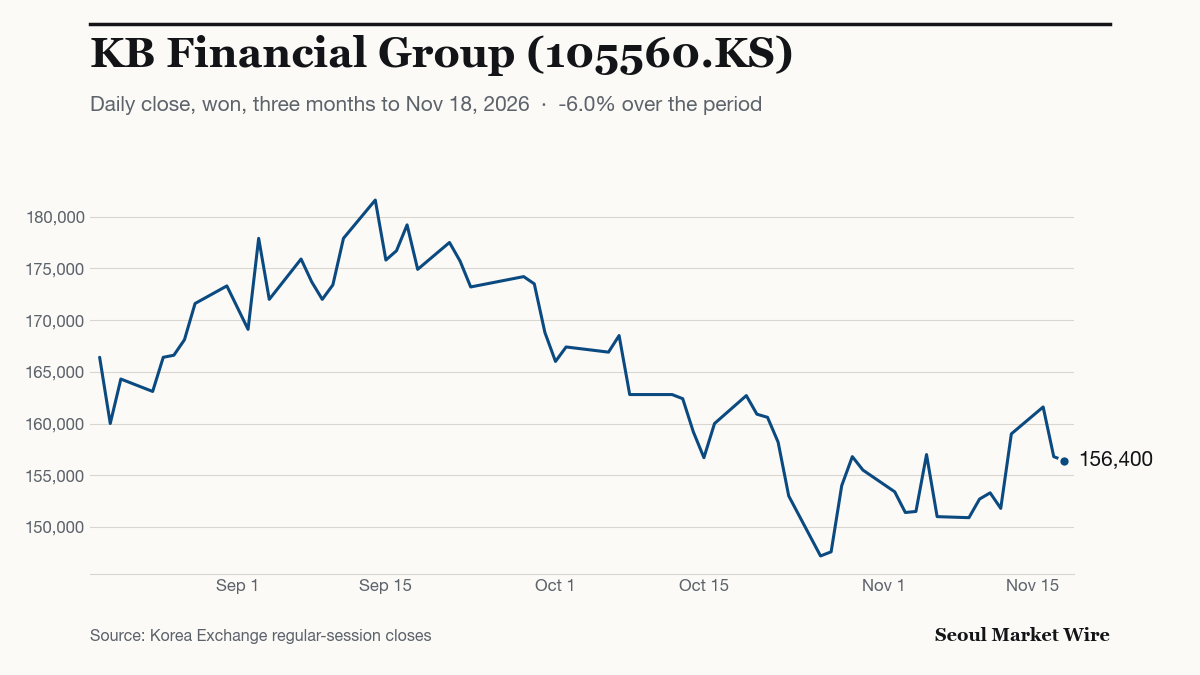
Market data: Korea Exchange regular-session close & Hana Bank USD/KRW reference rate, 2026-11-18 (KST)
Korea’s national household-lending target sets an aggregate growth objective. Individual lenders have their own targets, while borrowers face separate eligibility requirements.
For bank shareholders, the earnings effect depends on more than loan growth. Additional lending generates interest income, but funding costs, credit losses and operating expenses also affect profitability. Capital requirements matter for the capacity to lend and distribute earnings. KB Financial Group’s earnings disclosures illustrate these distinctions: they report lending and margins for KB Kookmin Bank, the group’s banking subsidiary, alongside capital figures for the group.
How do lenders’ growth targets work?
The Financial Services Commission announced a national household-loan growth target of 1.5% in April 2026. Its management framework combined annual institution-level targets with monthly and quarterly targets intended to reduce the risk of lending becoming abruptly scarce near year-end.
Separate mortgage targets addressed a problem that a total household-loan figure could conceal: lenders expanding mortgages while reducing other household credit. A restrained total can coexist with faster growth in one component. Mortgage-specific controls therefore address the composition of lending as well as its aggregate growth. FSC household-debt management plan
Under the April plan, institutions that exceeded their 2025 management targets faced deductions from their 2026 allowances. That adjustment applied to those specified years.
On August 13, the FSC raised the national target to 3.0% as part of measures supporting housing supply and financing for young adults and non-speculative buyers. This increased the aggregate growth target without setting a uniform 3.0% allowance for every bank. FSC housing-finance measures
In its October 15 update, the FSC said financial institutions had been instructed to manage group loans for new apartment subscriptions separately. The regulator cited those instructions in addressing concerns about a year-end lending squeeze. Separate management does not mean those loans are exempt from every lending restriction. FSC October update
Why is a growth allowance different from a borrower limit?
A lender’s growth allowance concerns its loan portfolio. For loans subject to DSR rules, a borrower’s debt service ratio measures annual debt repayments relative to annual income. A lender’s unused growth allowance does not override the applicable DSR limit.
Stressed DSR adds a stress-rate assumption to the repayment calculation to account for the possibility of higher future interest rates. This assumption assesses borrowing capacity rather than increasing the contractual interest rate charged to the customer. A larger assumed repayment burden can reduce the amount a customer qualifies to borrow even when the lender has room under its growth target. FSC explanation of stressed DSR
Loan structure also affects the assessment. The FSC distinguishes variable-rate loans from products with mixed or periodically resetting rates, reflecting differences in their exposure to rate changes. Its framework seeks to encourage fixed-rate lending.
This mechanism can restrain borrowing capacity even when market interest rates fall. Contractual rates and stress assumptions are separate inputs, so a lower loan rate need not produce an equivalent increase in borrowing capacity. Applicable stress rates and exemptions depend on the loan category and the rules in force. FSC stressed DSR framework
What do the reported figures actually measure?
Policy targets and company results can look comparable because both are expressed as percentages. Their periods, denominators and institutional scope differ.
The national target does not specify KB Kookmin Bank’s individual lending allowance. Comparing it directly with the bank’s reported household-loan growth would also mix an annual policy objective with a nine-month change in a particular portfolio.
| Measure | Reported figure | Primary-source scope and period | What it measures |
|---|---|---|---|
| National household-loan growth target | 1.5%, raised to 3.0% | FSC target for 2026, announced in April and revised in August | A policy objective, not realised lending growth or a uniform bank allowance |
| KB Kookmin Bank household-loan growth | 1.5% | Won-denominated household loans, end-2025 to end-September 2026 | Actual growth in the bank’s specified loan portfolio |
| KB Kookmin Bank corporate-loan growth | 5.5% | Won-denominated corporate loans, end-2025 to end-September 2026 | Growth in a separate loan category over the same period |
| KB Kookmin Bank net interest margin | 1.72%, down 2 basis points | Third quarter of 2026, compared with the preceding quarter | A bank margin measure, not a loan-growth rate |
| KB Financial Group CET1 ratio | Preliminary 13.80% | Group common equity Tier 1 ratio at end-September 2026 | Core equity capital relative to risk-weighted assets |
Sources: FSC April plan, FSC August revision and KB Financial’s third-quarter presentation.
How do lending volumes relate to earnings?
Household lending is only part of the bank’s loan book. Its won-denominated household loans rose 1.5% from end-2025 to end-September 2026, while corporate loans grew 5.5%. These figures cover the banking subsidiary, rather than lending across the entire financial group.
The bank’s net interest margin was 1.72% in the third quarter, down two basis points, or 0.02 percentage points, from the preceding quarter. Management attributed the contraction to higher funding costs despite some improvement in loan yields. KB earnings presentation
Loan growth covers the first nine months, while the margin comparison covers consecutive quarters.
A larger loan book can generate more interest income, while a narrower margin can offset some of that benefit. Credit losses and operating costs also affect how much income reaches the bottom line. Loan growth alone therefore cannot quantify the profit contribution of additional lending.
Nor does the presentation isolate the effect of household-lending targets on performance. Estimating that effect would require evidence about lending that the targets prevented or enabled, together with the income and costs associated with those loans.
How does lending affect capital and shareholder returns?
At end-September, KB Financial Group reported a preliminary common equity Tier 1 ratio of 13.80%, measuring core equity capital relative to risk-weighted assets. Unlike a loan-growth rate, this ratio relates a stock of capital to assets adjusted for their regulatory risk. KB capital disclosures
Loan volume and risk weights can both affect that denominator. A higher risk weight requires more capital to maintain the same capital ratio against a given amount of lending. An unused household-lending allowance is consequently not an equivalent amount available for dividends or share buybacks.
The FSC’s August package paired the higher aggregate lending target with plans to tighten DSR income criteria, increase mortgage risk weights and introduce a sectoral systemic risk buffer. These measures address borrower repayment capacity and the capital held against lending, alongside portfolio growth. FSC housing-finance package
What to watch next
KB Financial Group (KRX: 105560; data symbol: 105560.KS): December 31, 2026 is the year-end capital reference point for its first round of 2027 shareholder returns. This is a measurement date, not an announced results-release date. In its third-quarter presentation, the group stated that those returns would be determined by its year-end CET1 ratio. KB shareholder-return disclosures
Sources
- FSC — Government Unveils 2026 Household Debt Management Plan fsc.go.kr
- FSC — Plans to Boost Housing Supply and Housing Finance Support for Young Adults fsc.go.kr
- FSC — Household Loans, September 2026 fsc.go.kr
- FSC — Third-stage Stressed Debt Service Ratio Rules fsc.go.kr
- KB Financial Group — Third-quarter 2026 Earnings Presentation m.kbfg.com