Hyundai Motor and Kia rally, but brokers warn tariff powers remain
Kiwoom cited hopes of weaker tariff pressure, while IBK expected the administration's tariff stance to continue.

Market data: Korea Exchange regular-session close & Hana Bank USD/KRW reference rate, 2026-11-05 (KST)
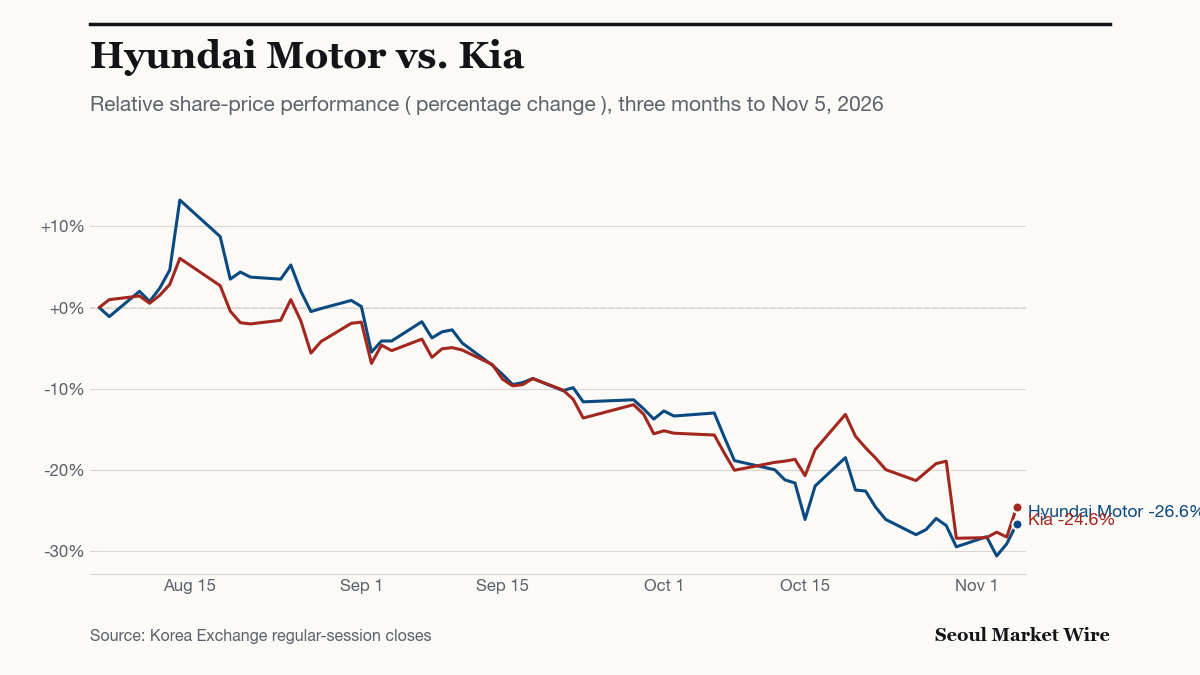
Hopes of weaker US tariff pressure helped Hyundai Motor and Kia rally, according to Kiwoom Securities’ Nov. 6 Morning Letter. But IBK Securities’ Nov. 5 Global Markets Monitor expected the Trump administration’s tariff stance to continue under existing trade laws.
Hyundai Motor rose 3.53% to 293,500 won and Kia gained 5.22% to 100,800 won at the Nov. 5 regular-session close in Seoul. The KOSPI fell 5.28% to 5,383.80, a session covered in our Nov. 5 market report.
The auto-share gains contrasted with declines across the artificial-intelligence supply chain. Kiwoom linked that weakness to concerns about US data-centre regulation.
Which tariff powers remain?
Existing legislation gives the administration trade-policy tools despite a change in congressional control, IBK argued. Its forecast concerned the continuation of the administration’s tariff stance; it did not establish that every current tariff would remain unchanged.
Section 232 of the Trade Expansion Act of 1962 concerns national-security risks from imports. The Commerce Department’s explanation describes an investigation and a report to the president on whether imports threaten to impair national security.
Section 301 of the Trade Act of 1974 addresses specified foreign trade practices. USTR describes its scope as foreign government acts, policies or practices that are unjustifiable, unreasonable or discriminatory and burden or restrict US commerce. Both provisions operate within statutory conditions; neither grants unrestricted tariff discretion.
What can a new Congress change?
Democrats won control of both chambers in the Nov. 3 US midterm elections, IBK reported. The incoming Congress begins its term on Jan. 3, 2027, under the Twentieth Amendment.
The brokerage expected Democratic control to strengthen congressional checks through budget negotiations and Senate confirmation of senior appointments. Those appointments include the Federal Reserve chair and vice-chair, who are nominated by the president and confirmed by the Senate.
Blocking new policies and changing established ones are separate tasks, according to SK Securities’ Nov. 5 macro report, The Age of the Veto: Policy Speed and Investment Costs. Its analysts expected greater constraints on new legislation and budgets without an automatic reversal of existing executive action.
Overriding a presidential veto requires a two-thirds vote in each chamber. SK argued that legislation opposed by Trump would therefore need Republican cooperation.
Who handles the December funding deadline?
Section 106 of Public Law 119–103 sets Dec. 11, 2026, as the expiry date for interim funding for covered activities, unless another provision or an earlier statutory trigger applies. Those triggers include enactment of funding for an activity or an applicable fiscal 2027 appropriations act that omits it.
The year-end budget talks would provide an early test of post-election bargaining, SK argued. It expected negotiations to focus on spending priorities and warned that a compromise might deliver limited deficit reduction. Mandatory spending and interest costs constrained how much discretionary-spending adjustments could achieve, in the brokerage’s assessment.
Those December negotiations fall to the current Congress. Republicans retain their majority until the incoming Congress takes office in January, SK noted.
Sources
- Kiwoom Securities — 11/06, Kiwoom Morning Letter, Nov. 6, 2026, pp. 1–2 stock.naver.com
- IBK Securities — Global Markets Monitor: Blue Wave Implications (Kim Ye-seul), Nov. 5, 2026, p. 1 stock.naver.com
- SK Securities — Macro Comment: The Era of the Veto — Policy Speed and Investment Costs (Shin Yoon-jung), Nov. 5, 2026, p. 1 stock.naver.com
- US Bureau of Industry and Security — Section 232 Investigations bis.gov
- USTR — Takes Action in Forced Labor Section 301 Investigations, July 23, 2026 ustr.gov
4 more sources
- National Archives — Constitution Questions and Answers: Presidential Veto archives.gov
- National Archives — Constitution: Twentieth Amendment archives.gov
- Federal Reserve — Board Members: Appointment and Confirmation federalreserve.gov
- Public Law 119–103 — Continuing Appropriations and Extensions Act, 2027, Section 106 govinfo.gov