Korean steel outlook hinges on lower costs amid China's glut
Lower raw-material costs could help Korean steelmakers in 2027, but selling prices and construction starts will determine how much relief reaches earnings. Brokers see different effects from US tariffs across exporters and local producers.

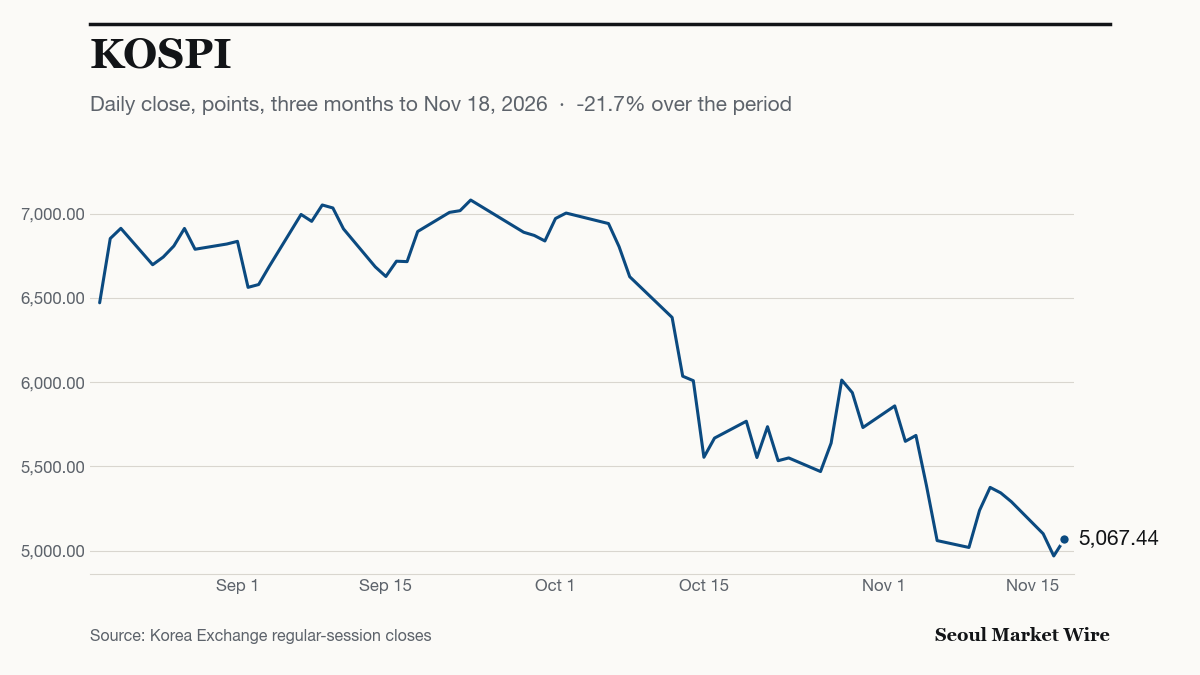
Market data: Korea Exchange regular-session close & Hana Bank USD/KRW reference rate, 2026-11-18 (KST)
Global steel shares outperformed non-ferrous-metal shares in the period covered by iM Securities’ Nov. 16 weekly, despite weak industry momentum. The brokerage attributed the relative strength to low price-to-book valuations and tariff-related profit expectations. For Korean steelmakers, the earnings case for 2027 depends partly on whether cheaper raw materials can offset pressure on selling prices.
In its Nov. 13 outlook, Hana Securities forecast easing input costs alongside persistent Chinese overcapacity and export pressure. Domestic rebar prices offer a warning against treating cost relief as evidence of stronger demand: the brokerage’s Nov. 16 price survey recorded another weekly decline.
Seven broker reports reviewed
| Brokerage | Date in 2026 | Focus |
|---|---|---|
| Hana Securities | Nov. 9 | Weekly prices and weak Chinese construction-steel demand |
| iM Securities | Nov. 9 | Emerging-market metals shares and hopes of tariff relief |
| Eugene Investment & Securities | Nov. 10 | US tariff durability and companies with US exposure |
| Hana Securities | Nov. 13 | Chinese demand, regional pricing and 2027 input costs |
| Hana Securities | Nov. 16 | Weekly prices and persistent Chinese oversupply |
| iM Securities | Nov. 16 | Global steel valuations and non-ferrous shares’ relative weakness |
| Eugene Investment & Securities | Nov. 17 | Construction orders and demand for bars and sections |
Source: Hana’s Nov. 16 weekly. These are separate price series, not a measure of steelmakers’ margins.
What explains the share-price divergence?
The global equity comparison reflects pressures on non-ferrous shares as well as support for steel. In its later weekly, iM linked non-ferrous stocks’ relative weakness to monetary-tightening concerns, higher interest rates and a stronger dollar.
Individual Korean stocks also had company-specific influences. The brokerage’s Nov. 9 report attributed Korea Zinc’s strength, despite weak results, to rebounding gold and expectations of shareholder returns and a stock split. Its Nov. 16 report associated subsequent weakness with falling precious-metal prices and flagged renewed uncertainty over corporate control.
Those observations concern share-price performance, rather than steel demand or mill profitability. The cost and construction forecasts address separate questions about how Korean steelmakers’ earnings might change.
Can lower costs offset Chinese oversupply?
The lower-cost case rests on two supply assumptions. Hana expects additional global iron ore supply and declining Chinese steel output to weaken ore prices. Normalising coking-coal supply should also limit further price increases, gradually reducing steelmakers’ raw-material burden.
Chinese demand is expected to contract more slowly, rather than return to growth. Hana cites worldsteel forecasts that Chinese steel demand will decline by 2.0% in 2026 and 1.0% in 2027. Both figures are forecasts. The brokerage points to fiscal support and a slower decline in property investment, while expecting tighter capacity-replacement rules and mill production cuts to reduce crude steel output. Structural overcapacity and export pressure would still limit a sustained price rebound, in its assessment. Hana’s Nov. 13 outlook.
Regional prices could consequently diverge. High tariffs and infrastructure spending underpin Hana’s expectation of relatively firm US prices. Its European forecast rests on tighter import restrictions and costs associated with the Carbon Border Adjustment Mechanism. CBAM entered its definitive regime on Jan. 1, 2026. European Commission.
The weekly observations show costs and selling prices falling together. In the Nov. 16 report, iron ore and Korean scrap prices declined, but domestic rebar fell too. Hot-rolled coil and plate were unchanged.
| Series reported by Hana | Nov. 9 report | Nov. 16 report |
|---|---|---|
| Korean rebar distribution price, won/tonne | 820,000 (-1.8%) | 790,000 (-3.7%) |
| Chinese iron ore import price, US dollars/tonne | 92.5 (+3.0%) | 89.9 (-2.8%) |
| Korean scrap price, won/tonne | 414,000 (-0.5%) | 405,000 (-2.2%) |
Figures in parentheses are the reports’ week-on-week changes. Dates refer to report publication; price-observation dates may differ. Nov. 9 report, Nov. 16 report.
Other Korean distribution prices in the later report were 920,000 won a tonne for domestic hot-rolled coil, 870,000 won for imported coil and 990,000 won for plate. The earlier weekly attributed plate’s increase to low distributor inventories and rebar’s weakness to poor demand.
Chinese hot-rolled coil fell 0.4% to 3,203 yuan a tonne in the later report. Australian coking coal was down 0.5% at $261 a tonne, free on board. US hot-rolled coil was quoted at $1,276 per short ton, down 0.3%. The US unit differs from the metric tonnes used for the other steel and raw-material series.
These are separate product prices, not a calculated mill margin. Selling-price declines could absorb the input-cost savings Hana expects, particularly if Chinese export pressure persists.
Who benefits if US tariffs remain?
Hopes of tariff relief and expectations of protection for US producers can support different companies. The Nov. 9 iM report attributed strength among some emerging-market steelmakers and miners partly to hopes that Congress would constrain US tariff policy. That was an explanation of selected share-price moves.
In its Nov. 10 analysis, Eugene Investment & Securities expected the 50% tariff on major steel products to remain. The brokerage cited support for domestic steelmaking and the executive authority underpinning Section 232 measures. Its argument concerned the durability of trade protection.
An exporter hoping for easier market access and a producer benefiting from protected US prices have different exposures. For Korean companies, Eugene identified potential relative benefits for SeAH Steel’s US-bound line pipe and oil-country tubular goods business, and for SeAH Steel Holdings’ US production operations.
Higher selling prices could help SeAH Steel, in the brokerage’s assessment. The same report described tariffs as a burden on Korean steel exports more broadly.
Nippon Steel raised its FY2026 underlying business profit forecast for U.S. Steel, including Nippon Steel Slovakia, to at least ¥230 billion from at least ¥180 billion. The figures are forecast minimums for the stated business scope, rather than a standalone U.S. Steel profit figure. Nippon Steel presentation, page 7.
For 2027, Cleveland-Cliffs said it expected adjusted EBITDA to exceed $4 billion, based on signed contracts and its then-current index-price outlook. That conditional forecast uses a different earnings measure and period from Nippon Steel’s underlying business profit projection. Cleveland-Cliffs results release.
Will construction orders become steel demand?
Domestic demand depends on the conversion of orders into building activity. Eugene’s Nov. 17 weekly cited Construction & Economy Research Institute of Korea projections for 2026 construction orders of 252 trillion won, up 13.7%.
Non-residential building orders were forecast to rise about 17% to 77 trillion won in 2026, supported by semiconductor fabs and AI data centres. The report puts 2027 non-residential orders at about 83 trillion won. Residential orders were projected at 108 trillion won in 2026, up 6.0%.
The corresponding steel-volume forecasts were much more modest. The institute projected 2027 construction demand growth of 0–3% for rebar and steel bars and 2–4% for sections, as cited by Eugene. Housing construction is associated with rebar demand, while steel-frame non-residential buildings support demand for sections.
On that basis, the brokerage identified Hyundai Steel and Dongkuk Steel, both producers of rebar and H-beams, as potential beneficiaries. This is a demand-recovery thesis for 2027. Current pricing remained weak in Hana’s two weekly surveys, with rebar declining in both.
Construction-order values include cost inflation, so their growth does not translate directly into additional steel tonnage. Eugene highlighted projected construction-cost inflation of 5.9% in 2026, which raises the monetary value of orders without implying an equivalent increase in physical building volume.
Financing creates another gap between an order and steel consumption. The report also warned that high interest rates and tight property project-finance funding could delay housing starts, pushing back demand for rebar. Eugene’s Nov. 17 report.
What to watch next
The cited sources give 2027 forecasts but no confirmed dates for the companies’ next earnings releases or subsequent industry-data updates. The dates below identify the evidence available, not scheduled catalysts.
| KRX ticker or indicator | Key sensitivity | Next evidence to assess and date status |
|---|---|---|
| POSCO Holdings (005490.KS) | Steel selling prices relative to raw-material costs | Next earnings and cost disclosures; release date unconfirmed in the cited sources. Baseline: Hana’s Nov. 13, 2026 outlook. |
| Dongkuk Steel (460860.KS) | Rebar and H-beam demand as construction orders become starts | Construction activity and sales volumes; next release date unconfirmed in the cited sources. Demand forecast covers 2027, as discussed in Eugene’s Nov. 17, 2026 report. |
| Korean rebar distribution price | Whether selling prices stabilise as input costs fall | Next price survey; publication date unconfirmed. Latest cited reading: 790,000 won a tonne, down 3.7% week on week, in Hana’s Nov. 16, 2026 report. |
Sources
- Hana Securities — 철강금속 Weekly(2026.11.09): 11월 중국 건설용 강재 수요 부진 전망 (Nov. 9, 2026) stock.naver.com
- iM Securities — Steel Weekly (11월 1주차) (Nov. 9, 2026) stock.naver.com
- Eugene Investment & Securities — 의회가 바뀌어도 철강 관세는 남는다 (Nov. 10, 2026) stock.naver.com
- Hana Securities — 저평가의 끝자락에 선 철강: 수입 규제 확대와 원가 하락이 겹치는 2027년 (Nov. 13, 2026) stock.naver.com
- Hana Securities — 철강금속 Weekly(2026.11.16): 중국철강협회, 중국 철강 공급과잉 지속 전망 (Nov. 16, 2026) stock.naver.com
9 more sources
- iM Securities — Steel Weekly (11월 2주차) (Nov. 16, 2026) stock.naver.com
- Eugene Investment & Securities — 철강 Weekly - 건설 수주 증가, 봉형강 수요도 회복될까 (Nov. 17, 2026) stock.naver.com
- Hana Securities — Steel and metals weekly, original report (Nov. 9, 2026) file.hanaw.com
- Hana Securities — 2027 steel outlook, original report (Nov. 13, 2026) file.hanaw.com
- Hana Securities — Steel and metals weekly, original report (Nov. 16, 2026) file.hanaw.com
- Nippon Steel — FY2026 earnings presentation (Nov. 5, 2026), page 7 nipponsteel.com
- Cleveland-Cliffs — Third-quarter 2026 results clevelandcliffs.com
- European Commission — Carbon Border Adjustment Mechanism taxation-customs.ec.europa.eu
- Eugene Investment & Securities — Steel Weekly, original report (Nov. 17, 2026) eugenefn.com