KOSPI opens 4.1% lower after Anthropic ends debut above IPO price
Anthropic finished 17.1% above its offer price but 12.9% below its opening trade. Broker reports frame the sell-off around AI profitability, credit conditions and the scope for further monetary tightening.
Market data: Korea Exchange regular-session close & Hana Bank USD/KRW reference rate, 2026-11-20 (KST)
Korean equities reversed the previous session’s rebound on Nov. 20 after a US sell-off, even as Anthropic finished its debut above its offer price. The KOSPI opened at 4,928.51, down 209.38 points, or 4.08%, according to Yonhap’s opening-market report.
Anthropic closed at $97.17 on Nov. 19, up 17.1% from its $83 offer price but down 12.9% from its $111.50 opening trade. The offering raised a record $81.3 billion, while the shares surrendered much of their initial premium during the session, according to EFE’s debut report.
A stronger Korean rebound required more than demand for newly listed shares in Daishin Securities’ assessment dated Nov. 18. The brokerage linked that recovery to evidence of AI revenue growth and profitability, improved sentiment and a return of foreign net buying. Its report treated Anthropic’s IPO as an opportunity to assess those conditions.
What changed at the Korean opening?
US stocks fell on Nov. 19 despite Anthropic closing above its IPO price. The Dow Jones Industrial Average lost 2.19%, the S&P 500 declined 2.02% and the Nasdaq Composite dropped 2.25%. Micron fell 2.10%, according to Yonhap’s market account.
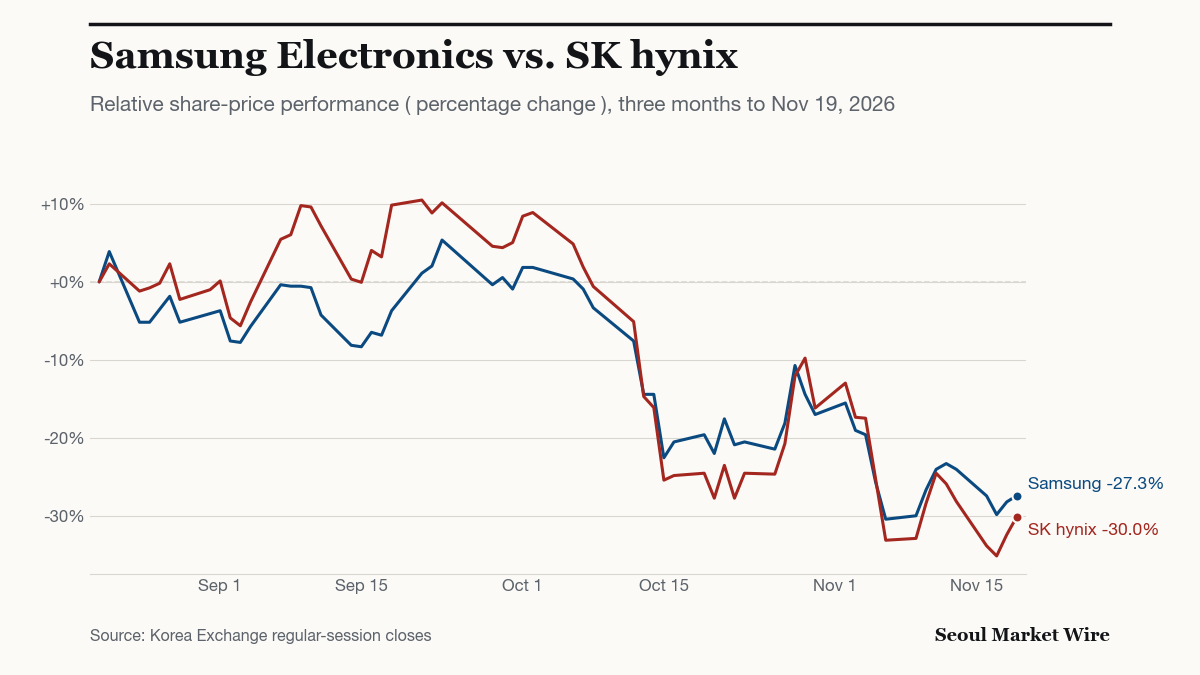
At 09:08 KST, Samsung Electronics was down 4.22% at 188,600 won and SK hynix was down 6.00% at 1,112,000 won. The KOSDAQ opened 3.48% lower at 660.98.
| Series | Nov. 19 regular-session close | Nov. 20 observation | Change from previous close |
|---|---|---|---|
| KOSPI | 5,137.89 | 4,928.51 at the open | -4.08% |
| KOSDAQ | 684.81 | 660.98 at the open | -3.48% |
| Samsung Electronics common shares | 196,900 won | 188,600 won at 09:08 KST | -4.22% |
| SK hynix | 1,183,000 won | 1,112,000 won at 09:08 KST | -6.00% |
The KOSPI’s opening decline more than reversed its previous session’s 1.39% gain. The KOSDAQ had risen 3.32% on Nov. 19.
What evidence supports the AI earnings case?
Chip demand supplied one part of the rebound argument. Nvidia’s third-quarter fiscal 2027 revenue reached $115.8 billion, up 103% from a year earlier. Data-centre revenue increased 110% to $107.6 billion. The company forecast fourth-quarter revenue of $130 billion, plus or minus 3%, in its official results announcement.
The figures demonstrate revenue growth at a supplier of AI infrastructure. Whether the businesses buying that infrastructure can earn sufficient returns is a separate question, and one that features prominently in the broker reports.
Leadership uncertainty also qualified the earnings argument. On the first page of its original PDF, Daishin judged uncertainty over Nvidia’s management following Jensen Huang’s departure to be a constraint on investor confidence, even with demand remaining strong.
Is equity weakness spreading into credit?
The assessment from iM Securities on Nov. 18 was that equity-market turbulence had not become broad financial instability. Its report described Nvidia’s credit default swap spreads, a measure of the cost of insuring against default, as stabilising lower. Broad US credit spreads were also easing after an early-November rise.
Those observations predated Anthropic’s debut. The brokerage acknowledged rising spreads at some lower-rated speculative-grade companies, distinguishing their financing pressures from conditions across the wider credit market.
Its economic assessment depended partly on oil and interest rates. Further oil-price stability could help the Federal Reserve end its tightening cycle, limiting the damage from falling equities to US activity. The argument appears on pages 1-2 of the original report.
Can AI investment earn back its cost?
Investment recovery is the central question in IBK Securities’ Nov. 20 US equity outlook. Its analysts describe a shift in attention from the scale of infrastructure spending to whether revenue growth can absorb the costs and improve earnings and cash flow. The report’s summary and page 18 set out that distinction.
Holding operating cash flow constant, higher AI capital spending reduces free cash flow. Depreciation lowers accounting profit without a matching cash outflow in that period. Revenue growth can help offset these pressures, but the timing matters: investment is committed before all the associated customer revenue is recognised.
The brokerage expects the backlog to convert into revenue from 2027, with recognition extending into 2028-2029 and beyond. It therefore anticipates gradual improvement in profitability and cash flow, even as demand supports further construction.
Borrowing creates another distinction between companies. IBK flags Oracle and GPU-focused cloud providers, often called neoclouds, for refinancing burdens and risks associated with project delays. Its discussion of neoclouds describes a business model in which spending on GPUs, servers and data centres precedes customer payments received over time.
Existing businesses provide a buffer for larger technology groups. Advertising, enterprise software and ecommerce generate cash that can help finance AI investment. On pages 3 and 21, the analysts judge the risk of financing pressure spreading into a system-wide credit crisis to be limited; page 24 examines neocloud vulnerabilities. These assessments are available in the original PDF.
Our reading of the two credit assessments is that weak investment returns can weigh on equities while broader credit markets remain relatively stable. Company-level funding pressure and systemic contagion are different risks.
How does monetary policy complicate the picture?
The Nov. 20 weekly macro report from Kiwoom Securities expects October US core personal consumption expenditures inflation to remain in the low 3% range year on year. Its calendar lists a consensus forecast of 3.2%, compared with a previous reading of 3.1%.
For the upcoming second estimate of third-quarter real GDP, the same table lists consensus growth of 3.5% at an annualised quarter-on-quarter rate. The analysts argue that growth at that pace, alongside persistent inflation, could increase Treasury-yield volatility. The figure is a forecast cited in Kiwoom’s report, not a newly released GDP result.
For Korea, the brokerage describes a 25-basis-point increase at the coming Bank of Korea (BOK) meeting as the prevailing expectation. Its calendar lists a prospective rate of 3.25%, against 3.00% previously. The analysts also expect upward revisions to growth forecasts and another rate increase in early 2027.
Kiwoom sees a policy dilemma: falling equities argue for caution, while resilient growth and inflation favour tighter policy. Its assessment puts particular weight on the central bank’s guidance about subsequent decisions, as set out in the one-page original report.
What to watch next
The next scheduled US releases provide readings on inflation expectations, prices and growth, the policy variables discussed in the reports. Times below are in KST; the stock rows identify exposures to those releases, not company announcement dates.
| KRX ticker / indicator | Key sensitivity | Next catalyst and date |
|---|---|---|
| Samsung Electronics (005930.KS) | AI investment sentiment and US interest-rate expectations | Final November University of Michigan consumer survey, including inflation expectations: Nov. 21, 00:00 KST. Official schedule. |
| SK hynix (000660.KS) | AI investment sentiment and the inflation outlook | October US personal income and outlays, including PCE inflation: Nov. 25, 22:30 KST. BEA calendar. |
| KOSPI / USD-KRW | US growth and the expected path of interest rates | Second estimate of third-quarter US GDP: Nov. 25, 22:30 KST. BEA calendar. |
Sources
- Daishin Securities, Lee Kyung-min and Ahn Beom-su (PDF dated Nov. 18; Naver listing Nov. 19), p. 1: Nvidia results and Anthropic IPO stock.naver.com
- Daishin Securities: Original report PDF stock.pstatic.net
- iM Securities, Park Sang-hyun (Nov. 18), pp. 1-2: Financial-market turbulence and credit conditions stock.naver.com
- iM Securities: Original report PDF stock.pstatic.net
- IBK Securities, Kim Ye-seul (Nov. 20), pp. 3, 18, 21 and 24: Approaching an Inflection Point stock.naver.com
9 more sources
- IBK Securities: Original report PDF stock.pstatic.net
- Kiwoom Securities, Kim Yu-mi and Kim Jeong-hyeon (Nov. 20), p. 1: Weekly Macro, US inflation and the Bank of Korea stock.naver.com
- Kiwoom Securities: Original report PDF stock.pstatic.net
- Yonhap (Nov. 20): KOSPI and KOSDAQ opening levels n.news.naver.com
- Yonhap (Nov. 20): Samsung Electronics and SK hynix prices at 09:08 KST; US closing moves n.news.naver.com
- EFE (Nov. 19): Anthropic offer price, opening trade and debut-session close efe.com
- NVIDIA (Nov. 17): Financial results for the third quarter of fiscal 2027 investor.nvidia.com
- University of Michigan: Final November consumer survey release schedule sca.isr.umich.edu
- US Bureau of Economic Analysis: 2026 release schedule bea.gov