Shinhan flags AI financing risk as KOSPI slides 5.2% below 5,000
Shinhan examines whether AI customers can sustain purchases if final demand weakens. Kiwoom's replacement-demand argument addresses a different question: whether other buyers can absorb chips affected by US restrictions.
Market data: Korea Exchange regular-session close & Hana Bank USD/KRW reference rate, 2026-11-20 (KST)
Unmet chip demand could cushion sales affected by US restrictions, but the customer-financing risk examined in Shinhan Securities’ Nov. 20 research would remain. Kiwoom Securities’ analysis of the same date argues that other buyers could absorb affected purchases. For Korean memory suppliers, what counts is whether replacement customers can fund their orders as well as use the chips.
The KOSPI closed down 5.21% at 4,869.96 on Nov. 20, a loss of 267.93 points. Shinhan’s publication notices record approval times of 11:07 a.m. KST for Market Radar and 7:48 a.m. KST for M.R.I that day. Those are approval times for releasing research, not confirmed publication or distribution times. The official notices distinguish the morning research from the brokerage’s closing commentary.
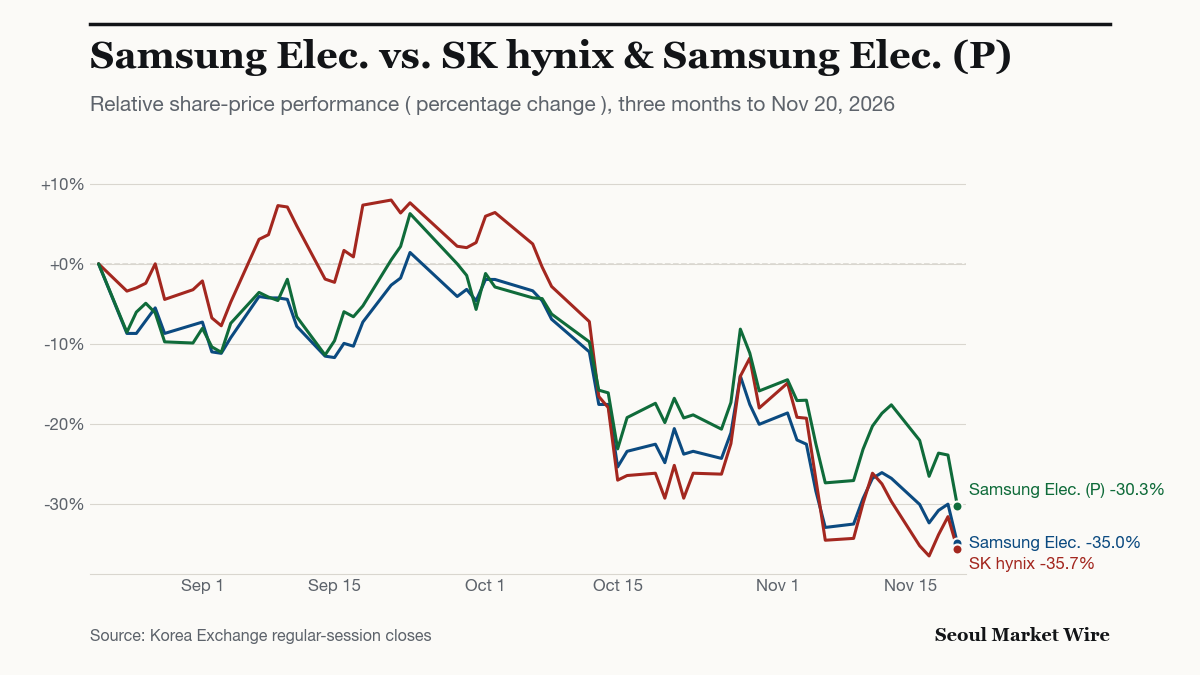
Among the chipmakers, Samsung Electronics (005930.KS) fell 7.01% to 183,100 won and SK hynix (000660.KS) lost 5.92% to 1,113,000 won. The KOSDAQ fell 5.71% to 645.68.
What does the sell-off establish?
Both major memory-chip stocks fell more sharply than the KOSPI. Those closing moves give the scale of the decline, not how much of it came from customer financing, export restrictions or other concerns.
Both pieces of research were released before the close. Market Radar discussed selling pressure while the index traded below 5,000. M.R.I examined financial vulnerabilities in the AI investment cycle.
The financing argument also differs from a claim that chip demand has already disappeared. It asks what happens to suppliers if the cash flows supporting purchases weaken. Replacement demand addresses another part of the problem: whether a different customer can buy the equipment.
What does the financing exposure include?
The M.R.I report cites an IMF analysis of 14 transactions involving about $300 billion in equity investment and $1.4 trillion in linked future revenue commitments. Nine of those transactions involved more than $650 billion in subsequent debt financing. These amounts describe different elements of the arrangements. The IMF analysis sets out the transaction coverage on printed page 9.
Revenue commitments are not financing and should not be added to equity and debt. Any leverage ratio requires a clearly defined denominator and transaction coverage. A purchase commitment describes future business; an equity investment or loan provides funding. Treating all three as interchangeable would obscure both the source of funds and the obligations attached to them.
Funding arrangements can connect investments, purchase commitments and guarantees with demand for suppliers’ products. If final demand weakens, suppliers may face lower sales alongside losses on their financial exposures. The same customer’s difficulties can therefore affect more than one part of a supplier’s business.
The brokerage compares this mechanism with telecom equipment vendors that financed customers’ purchases before carriers cut investment. Its argument is conditional: circular financing is not, by itself, evidence of an impending crisis. Sustainability depends on the cash flows ultimately generated by customers.
For Samsung Electronics and SK hynix, weaker customer spending could reduce demand for memory chips. The study does not quantify either manufacturer’s exposure to the transactions it discusses.
Can other customers replace restricted demand?
The US Bureau of Industry and Security (BIS) rule, effective Nov. 19, introduces licensing requirements for covered remote access to advanced chips at overseas data centres. It covers specified computing items used to provide more than 12 million aggregate TPP, a processing-performance measure, to or for entities headquartered, or with an ultimate parent headquartered, in Macau or Country Group D:5, which includes China.
The rule provides a 90-day licensing transition for existing covered services and an exception for qualifying commercial recommender systems, subject to reporting requirements. A licensing requirement is not a blanket sales prohibition. The Federal Register rule defines the covered services and exceptions.
In Kiwoom’s analysis, unmet chip demand provides a possible source of replacement buyers. That argument does not require every affected order to survive. It requires enough other customers to be able to purchase the equipment and take delivery within the relevant revenue period.
A numerical comparison needs consistent definitions across three distinct measures:
| Measure | What it describes | Basis required for comparison |
|---|---|---|
| Nvidia demand exposed to restrictions | Potential purchases affected by covered services and customers | A defined customer population, capacity assumptions, equipment revenue per gigawatt and a documented annualisation method |
| Nvidia revenue baseline | Revenue against which potential exposure is measured | The exact fiscal period, company-wide or segment scope, and the assumptions used to derive the forecast |
| Unmet Nvidia demand | Potential purchases beyond available supply under a specified scenario | The same comparison period, a documented demand-and-supply calculation, and assumptions about customers’ ability to take delivery |
Calculating how much revenue is protected requires those definitions. Capacity measured in gigawatts also needs a deployment schedule before it can be translated into annual equipment revenue.
The two research arguments can coexist. Other buyers may absorb chips affected by restrictions while customer-financing risks remain elsewhere in the investment chain. Replacement purchases would also use part of the remaining pool of unmet demand; they would not leave that pool unchanged.
What to watch next
| Date and time | Scheduled event | Relevance |
|---|---|---|
| Nov. 23 (release time unconfirmed) | November S&P Global US flash manufacturing and services PMIs | Activity and price readings provide context for growth and inflation. Official announcement |
| Nov. 25, 22:30 KST | US third-quarter GDP, second estimate, and October Personal Income and Outlays, including PCE inflation | Updated growth and inflation data precede the December policy meeting. BEA schedule |
| Nov. 26, Korea date | Bank of Korea monetary policy decision | The meeting sets domestic policy rates. Official meeting calendar |
| Dec. 8–9, US dates; decision Dec. 10 at 04:00 KST | Federal Open Market Committee meeting | The Fed’s calendar schedules the decision for 2 p.m. Eastern time on Dec. 9. Official calendar |
Sources
- Shinhan Securities — Market Radar: Flow shock persists as 5,000 breaks again (Nov. 20, morning) stock.naver.com
- Shinhan Securities — Shinhan M.R.I: AI circular financing, fuel for growth or a financial weak link stock.naver.com
- Shinhan Securities — M.R.I original PDF, Nov. 20 bbs2.shinhansec.com
- Shinhan Research — publication approval notices and market updates t.me
- IMF — Analysis of AI financing transactions, printed page 9 imf.org
8 more sources
- Kiwoom Securities — US AI chip curbs: no empty seats at a restaurant with a queue stock.naver.com
- Daishin Securities — China easing hopes ahead of the Anthropic IPO stock.naver.com
- Kiwoom Securities — Morning Letter, Naver listing titled Nov. 23 stock.naver.com
- US Bureau of Industry and Security — Addressing Remote Access to Advanced Semiconductors, effective Nov. 19 govinfo.gov
- S&P Global — November flash PMI release dates spglobal.com
- BEA — Economic release schedule bea.gov
- Bank of Korea — Monetary Policy Board meeting dates bok.or.kr
- Federal Reserve — December 2026 calendar federalreserve.gov