Eugene says memory prices could fall even while chip supply stays tight
Eugene's Nov. 19 report considers a gradual memory-price correction driven by customer budget constraints, with capacity expansion likely to continue even during a correction.
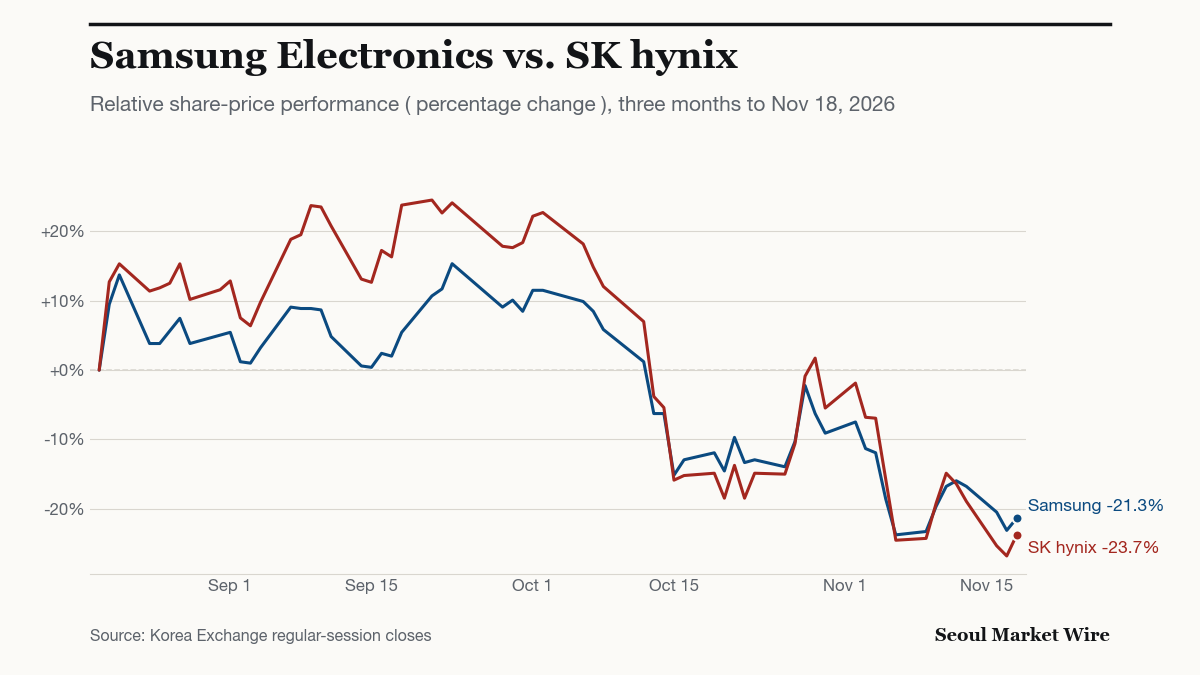
Market data: Korea Exchange regular-session close & Hana Bank USD/KRW reference rate, 2026-11-19 (KST)
Customer budget constraints could push memory prices lower even while chips remain scarce, Eugene Investment & Securities argues in its Nov. 19 report, “Investment will continue”. But the brokerage expects a gradual decline in that scenario, with capacity expansion likely to continue during the correction.
For Samsung Electronics and SK hynix, the warning separates demand for more memory from customers’ ability to finance purchases at higher prices. It describes a possible adjustment mechanism. Eugene report.
Why could tight supply coexist with price resistance?
Customers can face tight chip supply while resisting prices that exceed their budgets. A buyer may need additional memory but have limited funds available; another may have access to funding but judge the proposed price unattractive. Payment capacity and willingness to pay can therefore constrain purchases in different ways.
The brokerage’s warning concerns both constraints. Its report connects rising memory purchase costs with uncertainty over financing AI capital expenditure and weakness in PC and smartphone demand. The scope extends beyond memory bought for AI infrastructure, although the effect on prices would depend on demand and supply in each relevant segment.
In our analysis, buyer resistance could put pressure on negotiations before new production relieves a physical shortage. Whether that pressure produces a lower price would depend partly on sellers’ willingness to make concessions and the availability of other customers prepared to pay existing prices.
Spending totals alone cannot settle that question. A larger procurement bill can reflect higher prices, greater quantities or a different mix of products. Distinguishing those effects requires information about what customers are buying and on what terms.
Source: Nvidia fiscal Q3 2027 CFO commentary. Percentage change calculated from the disclosed, rounded balances.
Could weaker pricing coexist with continued investment?
A price correction and a halt to capacity expansion are separate propositions. Eugene’s scenario allows prices to decline gradually while manufacturers continue investing.
The report also examines a separate, more severe downturn beginning in mid-2027, modelled on the cycle that began in late 2018. The analysts regard that scenario as unlikely but estimate that both Korean manufacturers would retain sufficient financial capacity to sustain investment even under those assumptions.
That exercise tests how investment might withstand weaker earnings. Its estimates are brokerage projections, rather than announced company spending commitments. Nor should the severe downturn assumption be substituted for the gradual price adjustment described in the report’s budget warning.
The report retains an Overweight rating while questioning how much buyers can absorb at higher prices. Eugene report.
How do AI returns and financing affect the argument?
Questions about financing extend beyond the memory bill. In its Nov. 19 report, Kiwoom Securities argued that Nvidia’s results had left uncertainty over AI investment returns and funding unresolved. The report’s opening analysis explicitly links those concerns to the correction in AI shares since October. Kiwoom report.
That assessment concerns investment economics and market sentiment. It complements the budget question without measuring memory buyers’ remaining spending capacity.
In our analysis, access to funding and expectations of attractive AI returns could support continued spending and influence buyers’ willingness to accept higher memory prices. Demand relative to supply in the relevant memory segment would also matter. These are influences on negotiations, rather than necessary conditions that must all hold for prices to remain firm.
Changes in quantities, delivery terms and purchasing plans would help distinguish competing explanations for weaker pricing. A lower contract price alongside reduced orders would raise different questions from a lower price accompanying larger deliveries.
On the supply side, a capacity announcement describes a spending plan; additional saleable output is what changes the volume available to buyers. The timing of those stages matters when assessing whether customer resistance or expanding supply is driving a price adjustment.
What do Nvidia’s disclosures show?
Supply commitments at Nvidia rose to $390 billion at the end of fiscal Q3 2027, from $279 billion a quarter earlier. The company attributed the increase primarily to multi-year memory procurement. That explanation concerns the increase, rather than the composition of the entire balance. Nvidia CFO commentary.
The figures below compare Yuanta Securities’ Nov. 18 market review, posted Nov. 19, with the company disclosures. Dollar balances are reported in billions; they are not unrounded transaction totals.
| Metric / period | Brokerage report figure | Nvidia disclosure | Comparison |
|---|---|---|---|
| Supply commitments, fiscal Q2 2027 | $279 billion | $279 billion | Same disclosed balance |
| Supply commitments, fiscal Q3 2027 | $390 billion | $390 billion | Up $111 billion, or approximately 39.8%, from Q2 |
| Gross margin, fiscal Q3 actual to Q4 guidance | 74.9% to 71–72% | Non-GAAP: 74.9% to 71.0–72.0% | Down 2.9–3.9 percentage points |
Sources: Yuanta market review, Nvidia CFO commentary and Nvidia earnings release. Changes are calculated from the disclosed figures.
These disclosures describe Nvidia’s procurement commitments and profitability, not memory buyers’ remaining budgets. The margin comparison uses non-GAAP figures for both periods; fiscal Q3 ended on Oct. 25, 2026. Nvidia earnings release.
What to watch next
| KRX ticker | Key sensitivity | Next catalyst & date |
|---|---|---|
| Samsung Electronics — 005930.KS | Memory selling prices, shipment volumes and capacity spending | Next earnings and investment update; release date not established by the cited sources as of Nov. 19, 2026 |
| SK hynix — 000660.KS | Customer purchasing commitments, memory pricing and capacity spending | Next earnings and investment update; release date not established by the cited sources as of Nov. 19, 2026 |
Sources
- Eugene Investment & Securities: Investment will continue (Nov. 19, 2026) stock.naver.com
- Kiwoom Securities: If not Nvidia's results, then perhaps the Anthropic IPO (Nov. 19, 2026) stock.naver.com
- Yuanta Securities: Nov. 18 market review, posted Nov. 19, 2026 stock.naver.com
- Nvidia: Financial results for third quarter fiscal 2027 investor.nvidia.com
- Nvidia: Fiscal 2027 third-quarter CFO commentary s201.q4cdn.com