Meritz forecasts USD/KRW at 1,270 for end-2027, with oil a key risk
Exporters' dollar sales underpin Meritz's stronger-won forecast. Its lower bond-yield projections also rely on easing inflation, with Hormuz normalisation expected to begin in the second quarter of 2027.
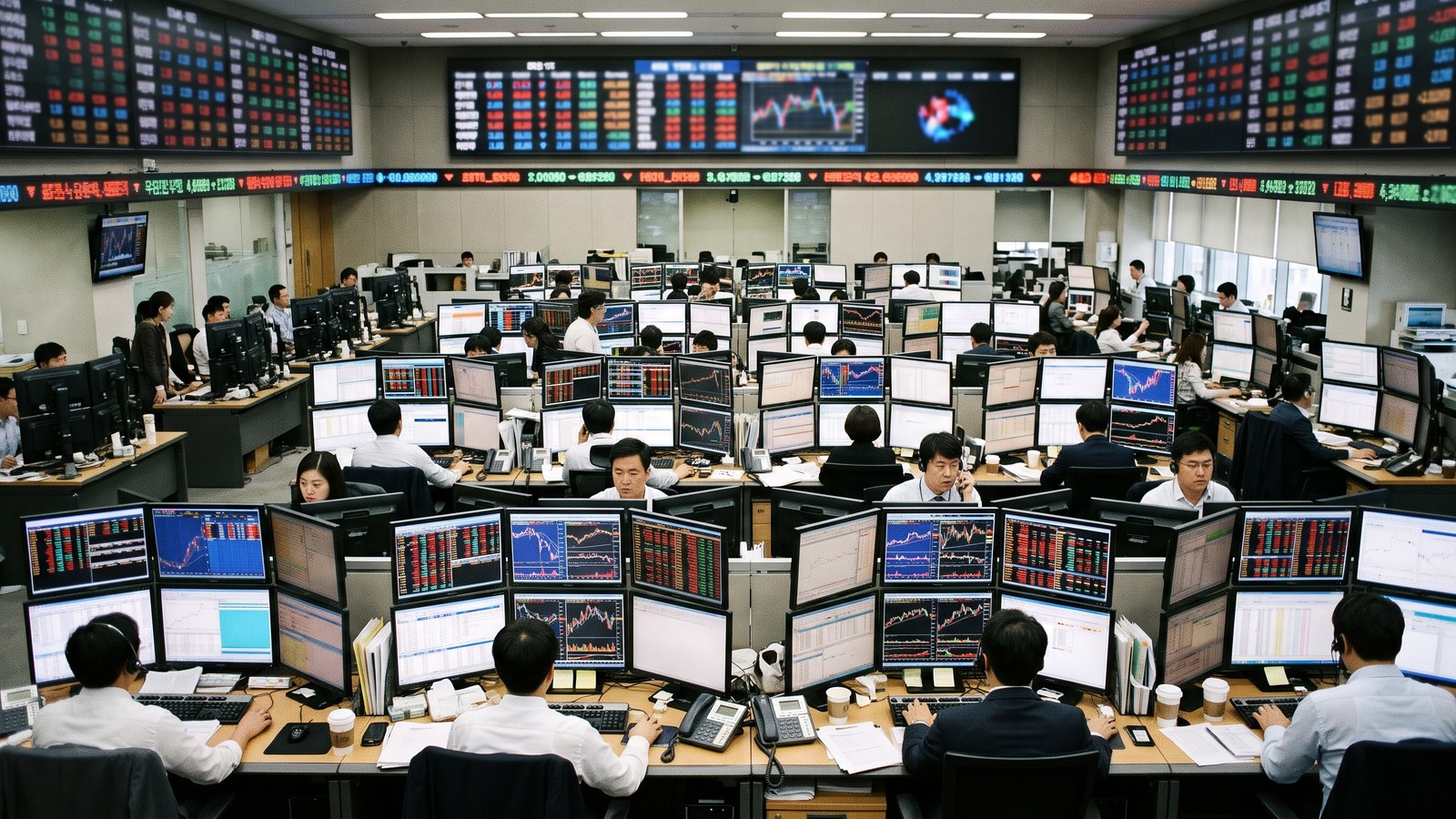
Market data: Korea Exchange regular-session close & Hana Bank USD/KRW reference rate, 2026-11-18 (KST)
A stronger won and lower government bond yields are central to Meritz Securities’ 2027 outlook. But the expected inflation relief depends partly on a diplomatic sequence that the brokerage forecasts, rather than a confirmed agreement or timetable for restoring shipping through the Strait of Hormuz.
Its Nov. 17 outlook puts USD/KRW at 1,270 by end-2027, with U.S. and Korean 10-year government bond yields at 4.3% and 3.6%, respectively. Semiconductor exporters’ conversion of dollar earnings supports the currency argument. Easing oil inflation and weaker U.S. consumer-sector conditions form part of the case for lower yields. These mechanisms need to be assessed separately. Meritz’s outlook.
What supports the currency forecast?
Export receipts provide the Korea-specific part of the argument. The brokerage expects semiconductor companies to convert substantial dollar earnings into won, increasing the supply of foreign currency offered in the domestic market.
An export sale and a currency conversion are separate transactions. Exporters contribute to this mechanism by converting dollar revenue into won.
Support for the same channel appears in Kiwoom Securities’ Nov. 18 Macro Snapshot. Its analysts identify strong exports and a narrowing Korean-U.S. interest-rate gap as factors favouring the won. They also caution that semiconductor-led growth has had limited spillover into other industries and domestic demand. Kiwoom’s Macro Snapshot.
Those observations are compatible. Exporters can supply dollars even when their earnings gains remain concentrated in a small part of the economy. A stronger currency would therefore not, by itself, demonstrate that household spending or non-semiconductor activity had recovered.
For the export-conversion argument to hold, dollar earnings must continue to translate into currency supply. The reports’ qualitative argument does not provide a fixed conversion schedule from which a monthly exchange-rate path can be calculated.
Where does oil create a risk?
The oil assumption is more gradual than an immediate settlement. Meritz envisages third-country mediation, followed by negotiations or a provisional ceasefire, then the beginning of Hormuz normalisation in the second quarter of 2027. It expects the geopolitical and logistics-disruption premiums embedded in oil prices to normalise during the second half.
Both periods are forecast assumptions. They are not announced diplomatic deadlines, and the start of normalisation is different from the completion of a return to normal shipping conditions.
A delay would weaken the timing of the expected energy disinflation. That is an implication of the scenario, rather than a separate forecast of renewed escalation: if disruption premiums persist, this source of inflation relief would arrive later.
Oil is not the entire bond-yield argument. The outlook also anticipates weaker U.S. consumer-facing employment and consumption in the third quarter of 2027, contributing to a change in the Federal Reserve’s policy stance. Delayed oil relief would challenge one part of that reasoning; it would not establish what every other driver of yields would do. Meritz’s outlook.
Crude prices, shipping conditions and market pricing of inflation relief are separate considerations.
What do the end-2027 figures measure?
The three forecasts share an endpoint but use different units:
| Measure | Meritz forecast | Forecast horizon |
|---|---|---|
| USD/KRW | 1,270 won per dollar | End-2027 |
| U.S. 10-year Treasury yield | 4.3% | End-2027 |
| Korea 10-year government bond yield | 3.6% | End-2027 |
Forecasts from Meritz’s Nov. 17 outlook; yields are percentages, not central-bank policy rates.
The currency projection is a year-end level, not an annual average. A lower USD/KRW number means fewer won are needed to buy one dollar. It does not describe uninterrupted appreciation through 2027.
Likewise, the bond projections concern market yields on 10-year debt. Neither figure is a forecast for the corresponding central bank’s policy rate, and neither central bank directly sets the 10-year yield.
Foreign equity flows require another distinction. Selling Korean shares and converting the proceeds into dollars are separate steps. Assessing the resulting foreign-exchange demand requires conversion and settlement information alongside equity net-selling data.
What to watch next
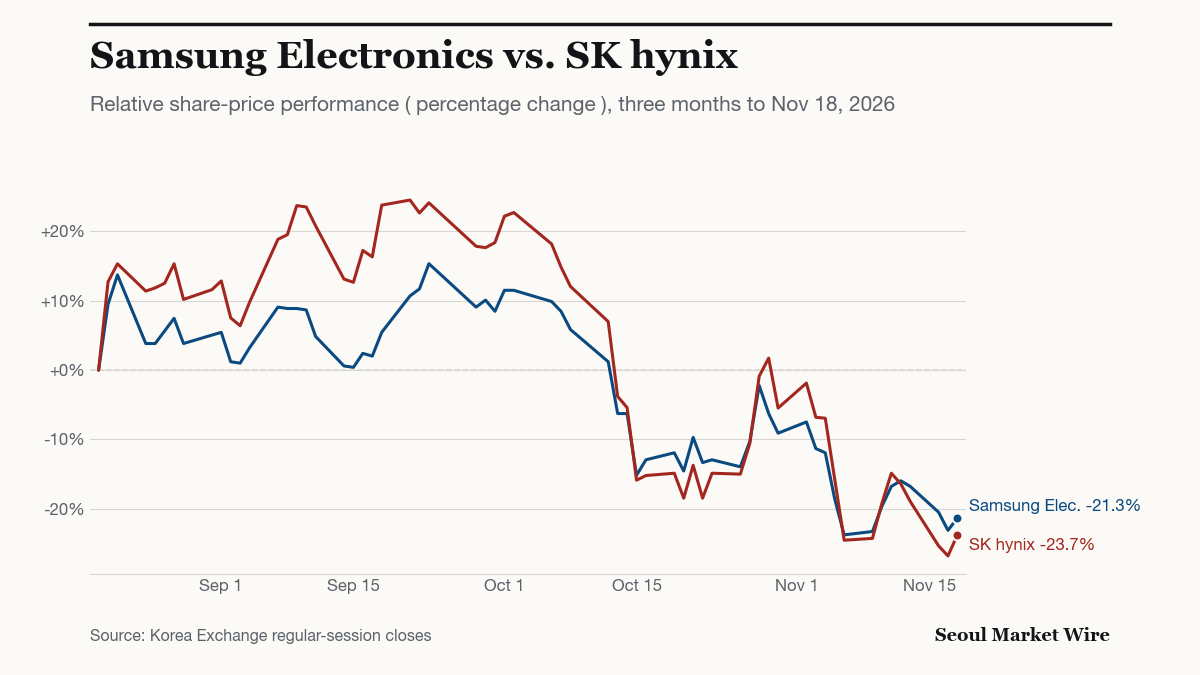
The relevant Korean equity names are Samsung Electronics (KRX: 005930) and SK hynix (KRX: 000660), given the outlook’s semiconductor-export channel. The dated catalysts below are macroeconomic releases and a policy meeting, not company earnings dates or scheduled currency conversions. All scheduled times below are in KST.
- Nov. 19, 00:30 — EIA Weekly Petroleum Status Report. U.S. inventories, production and refinery activity provide oil-market context; they do not directly measure Hormuz shipping conditions. EIA schedule.
- Nov. 19, 04:00 — Federal Reserve minutes. The record of the Oct. 27–28 meeting provides policy and economic discussion relevant to the U.S. rate assumptions. Federal Reserve calendar.
- Nov. 26 — Bank of Korea monetary policy decision meeting. The decision is the next scheduled domestic policy event relevant to the interest-rate-gap argument. Bank of Korea schedule.
Sources
- Meritz Securities — 2027 Outlook #3 (commentary edition): Asymmetry (Nov. 17, 2026) stock.naver.com
- Kiwoom Securities — Macro Snapshot: Korea's growth forecast raised despite AI investment concerns (Nov. 18, 2026) stock.naver.com
- EIA — Weekly Petroleum Status Report release schedule eia.gov
- EIA — Weekly Petroleum Status Report eia.gov
- Federal Reserve — November 2026 calendar federalreserve.gov