SK hynix's 1.4 million won target gap: three Buy ratings, different 2028 models
Yuanta, iM and DS rate SK hynix a Buy after its record third quarter, yet their targets run from 2.3 million to 3.7 million won. Yuanta and iM use different 2027 book values and multiples; DS forecasts operating profit to fall in 2028 and 2029.
Market data: Korea Exchange regular-session close & Hana Bank USD/KRW reference rate, 2026-11-20 (KST)
A record quarter, a 10.44% fall
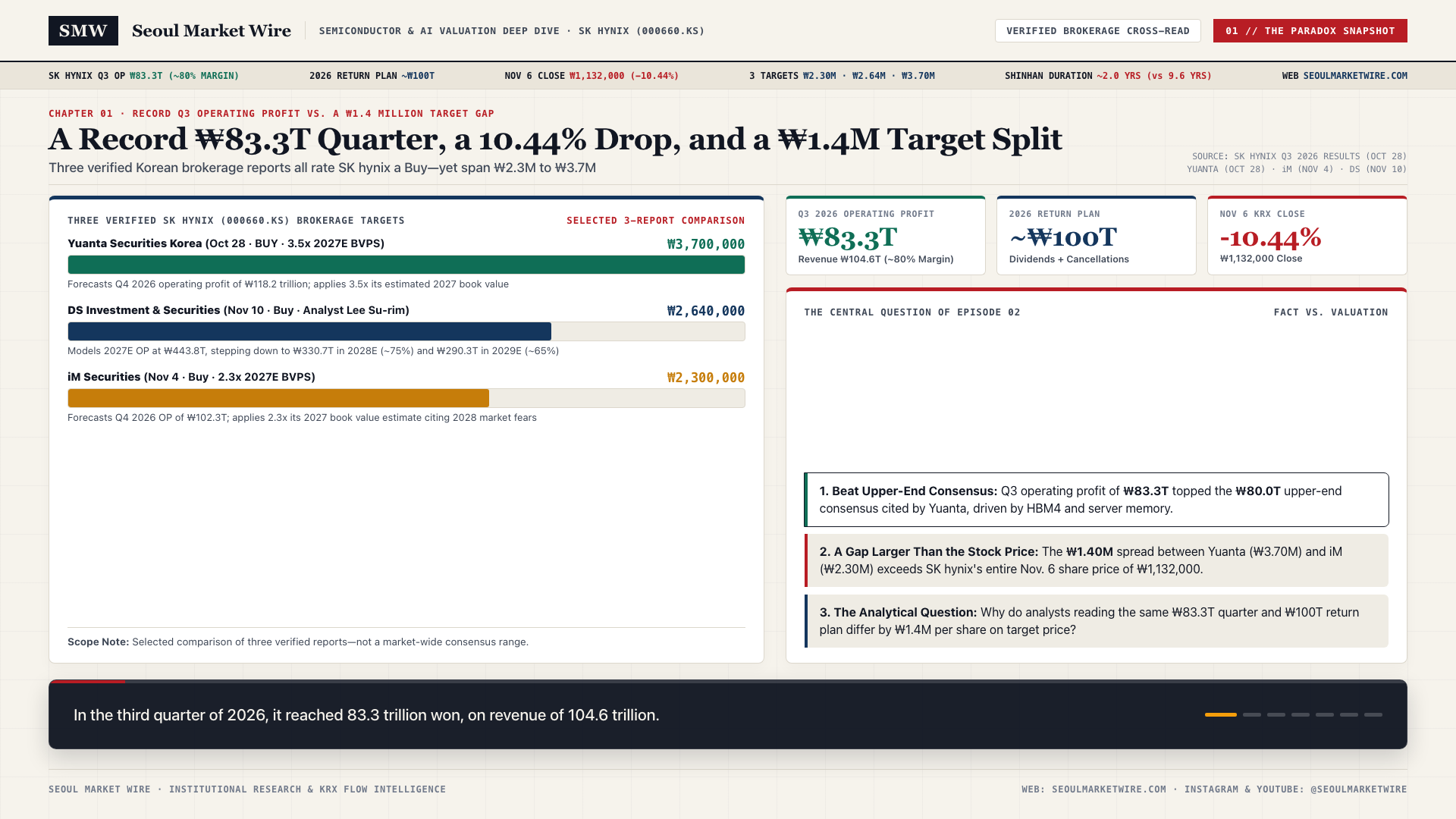
SK hynix has reported record quarterly operating profit. In the third quarter of 2026, it reached 83.3 trillion won, on revenue of 104.6 trillion. That is an operating margin near 80 percent. It beat the upper end of consensus cited by Yuanta Securities Korea, 80.0 trillion won. The company also outlined roughly 100 trillion won in shareholder returns for 2026. The results came out on October 28. On November 6, the stock fell 10.44 percent, to 1,132,000 won. Three Korean brokerage reports we verified all keep a Buy rating. Yuanta, on October 28, set a target of 3.7 million won. iM Securities, on November 4, set 2.3 million. DS Investment and Securities, on November 10, set 2.64 million. These three reports are a selected comparison. They do not represent a market-wide consensus range, and other brokers may sit inside or outside that band. Even so, the top target sits 1.4 million won above the bottom one, more than the share price itself after the fall. So here is the question for this episode. Why do Korean analysts looking at the same 83.3 trillion won quarter, and the same 100 trillion won capital-return plan, differ by 1.4 million won per share on SK hynix’s target price?
Three profit lines, one return plan
The 83.3 trillion won figure is operating profit. Net income came in well below expectations. Profit attributable to owners of the parent came to 41.6 trillion won, against a consensus of 65.4 trillion cited by Yuanta. The shortfall came below the operating line: 11.6 trillion won in foreign-exchange losses and 22.9 trillion won in investment-valuation losses, including Kioxia. A third figure, preliminary consolidated net income, was about 39.78 trillion won. That is a different measure, and it cannot be swapped for the attributable number. Now the returns. For 2026, SK hynix outlined about 100 trillion won in total: at least 30 trillion in cash dividends, and at least 60 trillion in share repurchases and cancellations. A newly approved 20 trillion won buyback splits two ways. Ten trillion is earmarked for cancellation. About 10 trillion is set aside for employee compensation, and that portion is excluded from shareholder returns. The third-quarter dividend was 20,000 won per share, about 14 trillion won in total: 10,000 won regular, plus a 10,000 won special dividend linked to Kioxia gains. The three selected reports draw on these same disclosures. The disagreement begins with what they assume comes next.
Different forecasts, different multiples
Yuanta forecasts fourth-quarter operating profit of 118.2 trillion won and applies 3.5 times its own 2027 book value per share. iM forecasts 102.3 trillion and applies 2.3 times its own 2027 book value estimate, so the multiple and the book value beneath it both differ. That lower multiple reflects market fears of a 2028 profit collapse, yet iM’s own model has operating profit rising from 452.8 trillion won in 2027 to 542.0 trillion in 2028, even as return on equity falls from about 66 percent to 47. DS analyst Lee Su-rim models 443.8 trillion won in 2027, then 330.7 trillion in 2028 and 290.3 trillion in 2029, about 75 and 65 percent of 2027. DS expects HBM4 contract prices to lift early-2027 DRAM prices, with a larger HBM share offsetting softer conventional DRAM in the second half. Shinhan Securities’ separate November 6 model counts excess profit, earnings above a 10 percent annual charge on equity. For Samsung Electronics and SK hynix combined, it set about 2,222 trillion won of October market value against about 1,100 trillion of forecast end-2026 book equity. Holding 2029 onward at the 2028 level, June peak prices implied about 9.6 years of excess profit. By October, about two: 2027, plus 89 percent of 2028, and nothing beyond.
Slower hyperscaler growth, a 2027 cash-flow trough
Durability depends on customers’ spending. Shinhan’s economists estimate capital spending by the major hyperscalers at about 1.07 trillion dollars in 2027. Year-on-year growth slows from 109 percent in the fourth quarter of 2026 to 20 percent in the fourth quarter of 2027. In dollars, the annual increase shrinks from about 400 billion in 2026 to about 290 billion in 2027. Spending still rises, at a slower pace. Shinhan’s overseas equities team uses a separate yardstick: a calendar-year GAAP capex consensus of about 1.14 trillion dollars in 2027, up 42 percent, for Microsoft, Meta, Amazon, Alphabet and Oracle. The two estimates use different definitions, so the gap between them is no like-for-like disagreement. That team projects the group’s combined free cash flow bottoming in 2027, which it says keeps external borrowing important. Hana Securities adds a replacement angle. In July, it put the economic usefulness of AI servers at two to three years, pointing to recurring replacement capex funded through corporate bonds and structured finance. For memory makers, short server lives can mean repeat demand. That demand also leans on financing conditions. Tighter credit could affect future orders.
Where the pipeline sits, and what rules can reach
Next, power and permits. IBK, Kiwoom and Daishin judged a federal moratorium on U.S. data-center construction unlikely, citing the 60-vote Senate cloture threshold, veto risk and bipartisan support for AI. Cost is another matter. On September 16, the House passed the Ratepayer Protection Act, H.R. 9340, by 417 to 3. It would require state regulators to consider standards for recovering the full incremental cost of grid upgrades from sites with peak demand of 100 megawatts or more. The Senate has yet to act. Eugene Securities used DCMap’s October 2026 database, which mixes power definitions. It tallied 142.5 gigawatts of reported pipeline power across five states where Democrats won the governorship: Texas, Georgia, Ohio, Nevada and Iowa. That is 505 of 1,599 projects, and 41.2 percent of a 345.9 gigawatt national pipeline. Texas alone holds 93.1 gigawatts, about three times Virginia’s 31.6. Before the election, Republican Governor Greg Abbott ordered a grid review on August 3, and on September 21 directed the TCEQ to halt data-center permits until an ERCOT audit was complete. The 41.2 percent measures geographic concentration. It does not guarantee delays. Hanwha estimates about 75 percent of U.S. capacity due in 2027 is already under construction, which points to greater exposure among later projects.
Nvidia changes its CEO, Korean chip exports jump
Then the customer. On November 12, Nvidia announced Jensen Huang’s resignation as chief executive and named chief financial officer Colette Kress interim CEO. Nvidia fell 4.3 percent that day, to 166 dollars and 19 cents, after an intraday low of 148 dollars and 80 cents. AMD rose 5.9 percent and Broadcom 5.5 percent. All three SK hynix targets we compared predate that announcement. Kiwoom’s Han Ji-young and Yoo Ji-yoon, writing on November 13, expect locked-in Vera Rubin production schedules and supply contracts to limit operational disruption over the next one to two years. They also flag a medium-term risk: new leadership could revise supplier order allocations or joint development schedules. The export data looks strong. iM’s Park Sang-hyun noted on November 12 that Korea Customs Service provisional figures for November 1 through 10 showed semiconductor exports up 331.2 percent from a year earlier, with computer peripherals up 237.7 percent. A ten-day export value reflects volumes, prices and product mix across the whole country. It shows strong shipments by value in early November. On November 17, Nvidia said Vera Rubin had shipped and its roadmap remained on track. Supplier allocations remain a separate question.
One answer, three checkpoints
The three reports read the same quarter. Yuanta and iM differ on fourth-quarter profit, 2027 book value and the multiple applied. DS writes a 2028 and 2029 decline into its numbers. Our reading, which no single broker states, is that these choices reflect a debate over how long high profits can last, and Shinhan’s model suggests October prices gave that durability little credit. Here is what could change those forecasts. First, a scheduled policy date: January 10, 2027, when the suspension of the U.S. Bureau of Industry and Security’s Affiliates Rule, published November 9, is due to end. Its relevance depends on which counterparties fall within the rule. Second, the January 2027 earnings season, which Shinhan identifies as the test of whether 2028 pricing doubts spill into cuts to 2027 memory shipment forecasts. Shinhan’s conditional 4,800 KOSPI benchmark discounts 2027 book value at an 11.5 percent cost of equity and assigns no value to excess profit from 2028 onward. If shipment cuts lower book value, Shinhan says that figure must be recalculated. With multiples unchanged, book-value-based targets would fall too. Third, hyperscaler free cash flow and debt-issuance terms, alongside Nvidia’s supplier allocation guidance after Huang. Not investment advice. Sources are linked in the episode notes at seoulmarketwire.com.
| Brokerage / Model | Report Date | Rating & Target Price | Key Earnings & Valuation Assumptions |
|---|---|---|---|
| Yuanta Securities Korea | Oct. 28, 2026 | BUY · ₩3,700,000 | Forecasts Q4 2026 OP of ₩118.2T; applies 3.5x its estimated 2027 book value per share |
| DS Investment & Securities | Nov. 10, 2026 | Buy · ₩2,640,000 | Analyst Lee Su-rim models 2027E OP at ₩443.8T, stepping down to ₩330.7T in 2028E (about 75%) and ₩290.3T in 2029E (about 65%) |
| iM Securities | Nov. 4, 2026 | Buy · ₩2,300,000 | Forecasts Q4 2026 OP of ₩102.3T and 2027E→2028E OP rising ₩452.8T→₩542.0T (ROE 66%→47%), applying 2.3x 2027E BVPS on 2028 market fears |
| Shinhan Duration Model | Nov. 6 & 11, 2026 | About 2.0 years of excess profit | Combined 005930.KS + 000660.KS Oct market value (about ₩2,222T) vs. end-2026E book (about ₩1,100T) at 10% charge implies FY27 + 89% FY28 excess profit (down from 9.6 yrs in June) |
What to watch next
Three concrete checkpoints in early 2027 will test the earnings durability assumptions behind these target prices for 000660.KS (SK hynix) and 005930.KS (Samsung Electronics):
- January 10, 2027 U.S. BIS Affiliates Rule Deadline: The suspension of the U.S. Bureau of Industry and Security’s Affiliates Rule (published in the Federal Register on Nov. 9, 2026) is scheduled to expire on Jan. 10, 2027.
- January 2027 Earnings Season & Shinhan’s 4,800 KOSPI Benchmark: Shinhan Securities identifies the January 2027 reporting window as the key checkpoint for whether 2028 memory pricing doubts spill back into cuts to 2027 shipment forecasts, which would lower projected book value and require recalculating its conditional 4,800 KOSPI valuation benchmark.
- Hyperscaler Debt Terms & Post-Huang Nvidia Allocations: Watch corporate bond and structured-finance terms as Microsoft, Meta, Amazon, Alphabet, and Oracle approach their projected 2027 free-cash-flow trough, alongside Nvidia’s supplier order allocation guidance following Jensen Huang’s Nov. 12 CEO transition.
Sources
- SK hynix — Official Q3 2026 Business Results & Shareholder Return Announcement (Oct. 28, 2026) news.skhynix.com
- Yuanta Securities Korea — SK hynix Company Report (Oct. 28, 2026) 05.myasset.com
- iM Securities — SK hynix Company Report (Nov. 4, 2026) imfnsec.tistory.com
- The Korea Economic Daily — DS Investment & Securities SK hynix 2027–2029 Profit Forecasts (Nov. 10, 2026) n.news.naver.com
- Shinhan Securities — Official 2027 Economic and Financial-Market Outlook (Nov. 6, 2026) bbs2.shinhansec.com