US AI controls put replacement demand in focus for Korean memory makers
Hanwha argues that other customers could absorb China-related GPU volumes affected by tighter US controls. That outlook depends on replacement orders.
Market data: Korea Exchange regular-session close & Hana Bank USD/KRW reference rate, 2026-11-18 (KST)
Tighter US controls could redirect AI hardware purchases without causing an equivalent loss of memory demand, according to Hanwha Investment & Securities’ Nov. 17 semiconductor assessment. The brokerage argues that other customers could absorb China-related GPU volumes affected by restrictions. The unresolved question is whether those buyers place replacement orders, and when.
That is a broader demand argument, not a quantified assessment of the US remote-access rule announced on Nov. 16. It provides no basis here for calculating how much revenue Samsung Electronics or SK hynix would lose or recover under that measure.
At the Nov. 18 KRX regular-session close, Samsung Electronics rose 2.31% to 194,700 won, while SK hynix gained 4.19% to 1,144,000 won. The KOSPI advanced 1.99% to 5,067.44 from 4,968.48 the previous day. The index close is recorded in the Nov. 18 market report.
What does the US measure control?
In its Nov. 16 announcement, the Bureau of Industry and Security described an interim final rule intended to prevent remote access to advanced chips and servers through third-country data centres from circumventing existing restrictions.
Remote access allows a customer to use computing capacity located abroad without the chips themselves entering the customer’s country. The agency described the measure as bringing protections for remote computing access into closer alignment with controls on physical shipments.
For memory suppliers, the commercial question is how restrictions affect accelerator orders and production. The announcement explains the regulatory objective. A restriction on access and a reduction in equipment purchases are separate steps in that analysis.
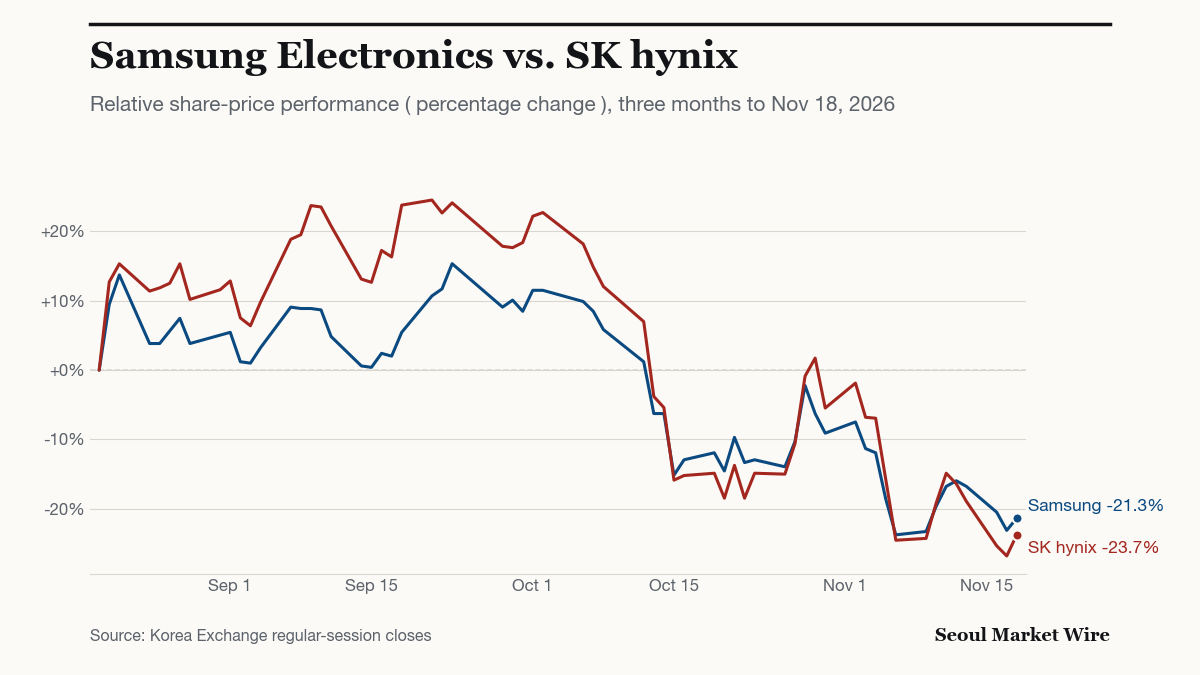
One-session price changes, based on KRX regular-session closes.
Can other customers absorb displaced demand?
The central argument in the Hanwha industry assessment was that tighter China controls need not cause a structural decline in memory demand because other customers could absorb affected GPU volumes.
That outlook depends on other customers maintaining orders. Potential demand must translate into purchases to offset volumes lost elsewhere. The existence of interested buyers alone establishes neither the timing nor the size of those purchases.
High-bandwidth memory is used in AI accelerators. If an accelerator is produced for a different customer, it still requires memory. If an order disappears without a replacement, that mechanism no longer offsets the loss. This is the commercial logic of substitution, rather than an estimate of the new rule’s effect.
Timing also matters. A replacement order delivered in a later period would not necessarily offset the original supplier’s revenue in the quarter when a shipment was cancelled or delayed. Even an unchanged number of accelerators would leave questions about memory content, supplier allocation and selling prices. Those variables require company-specific evidence before an industry demand argument can become an earnings forecast.
A broader investment slowdown would weaken the substitution argument. If potential replacement buyers reduced spending alongside restricted customers, fewer orders would be available to absorb displaced volumes.
What do the earnings figures establish?
The Nov. 18 research digest records KB Securities’ headline Nvidia figures as revenue of $115.8 billion and earnings per share of $2.68. Comparing that summary with the company’s Nov. 17 release identifies the accounting basis of the EPS figure:
| Metric, fiscal Q3 2027 | Brokerage figure recorded in Nov. 18 research digest | Nvidia’s official release | Comparison |
|---|---|---|---|
| Revenue | $115.8 billion | $115.8 billion | Matches at the disclosed precision |
| Diluted EPS, non-GAAP | $2.68, labelled only as EPS | $2.68 | Matches the non-GAAP measure |
| Diluted EPS, GAAP | Not separately identified | $2.70 | Distinct from the digest’s $2.68 figure |
Revenue rose 103% from a year earlier. The reported quarter ended on Oct. 25, before the Nov. 16 rule announcement.
For fiscal Q4, Nvidia forecast revenue of $130 billion, plus or minus 3%, without assuming China Data Center compute revenue.
The Korean shares’ one-day gains likewise record repricing, rather than a count of orders won or lost. Market prices, reported sales and prospective demand answer different questions; treating them as interchangeable would overstate what the rebound established.
Separate DRAM litigation risk
On Nov. 14, US District Judge Noël Wise denied a motion to dismiss a proposed class action alleging DRAM price-fixing against Samsung, SK hynix and Micron.
The decision allowed the case to proceed without establishing liability or certifying a class.
What to watch next
The dated market event below is the Nov. 19 trading session, not a scheduled company earnings announcement. Hanwha’s examination-day notice confirms that the KRX regular equity session opens and closes one hour later than usual.
| KRX ticker | Key sensitivity | Next market event and date |
|---|---|---|
| Samsung Electronics — 005930.KS | Memory orders, shipment timing and pricing | Nov. 19, 2026: KRX regular session, 10:00–16:30 KST |
| SK hynix — 000660.KS | AI accelerator orders and associated memory demand | Nov. 19, 2026: KRX regular session, 10:00–16:30 KST |
Sources
- Hanwha Investment & Securities — Semiconductor industry report, Nov. 17 stock.naver.com
- BIS — Rule addressing remote access to advanced chips and servers, Nov. 16 bis.gov
- Yonhap News Agency — KOSPI closing report, Nov. 18 yna.co.kr
- Naver Pay Securities — Samsung Electronics historical daily prices finance.naver.com
- Naver Pay Securities — SK hynix historical daily prices finance.naver.com