Korean stocks slide; earlier credit assessment predates selloff
The KOSPI fell 5.21% and the won weakened at the 3:30 p.m. reference time on Nov. 20. A brokerage's earlier assessment of limited financial contagion offers no evidence of credit conditions after that selloff.
Market data: Korea Exchange intraday and session figures on 2026-11-20 (KST)
Falling share prices can coexist with stable credit markets, but the reassuring assessment cited here was issued before Korea’s Nov. 20 selloff. The KOSPI closed down 5.21% at 4,869.96, while the KOSDAQ lost 5.71% to 645.68. The Korea Economic Daily reported both closes.
The won weakened to 1,336.2 per dollar at 3:30 p.m. KST on Nov. 20, compared with 1,330.0 at the same reference time in the previous session, according to Yonhap.
An assessment published by iM Securities on Nov. 18 judged the risk of broader financial instability to be limited. That judgment provides a starting point for comparison, but no evidence that credit conditions held through the subsequent equity decline.
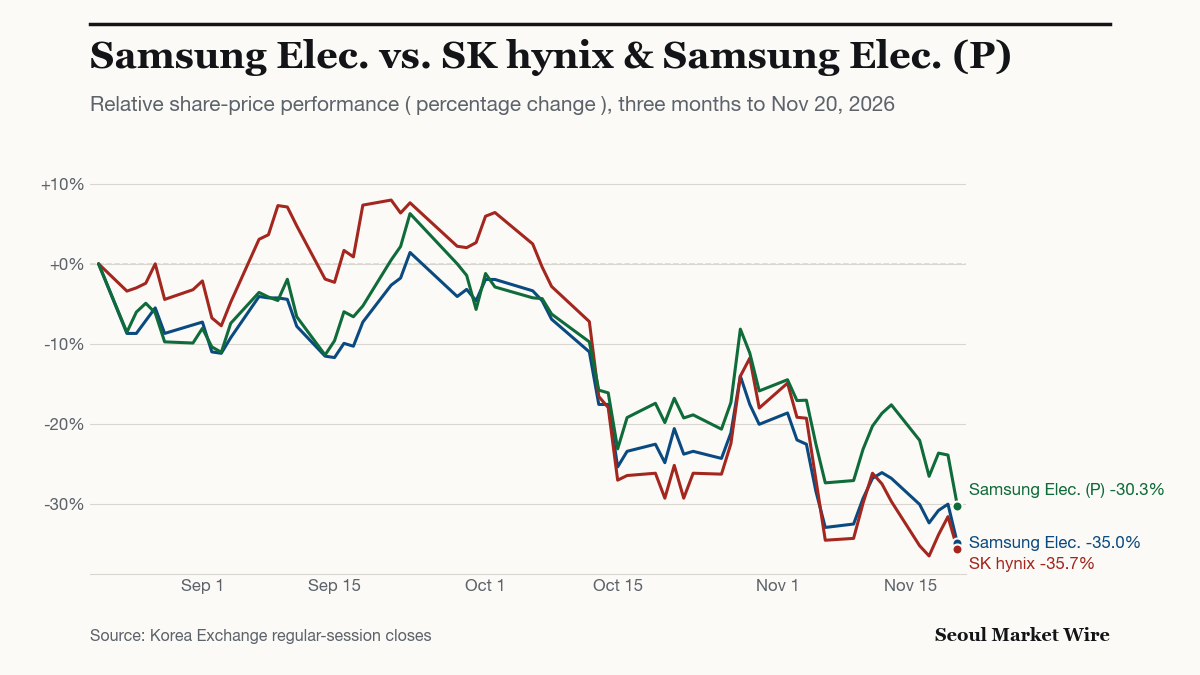
Chart basis: Foreign net selling reported by Yonhap at 15:53 KST on Nov. 20. The bars cover separate markets and foreign investors only; they are not a complete investor-category breakdown.
What did the Nov. 20 flows establish?
Foreign investors sold a net 1.132 trillion won of KOSPI shares and 171.2 billion won of KOSDAQ shares, according to the same Yonhap report. These figures describe net equity transactions, after purchases and sales have been offset.
A market-wide net figure incorporates buying in some stocks as well as selling in others. Comparing selected stocks’ net sales with that total would not measure their share of all foreign sell orders.
The two chipmakers suffered larger percentage declines than the KOSPI. Shares of Samsung Electronics (005930.KS) fell 7.01% to 183,100 won, while SK hynix (000660.KS) dropped 5.92% to 1,113,000 won. Both prices were reported in the closing-market coverage. Their declines establish price weakness; the stock-level foreign-selling estimates are excluded because their valuation method and comparability with the market total could not be verified.
Equity transactions also leave a separate foreign-exchange question unanswered. Net sales do not reveal whether investors converted the proceeds into dollars, retained won balances or reinvested in other assets. The simultaneous fall in stocks and the currency therefore provides no transaction-level measure of how much foreign equity selling contributed to the won’s decline.
Data basis: The article and chart use Yonhap’s reported market totals. The earlier Naver provisional figures are excluded because their extraction time and common reporting basis could not be established. No residual purchase amount is assigned to other investor categories.
What did the earlier credit assessment show?
In its Nov. 18 report, iM described Nvidia’s credit default swap pricing as easing and judged the risk of equity volatility spreading into broader financial instability to be low at that time. Its assessment of limited damage to the US economy was conditional on further oil-price stabilisation and an end to Federal Reserve rate increases.
Both the date and the conditions matter. The argument was not that any subsequent fall in technology shares would be harmless. It was that the credit conditions described then, together with the stated oil and monetary-policy assumptions, could limit the economic impact.
The evidence cited here includes no comparable credit-market observation after the Nov. 20 selloff. Establishing whether that assessment still applied would require dated CDS or credit-spread readings covering the later period. Without them, neither continued stability nor contagion can be inferred.
There is a geographic limit, too: the assessment covers US credit. Korean borrowing costs and funding availability would need to be examined separately.
How could demand and financing risks interact?
Weaker-than-expected end demand is one potential vulnerability identified in Shinhan Investment’s Nov. 20 analysis of AI circular financing. Its telecom-equipment comparison describes how supplier financing became a burden when customers reduced investment.
The mechanism links two exposures. Financial support can bring customers’ purchases forward, raising suppliers’ sales before those customers generate independent cash flows. If demand subsequently disappoints, suppliers can face weaker orders and deterioration in the financial assets created by that support.
This is a conditional risk, not evidence that the losses have already occurred. It also explains why a share-price decline, an order slowdown and a credit loss are different observations. One may precede another, but the sequence has to be demonstrated.
For the more reassuring interpretation to hold, customers would need sufficient cash generation or continued financing to meet their obligations. For the adverse mechanism described by the brokerage to develop, weaker demand would have to impair purchases, repayment capacity or both. The report identifies that connection without establishing its status after Nov. 20.
How does domestic policy fit?
The tension between inflation pressure and financial-market volatility was highlighted in Kiwoom Securities’ Nov. 20 Weekly Macro report. Its analysts described the Bank of Korea as facing favourable economic indicators and inflation pressure while domestic and overseas equity corrections increased financial-market uncertainty.
That passage identifies competing considerations for policy.
Growth projections provide background to that dilemma:
| Forecaster and forecast vintage | 2026 GDP growth | 2027 GDP growth |
|---|---|---|
| Bank of Korea, Aug. 27, 2026 | 3.3% | 2.9% |
| IMF mission, Nov. 17, 2026; reported by Korea.net on Nov. 18 | 3.9% | 3.3% |
| KDI, second-half 2026 outlook | 3.8% | 3.9% |
Forecast vintages differ. These are annual growth projections.
What to watch next
The BEA release calendar lists both US releases below for 8:30 a.m. Eastern Standard Time, equivalent to 22:30 KST. The Bank of Korea’s official calendar lists its next policy-setting meeting for Nov. 26.
| Date and time, KST | Scheduled event | Relevance |
|---|---|---|
| Nov. 25, 22:30 | BEA October personal income and outlays, including PCE prices | Provides updated US consumption and inflation data. |
| Nov. 25, 22:30 | BEA second estimate of third-quarter US GDP | Revises the estimate of US economic growth. |
| Nov. 26; time not specified here | Bank of Korea monetary-policy decision | Shows how the BOK weighs inflation and growth against financial-market volatility. |
Sources
- Yonhap — Won weakens to 1,336.2 per dollar at the 3:30 p.m. reference time (Nov. 20, 2026) yna.co.kr
- The Korea Economic Daily — Semiconductor shares fall as KOSPI closes below 4,900 (Nov. 20, 2026) hankyung.com
- iM Securities — Turbulent financial markets, but the turmoil is still orderly (Nov. 18, 2026) stock.naver.com
- Shinhan Investment — Shinhan M.R.I: AI circular financing, fuel for growth or a financial weak link (Nov. 20, 2026) stock.naver.com
- Kiwoom Securities — Weekly Macro: US inflation and Korea's rate meeting in focus (Nov. 20, 2026) stock.naver.com
5 more sources
- Bank of Korea — Economic Outlook (Aug. 27, 2026) bok.or.kr
- Korea.net — IMF mission forecasts Korean growth of 3.9% in 2026 and 3.3% in 2027 (Nov. 18, 2026) korea.net
- KDI — Economic Outlook, second half of 2026 m.kdi.re.kr
- Bank of Korea — Monetary Policy Board meeting schedule bok.or.kr
- US Bureau of Economic Analysis — Release schedule bea.gov