Safe-haven dollar demand complicates the export case for a stronger won
Kiwoom identifies exports and a narrower interest-rate gap as potential support for the won. Its dollar analysis and official Korean data also show why currency measures and trading dates must be kept separate.
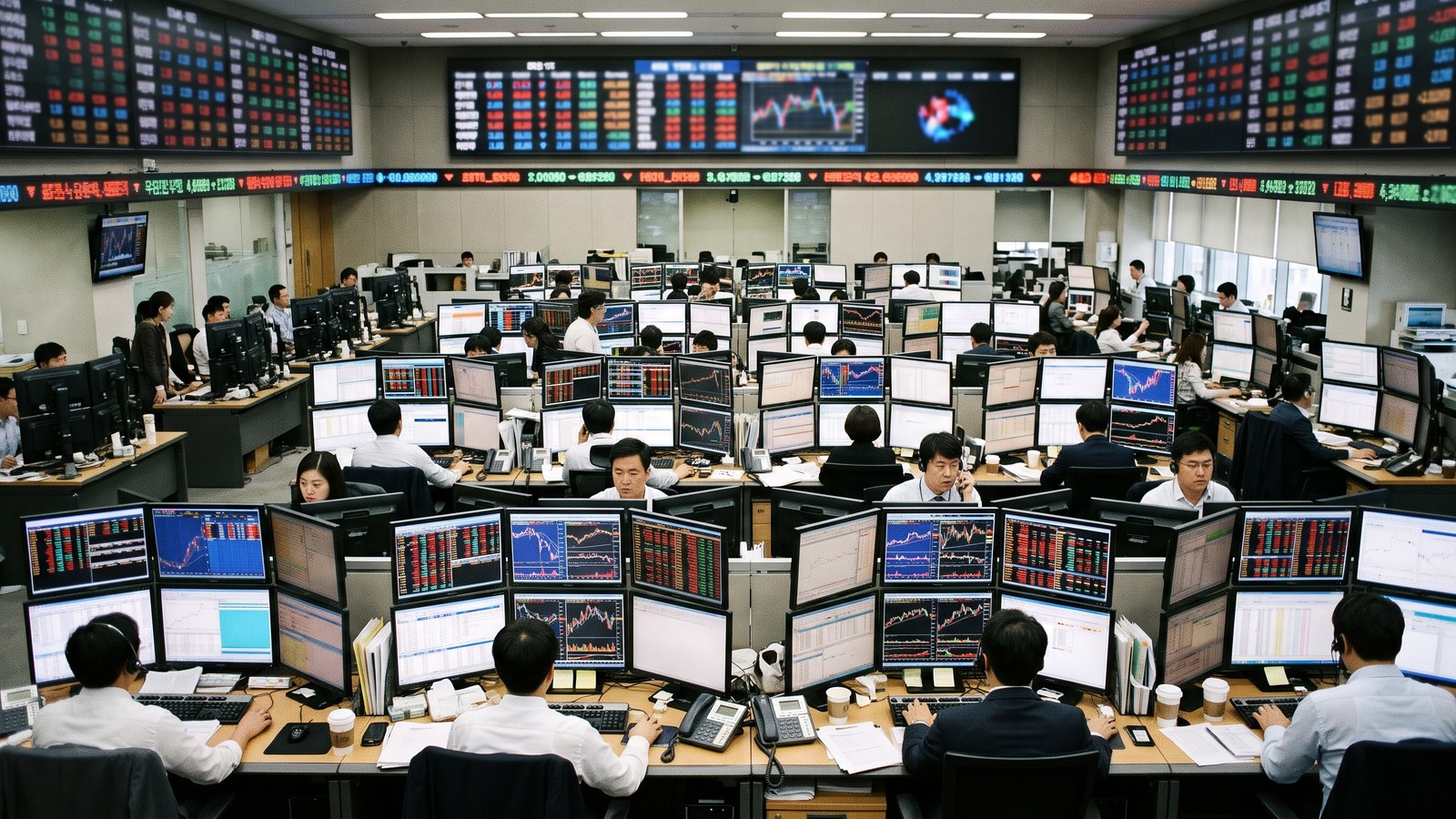
Market data: Korea Exchange regular-session close & Hana Bank USD/KRW reference rate, 2026-11-20 (KST)
Strong exports and a narrower Korea-US interest-rate gap can support the won. But safe-haven demand can sustain the dollar even when Treasury yields fall, complicating any argument that export strength alone will deliver currency appreciation.
Two Kiwoom Securities reports, dated Nov. 18 and Nov. 20, 2026, describe those competing forces. Their arguments concern different transactions and observation periods. Neither measures which force dominated Korea’s subsequent Nov. 20 currency trading.
How much does the export argument establish?
On page 1 of the Nov. 18 Macro Snapshot, economist Kim Yu-mi identifies a narrowing Korea-US interest-rate gap and increased foreign-currency supply from strong exports as factors favouring won appreciation. That describes supportive influences, rather than an unconditional exchange-rate forecast. Kiwoom Macro Snapshot, p. 1.
Her analysis also links stronger growth expectations and anticipated Bank of Korea rate increases to limits on declines in domestic market yields. The policy argument explicitly concerns further tightening. It also recognises that a deeper equity correction could temper the central bank’s hawkish communication.
Interest-rate expectations affect the relative appeal of won and dollar assets. Export receipts operate through a separate channel: they create potential foreign-currency supply, with demand for won arising when companies exchange those receipts. Retaining a dollar payment leaves an exporter holding dollars; converting it creates a purchase of won.
The report’s domestic caveat is that semiconductor-led expansion has spread only narrowly to other industries and domestic demand. Higher financing costs could constrain consumption and investment. Strong export receipts therefore need not imply an equally strong recovery across the economy.
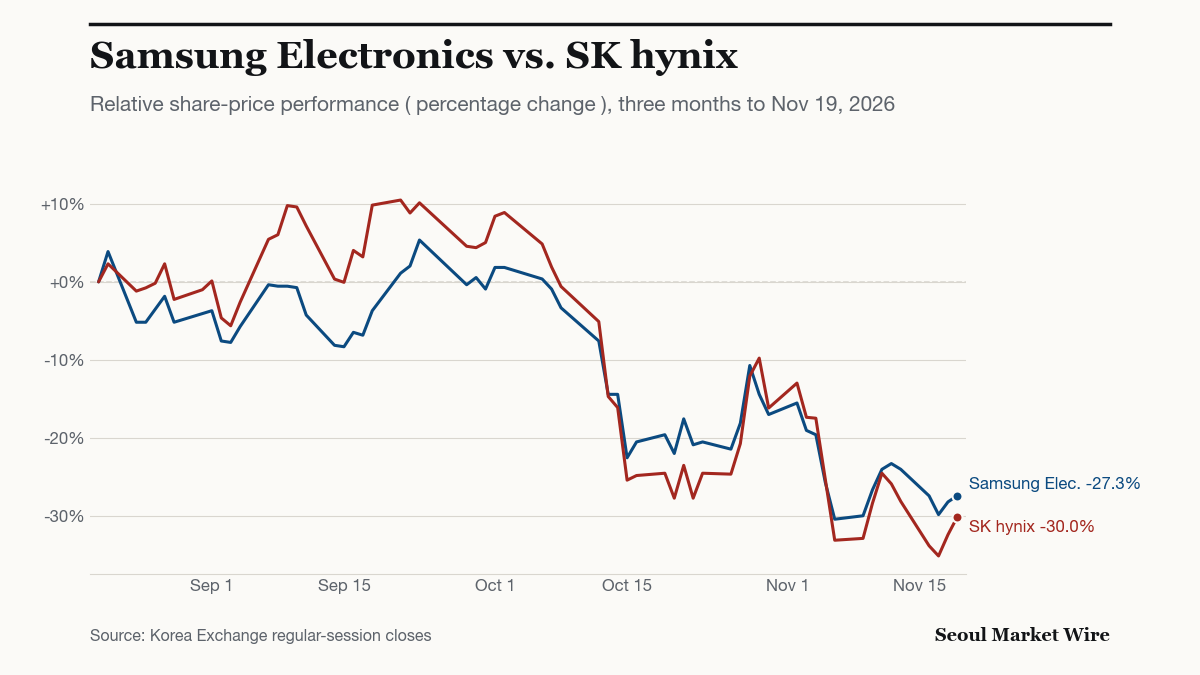
Source: Bank of Korea, financial-market indicators published Nov. 20. The chart uses its closing series through Nov. 19, not the Hana Bank reference rate.
Which dollar measure did the currency report describe?
The Nov. 20 FICC Daily, credited to Kim Yu-mi, An Ye-ha and Sim Su-bin, reviews the preceding US session. Its dollar-index chart ends on Nov. 19, and its page 1 table records the index at 103.940, up 0.07%. The same table puts the US 10-year Treasury yield at 5.048%, down 2.01 basis points. Kiwoom FICC Daily, pp. 1–2.
The analysts attribute dollar resilience to concern about further Federal Reserve tightening and safe-haven demand associated with weaker equities. Their observation supports a limited point: a falling Treasury yield does not, by itself, determine the dollar’s direction.
Broad dollar strength and a rise in USD/KRW are different observations; each requires its own measure and timestamp. The dollar index measures the currency against a basket. USD/KRW expresses the number of won needed to buy one dollar, so a decline indicates won appreciation against the dollar.
The Bank of Korea’s release published Nov. 20 records USD/KRW falling from 1,333.0 to 1,330.0 on Nov. 19 and attributes the move partly to exporters selling dollars. The release does not quantify exporters’ dollar sales. BOK financial-market indicators.
Do the report’s readings match the official series?
A comparison of the two Nov. 20 publications shows why their figures cannot be combined indiscriminately. The BOK observations below are dated Nov. 19; Kiwoom labels its table entries as closing readings but does not provide a matching fixing time for each instrument.
| Metric | Kiwoom Nov. 20 report | BOK Nov. 19 observation | Comparison |
|---|---|---|---|
| Korean three-year government bond yield | 3.716% | 3.716% | Matches at published precision; both round to 3.72%. |
| Korean five-year government bond yield | 3.807% | 3.812% | Report is 0.5 basis point lower; both round to 3.81%. |
| USD/KRW, won per dollar | 1,335.5 | 1,330.0 | Report is 5.5 won higher; not a rounding difference. |
Sources: Kiwoom, p. 1 and the spreadsheet attached to the BOK release. The BOK identifies the Korean bond yields as Korea Financial Investment Association final quotation yields; Kiwoom cites Bloomberg.
The fixing and quotation bases are not fully reconciled. Consequently, the report’s 1,335.5 reading is not used here as a substitute for the BOK close, and neither is presented as Korea’s Nov. 20 closing exchange rate. Two-decimal rounding also conceals the five-year yield difference.
What can foreign equity selling establish?
Foreign investors sold a net 1.0956 trillion won of KOSPI shares on Nov. 20, about 1.10 trillion won, according to provisional KRX data distributed by Naver Pay Securities. That measures net equity transactions, not dollar purchases. Investor trading trends.
Sale proceeds can remain in won, be reinvested in Korean assets or interact with existing currency hedges.
Subtracting share sales from export receipts would therefore produce no reliable measure of currency pressure. Such a comparison requires matched periods, consistent units and evidence of actual conversion. Export growth and net equity selling describe potential channels; transaction-level currency evidence is needed to establish their relative contribution.
Does dollar demand require a wider credit crisis?
Safe-haven demand can arise without a general breakdown in credit markets. In a Nov. 18 assessment, iM Securities judged the risk of equity volatility spreading into broader financial instability to be limited and cited easing Nvidia credit-default-swap premiums. Its assessment preceded the Nov. 20 equity sell-off. iM Securities report.
Subsequent credit-spread readings would test that assessment. Evidence of currency conversion would show whether the response to equity losses generated dollar demand against won.
What to watch next
The next scheduled Bank of Korea policy-setting meeting is Nov. 26, 2026. The equity tickers below identify flow series to track around that macro event, not company earnings dates or predicted share-price reactions.
| KRX ticker or indicator | Key sensitivity | Next catalyst and date |
|---|---|---|
| USD/KRW | Korean rate expectations and actual currency conversion | BOK policy-setting meeting, Nov. 26, 2026 |
| Samsung Electronics (005930.KS) | Foreign equity trading, kept separate from inferred FX transactions | BOK policy-setting meeting, Nov. 26, 2026 |
| SK hynix (000660.KS) | Foreign equity trading, kept separate from inferred FX transactions | BOK policy-setting meeting, Nov. 26, 2026 |
Sources
- Kiwoom Securities — Macro Snapshot, Kim Yu-mi (Nov. 18, 2026), p. 1 stock.naver.com
- Kiwoom Securities — Macro Snapshot original PDF (Nov. 18, 2026) stock.pstatic.net
- Kiwoom Securities — FICC Daily, Kim Yu-mi, An Ye-ha and Sim Su-bin (Nov. 20, 2026), pp. 1-2 stock.naver.com
- Kiwoom Securities — FICC Daily original PDF (Nov. 20, 2026) stock.pstatic.net
- iM Securities — Financial market turmoil, still an orderly one (Nov. 18, 2026) stock.naver.com