iM keeps Hyundai Marine & Fire target at 58,000 won; Kiwoom retains 42,000 won
Both brokerages retain Buy ratings, with targets 16,000 won apart. Insurance operations improved, but investment losses weighed on earnings and distributable profit remained in deficit.

Market data: Korea Exchange regular-session close & Hana Bank USD/KRW reference rate, 2026-11-16 (KST)
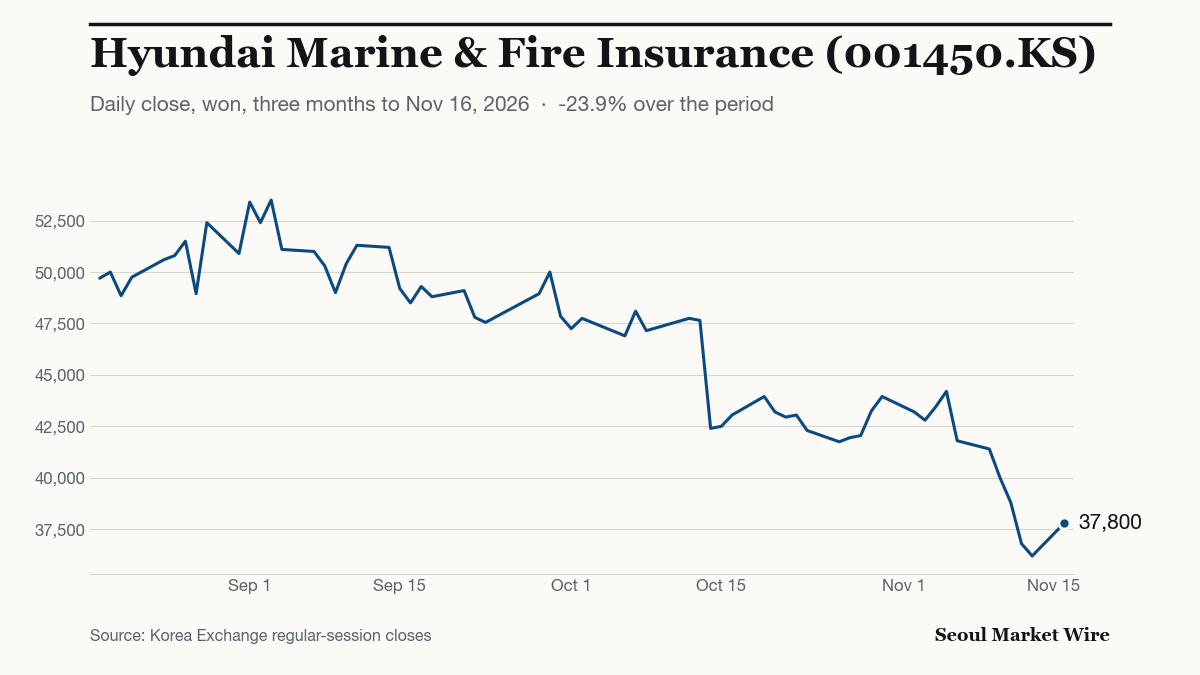
The price targets for Hyundai Marine & Fire Insurance remain 16,000 won apart after a third-quarter earnings miss. In their Nov. 16 reviews, iM Securities retained its 58,000-won target, while Kiwoom Securities kept its target at 42,000 won. Both maintained Buy ratings.
Against the reports’ reference share price of 36,200 won, those targets imply upside of 60.2% and 16.0%, respectively. These comparisons use the price cited in the reports, rather than the Nov. 16 closing price.
Third-quarter standalone net profit fell 9.6% year on year to 165.7 billion won, missing market expectations. Better insurance results did not prevent the decline in net income: investments produced a loss, while the deficit in distributable profit remained a separate concern for dividends.
Where did insurance operations improve?
Lower claims costs and a smaller motor insurance loss were two sources of improvement. Kiwoom estimated that managed-benefit rules affecting certain treatments covered by indemnity health insurance reduced claims costs by about 4 billion won a month.
The benefit was not uniform across treatments. The research material describes savings on manual therapy and extracorporeal shockwave therapy alongside higher claims costs for other non-covered treatments. Those increases partly offset the reductions in the targeted treatments.
Motor insurance also improved, although it remained loss-making. The brokerage put the segment’s quarterly loss at 13.1 billion won, compared with 55.3 billion won a year earlier. That represents a 42.2 billion-won narrowing of the loss, rather than a return to profit.
Premium rates for indemnity health and motor insurance in early 2027 are monitoring factors identified by iM. Its review focused on the rates to be announced at the start of the year.
Why did net profit still decline?
Investments moved in the opposite direction to insurance operations. The investment result swung to a loss of 27.8 billion won, with iM identifying losses on structured bonds and alternative investments.
The quarter therefore combined an improvement in insurance operations with an investment loss. The reported 165.7 billion won in standalone net profit reflects the insurer’s combined results, rather than the performance of its insurance business alone.
What is holding back dividends?
Distributable profit deteriorated by about 300 billion won during the quarter, leaving a deficit in the 900 billion-won range, according to iM’s estimate. The brokerage highlighted the decline in other comprehensive income alongside the deterioration in distributable profit.
That balance measures profit available for distribution, rather than the quarter’s standalone net income. A profitable quarter can therefore coexist with a distributable-profit deficit.
On dividends, the assessments had distinct emphases. iM highlighted the deterioration in distributable profit. Kiwoom said more stable earnings and a recovery in distributable profit were needed.
The basic-capital ratio also weakened: iM reported a decline of 2.4 percentage points quarter on quarter to 81.4%.