KAI targets span 135,000–186,000 won as brokers weigh deliveries and order risks
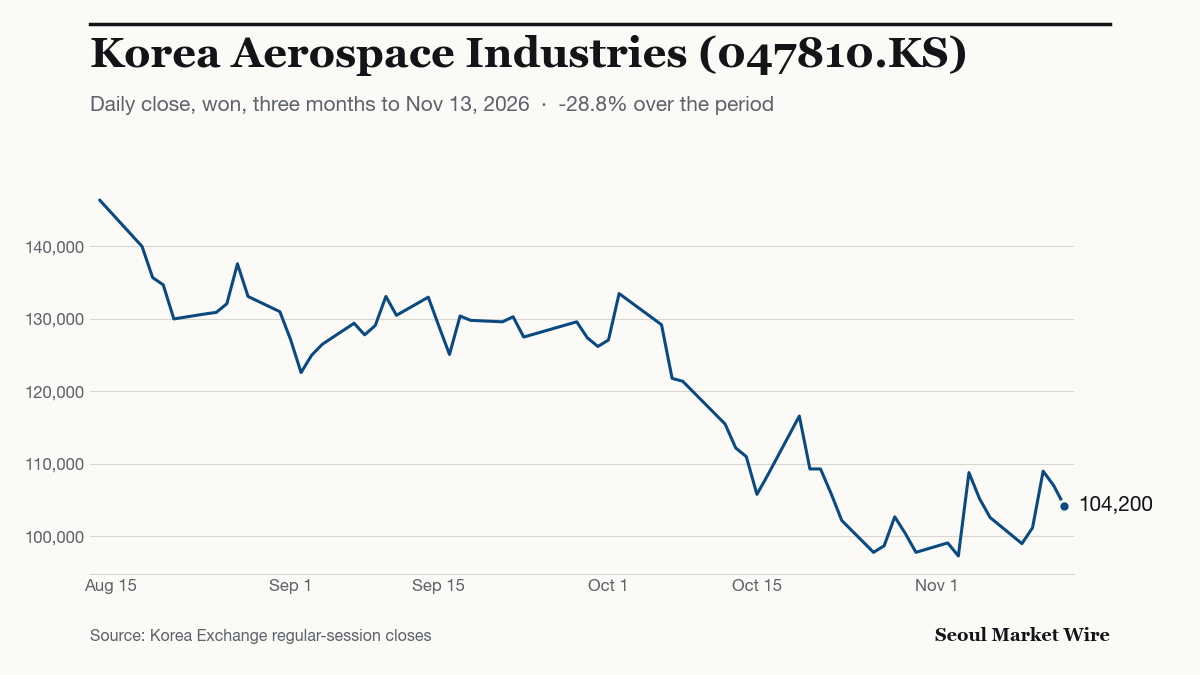
KAI closed at 104,200 won on Nov. 13, below the lowest target of 135,000 won among the 10 reports reviewed here. Their forecasts focus on delivery growth from 2027, with provisions and export-contract timing among the risks.
Market data: Korea Exchange regular-session close & Hana Bank USD/KRW reference rate, 2026-11-13 (KST)
Price targets for Korea Aerospace Industries (KAI) range from 135,000 to 186,000 won in the 10 reports reviewed here. The Nov. 4 assessments pair forecasts for delivery growth from 2027 with near-term helicopter delays, provision risks and uncertainty over new orders.
The selected targets average 162,000 won, with a median of 161,500 won. This group does not represent the company’s entire brokerage coverage. KAI closed at 104,200 won, down 2.62%, in the KRX regular session on Nov. 13, below every target in the group.
| Brokerage | Report date | Target price |
|---|---|---|
| DS Investment & Securities | Nov. 4, 2026 | 186,000 won |
| Kiwoom Securities | Nov. 4, 2026 | 185,000 won |
| Yuanta Securities Korea | Nov. 4, 2026 | 182,000 won |
| Daishin Securities | Nov. 4, 2026 | 173,000 won |
| Mirae Asset Securities | Nov. 4, 2026 | 173,000 won |
| Hanwha Investment & Securities | Nov. 4, 2026 | 150,000 won |
| SK Securities | Nov. 4, 2026 | 150,000 won |
| Eugene Investment & Securities | Nov. 4, 2026 | 146,000 won |
| Shinhan Securities | Nov. 4, 2026 | 140,000 won |
| iM Securities | Nov. 4, 2026 | 135,000 won |
Delivery growth from 2027
Third-quarter revenue rose 51.6% year on year to 1.0643 trillion won, while operating profit increased 31.9% to 79.4 billion won. The consolidated operating margin was 7.5%, down 1.1 percentage points.
In its Nov. 4 report, Eugene Investment & Securities attributed 212.9 billion won in third-quarter revenue to the delivery of two KF-21 fighters to the Korean military. Its analysts forecast about 60 aircraft deliveries in 2027 and about 90 in 2028.
For the quarter’s profit, the brokerage estimated that currency-related revisions to export-project costs contributed about 40 billion won, partly offset by about 30 billion won in one-off charges. The charges included provisions for Iraqi receivables, warranty obligations and G280 losses.
LAH delays and revenue timing
An engine defect interrupted LAH light armed helicopter deliveries, according to iM Securities’ Nov. 4 assessment. KAI had planned to deliver 30 LAHs in 2026 and delivered seven in the first half. The report described deliveries resuming in November, but forecast only two or three additional aircraft by year-end, leaving a shortfall of about 20.
Its analysts estimated a 400 billion to 500 billion won reduction from the original 5.7 trillion won annual revenue guidance. In Eugene’s assessment, the delays shifted deliveries into later years.
Different valuation horizons
The valuation case depends on the earnings period used. In its Nov. 4 report, Daishin Securities based its target on a 30.8-times P/E multiple applied to its forecast 2028 earnings attributable to owners of the parent. It put KAI’s 36-month forward P/E at 20.3 times, versus 18.0 times for global peers.
By comparison, Eugene’s report cited a consensus-based 12-month forward P/E of 24.2 times, against a historical average of 26.5 times. These were report-date valuations, not multiples recalculated at the Nov. 13 close. The different forecast horizons also prevent direct comparison.
Fourth-quarter provision risks
Currency effects varied by business. Hanwha Investment & Securities’ Nov. 4 analysis linked won strength to weaker aerostructures profitability, while identifying a benefit from revised estimated costs on export projects.
Additional Iraq bad-debt provisions were a risk in Yuanta Securities Korea’s Nov. 4 forecast, despite its expectation of record quarterly revenue and at least six KF-21 deliveries. Eugene’s projection of operating profit above 100 billion won was conditional on no further provisions.
The remaining order gap
As of its Nov. 4 report, Eugene estimated that KAI needed a further 8.2 trillion won in orders to meet its 2026 target of 10.4 trillion won. If KAI secured about 3 trillion won from a third LAH production batch and 0.4 trillion won in additional aerostructures orders, the remaining gap would be roughly 4.8 trillion won. Those potential contracts were assumptions in that calculation, not orders already secured.
The same report identified about 1.45 trillion won in third-quarter aircraft-export orders for which the customer country and aircraft type were undisclosed.
Sources
- Eugene Investment & Securities — Korea Aerospace Industries: Everything has bottomed out (2026-11-04) stock.naver.com
- Daishin Securities — Korea Aerospace Industries 3Q26 review: Production revenue at home and abroad gathers pace (2026-11-04) stock.naver.com
- Yuanta Securities Korea — Korea Aerospace Industries 3Q26 review: Surprises in both earnings and orders (2026-11-04) stock.naver.com
- Hanwha Investment & Securities — Korea Aerospace Industries 3Q26 review: In line, and why fighter jets now matter (2026-11-04) stock.naver.com
- iM Securities — Korea Aerospace Industries 3Q26: A prelude to renewed defence orders? (2026-11-04) stock.naver.com
6 more sources
- DS Investment & Securities — Korea Aerospace Industries: Confidence behind the annual order target (2026-11-04) stock.naver.com
- Kiwoom Securities — Korea Aerospace Industries: Fourth-quarter orders are key (2026-11-04) stock.naver.com
- Mirae Asset Securities — Korea Aerospace Industries: Potential in earnings and orders (2026-11-04) stock.naver.com
- SK Securities — Korea Aerospace Industries: Growth in 2027-28 and year-end orders (2026-11-04) stock.naver.com
- Shinhan Securities — Korea Aerospace Industries: Time to deliver on aircraft and orders (2026-11-04) stock.naver.com
- Yahoo Finance — Korea Aerospace Industries historical prices finance.yahoo.com